
Last Updated on September 21, 2025 by Brian Beck
Every lawn owner knows the feeling: you water, you fertilize, you seed, and… nothing. The grass still looks stressed, thin, or lifeless. Weeks pass, and frustration builds.
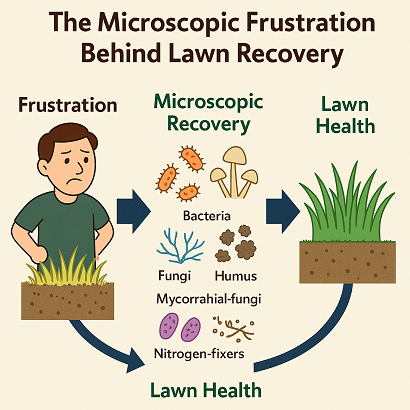
But here’s the twist: the very thing that causes that frustration—the microscopic world—is also the only thing that can truly drive recovery.
The Invisible Source of Problems
When a lawn is weak, the issue is almost never what you see on the surface. It’s what’s happening underneath:
-
Soil microbes may be depleted or dormant.
-
Nutrients could be locked up in forms the plant can’t use.
-
Compaction and low humus mean roots are suffocating.
-
Carbon, the fuel for microbial life, is missing.
On top, all you see is yellowing or thinning grass. But underground, it’s the breakdown of the microscopic system that has created the crisis. That’s why surface-level “fixes” rarely last.
Microscopic Engines of Recovery
Here’s where patience comes in: recovery always starts at the microscopic level.
-
Bacteria and fungi reorganize and repopulate the soil.
-
Mycorrhizal fungi reconnect roots to nutrients and water.
-
Humus slowly forms, restoring the soil’s ability to hold water and minerals.
-
Nitrogen-fixers begin capturing atmospheric nitrogen and converting it into usable food for the plant.
This doesn’t happen overnight. You can’t rush microbes into maturity. They need structure, biology, and proper nutrition—not a quick chemical reaction.
Why the Wait Feels Frustrating
The toughest part for lawn owners is the lag time. You may be doing the right things—adding biology, balancing pH, feeding with carbon-rich humates—but the grass won’t show its gratitude immediately.
During this waiting period, frustration sets in. But the truth is, that’s the exact moment the recovery is underway. The invisible world is rebuilding its population and infrastructure, and once it reaches a tipping point, the change above ground comes fast.
Patience Pays Off
The frustration you feel is actually a sign you’re on the right track. It means you’re working at the microbial level, where real solutions are built. When the biology catches up, the results are not just cosmetic—they’re structural, sustainable, and long-lasting.
Takeaway: The same microscopic world that causes frustration when it breaks down is the only force that can drive your lawn back to health. Trust the biology, stay patient, and let the microscopic engine rebuild the system that keeps your lawn alive.
https://www.linkedin.com/pulse/when-life-moves-building-soil-workforce-rocky-mountain-bioag-srjdf/?trackingId=Tg6FlwKgr1F05NboETdq%2FA%3D%3D