
Last Updated on July 18, 2025 by Brian Beck
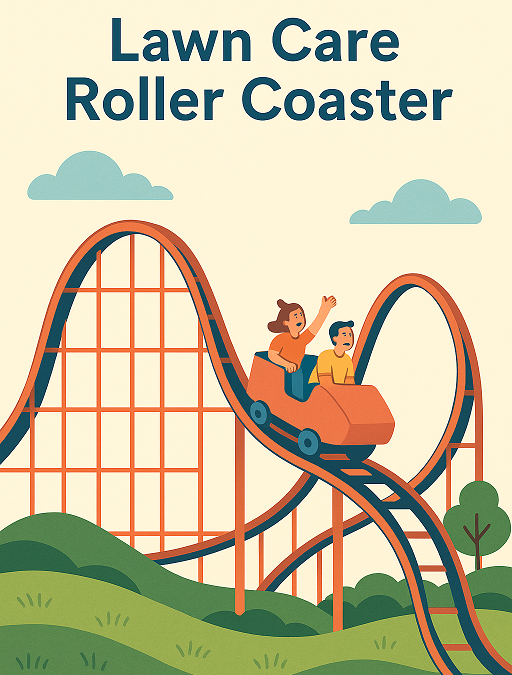
🎢 The May Sprint & Summer Stall: Why Traditional Lawn Care is a Costly Roller Coaster
Every year, like clockwork, there’s a mad dash in May. Lawns are suddenly the top priority—out come the mowers, fertilizer bags, sprinkler timers, and weed killers. Homeowners and landscapers alike scramble to make everything green and lush, as if beauty is a race to be won before Memorial Day.
But what happens next?
Summer hits.
Heat scorches. Water evaporates. Fertilizer fizzles. Disease creeps in. And most importantly—people burn out.
The excitement turns to exhaustion, and that once-dedicated sprint becomes a neglected track. By August, many have mentally checked out, overwhelmed by the high-maintenance mess they’ve created.
And come fall? It’s time to “catch up.” Again. More fertilizer. More watering. More aeration. More seed. More spending.
This isn’t lawn care. This is lawn chaos.
💸 The Real Cost of the Catch-Up Cycle
This start-stop strategy is not just inefficient—it’s massively wasteful:
-
Nutrients are lost in hot, dry soils with no microbial life to hold them.
-
Water is wasted as shallow-rooted lawns dry out quickly under stress.
-
Time is wasted as homeowners repeat the same reactive steps each season.
-
Energy is wasted on systems that are short-term fixes, not long-term solutions.
What’s worse? It teaches people to expect failure. To accept that “this is just what lawns do.” So, they throw in the towel, or they double down—restarting the roller coaster year after year.
🧪 This is a Synthetic System Problem
This seasonal cycle of burnout is rooted in a synthetic fertility mindset—one that:
-
Relies on salt-based fertilizers to force growth rather than build biology.
-
Depends on constant reapplication to mask deeper problems.
-
Destroys consistency and continuity, forcing constant “resets.”
-
Depletes the soil with no regenerative capacity, requiring even more inputs next year.
It’s a system built on dependency, not resilience.
The synthetic model is a sprint—not a strategy. And like all sprinters, it runs out of steam fast.
🌱 The Biological System is a Season-Long Strategy
Contrast that with a biological fertility system, which builds over time:
-
It starts earlier by conditioning the soil before the season hits.
-
It continues through the heat, because the biology supports root function and moisture retention.
-
It eases into fall with natural growth that doesn’t require catch-up applications.
-
It provides year-to-year consistency, so every season gets easier—not harder.
In a biological system, you don’t burn out—because your soil doesn’t.
You build momentum. You reduce inputs. You keep your footing instead of slipping back every summer.
📉 Why the Roller Coaster Isn’t Worth the Ride
If you’re tired of:
-
Wasting water and fertilizer
-
Spending your weekends playing turf triage
-
Watching your lawn thrive in May, crash in July, and limp into September…
Then it’s time to step off the roller coaster.
✅ Choose Regeneration Over Reaction
The synthetic cycle is designed to make you chase results—again and again.
The biological system is designed to help you hold onto progress.
One burns out.
The other builds up.
The race to green is over. It’s time to manage your lawn with patience, purpose, and biological precision.