
Last Updated on July 8, 2025 by Brian Beck
The Marvel of Photosynthesis – Nature’s Most Elegant Power Plant
When you walk across your lawn or glance at a patch of green leaves dancing in the sun, you may not realize you’re witnessing one of the most miraculous processes in all of nature: photosynthesis. This elegant biochemical system is the foundation of nearly all life on Earth. It’s quiet, invisible, and astonishingly powerful.
Let’s pull back the green curtain and explore the beautiful complexity of photosynthesis—and why it’s not just a textbook topic, but the very reason your lawn grows, your food exists, and you can breathe.
What is Photosynthesis?
At its core, photosynthesis is the process by which plants, algae, and some bacteria convert light energy into chemical energy.
In simpler terms: plants eat sunlight and turn it into fuel.
But it’s not magic. It’s a tightly choreographed dance of light, water, carbon dioxide, and some very clever molecules.
The Photosynthesis Formula
The general equation for photosynthesis looks like this:
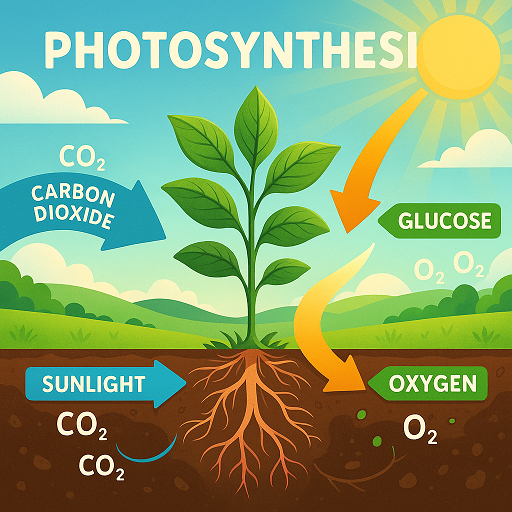
6 CO₂ + 6 H₂O + sunlight → C₆H₁₂O₆ + 6 O₂
In words:
-
Carbon dioxide from the air
-
Water from the soil
-
Sunlight as the energy source
Are converted into: -
Glucose (a simple sugar the plant uses as energy)
-
Oxygen (which is released into the atmosphere)
The Two Stages of Photosynthesis
🌞 1. Light-Dependent Reactions (Occurs in the thylakoid membranes of chloroplasts)
This is the part where sunlight hits the plant, and the magic begins:
-
Chlorophyll, the pigment that gives plants their green color, captures photons of sunlight.
-
This light energy splits water molecules (H₂O) into oxygen (O₂), protons (H⁺), and electrons (e⁻).
-
The oxygen is released into the air.
-
The electrons are passed down an electron transport chain, creating energy-rich molecules called ATP and NADPH.
These two energy carriers—ATP (adenosine triphosphate) and NADPH (nicotinamide adenine dinucleotide phosphate)—power the next stage.
🌿 2. The Calvin Cycle (Light-Independent Reactions)
Now that energy has been captured and stored, it’s time to build sugar:
-
Carbon dioxide (CO₂) enters through tiny pores on the leaf called stomata.
-
Using the ATP and NADPH from the light reactions, plants assemble glucose—a simple sugar that acts as fuel.
-
This glucose is used to build everything from cellulose (plant structure) to starch (energy storage) to the very roots that anchor the plant in soil.
Why Should You Care?
Photosynthesis isn’t just an academic curiosity—it’s everything.
🌍 It makes the oxygen you breathe.
🌿 It powers your lawn, garden, and food chain.
💧 It regulates the water cycle.
🌾 It’s the foundation of all agriculture.
In your lawn, photosynthesis fuels the carbohydrate exchange that helps microbial life flourish. It provides exudates (sugars) to feed microbes, carbon to build healthy soil, and the energy required for root expansion and recovery. It’s also directly affected by how balanced your soil minerals are—especially magnesium, iron, and trace elements like manganese and zinc that aid in chlorophyll production.
Photosynthesis and Soil Health
Here’s where your decisions make a huge difference. A biologically healthy soil environment—rich in microbial life and balanced in minerals—amplifies photosynthesis. The better the soil, the better the plant’s ability to convert sunlight into energy efficiently and without stress.
But if your soil is compacted, mineral-deficient, or synthetic-dependent, photosynthesis becomes strained, reducing sugar output, weakening plants, and stalling soil regeneration.
In Summary
Photosynthesis is the planet’s oldest, most reliable energy system. And it happens silently, daily, right beneath your feet.
If you want a greener lawn, a stronger garden, or a more sustainable future—build the soil, support microbial life, and let photosynthesis thrive.
Because every blade of grass is a solar-powered factory.
And every leaf is doing chemistry more advanced than any lab on Earth.
Let’s respect it, support it, and grow with it. 🌱