
Last Updated on July 29, 2025 by Brian Beck
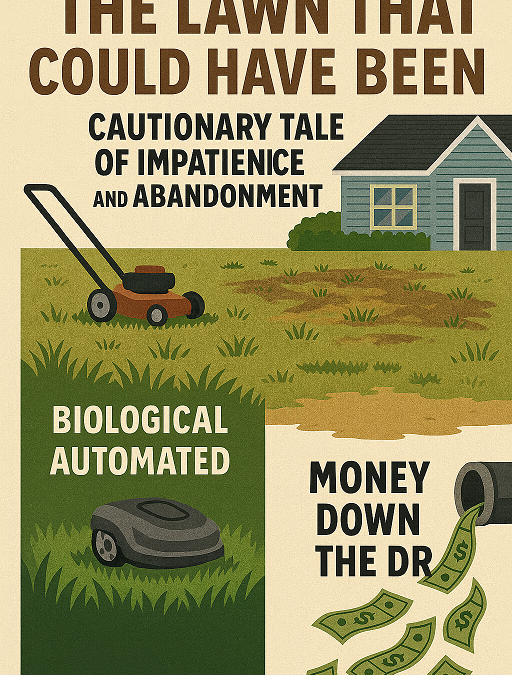
There once was a customer—we’ll call her Linda—who had all the right pieces in place. She had chosen to break free from the costly, chemical-laden cycle of conventional lawn care. She had embraced a biological fertility program. Even better, she’d installed a robotic mower, stepping into the future with automation and sustainability. In many ways, Linda was ahead of the curve.
But sometimes, the biggest threat to progress isn’t ignorance—it’s impatience.
Back in 2024, Linda noticed some inconsistencies in the appearance of her front yard. Instead of shrugging it off or jumping to conclusions, she took the right next step: a soil test. We encouraged her to get one, and to her credit, she agreed—even though the year before, she told us point-blank: “I just don’t have the patience for biology.”
Still, progress.
The test results came back. As expected, the soil needed correction. We developed a plan and started implementing it in September of 2024. Late in the season, yes—but still enough time to set the stage for a thriving, resilient lawn. Biology doesn’t work overnight. Like any good investment, it takes time to yield results.
But then… silence.
I called several times in 2025 to check in, to support the process, to see how the front yard was progressing. No response. Eventually, I drove by the property.
What I saw was disheartening.
The entire front yard had been resodded.
The customer had ripped out the progress, the biological foundation we’d started to build, and abandoned the system entirely. Gone were the delicate fungal networks that were just starting to establish themselves—the very organisms that would’ve reduced compaction, increased organic matter, improved water retention, and made the turf resilient. Destroyed.
Gone too were the robotic mower guide wires—cut through and tossed aside in favor of manual mowing. The mower was nowhere in sight.
And worst of all? The new sod didn’t even look good. It was stressed, limp, and struggling in the July heat.
What a tragedy.
On the surface, it might seem like just another homeowner decision. But the hidden costs are enormous:
-
Sod replacement likely cost twice what the biological correction would have.
-
The soil’s biology was destroyed, eliminating the natural systems that save money over time.
-
Water bills will rise because the soil no longer retains moisture efficiently.
-
Labor costs return with the need for weekly mowing.
-
The robotic mower—an upfront investment in time and money—was rendered useless.