
Last Updated on January 27, 2026 by Brian Beck
Robotic mowers tend to trigger one of two reactions:
-
“That’s cool.”
-
“Yeah… but that won’t work for my yard.”
Most hesitation doesn’t come from facts. It comes from assumptions—often based on early-generation robots, bad YouTube videos, or pure imagination.
Let’s clear the air.
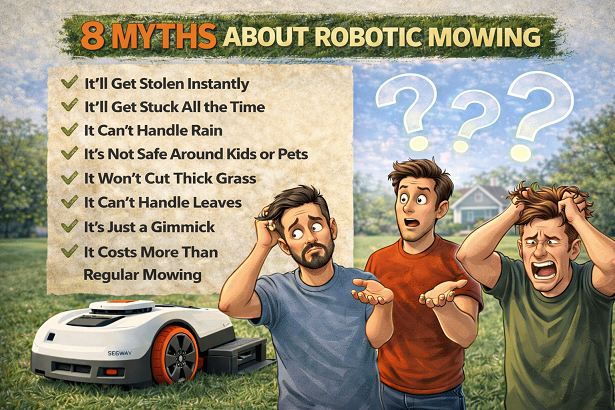
Below are the most common myths that stop homeowners from considering robotic mowing—and the reality behind each one.
Myth #1: “It’ll Get Stolen Instantly”
This is usually the first concern people voice.
The reality:
Modern robotic mowers are not free-roaming valuables. They are:
-
Locked to a specific property
-
Disabled without authorization
-
Trackable depending on model
-
Virtually useless to anyone who steals one
A stolen robotic mower is about as valuable as a locked smartphone tied to someone else’s account.
Ironically: Traditional mowers, blowers, and trimmers are far easier to steal—and far easier to resell.
Myth #2: “It’ll Get Stuck All the Time”
People picture a robot helplessly wedged against every tree root or sprinkler head.
The reality:
A properly qualified lawn + a proper setup eliminates most “stuck” events.
When robotic mowers do struggle, it’s usually because of:
-
Deep holes or sink spots
-
Poor edging or broken borders
-
Severe slopes or abrupt transitions
-
Constant clutter (toys, sticks, dog bones)
Here’s the key insight:
If a robot gets stuck there, a traditional mower probably struggles there too.
The difference is the robot reveals problem areas instead of hiding them.
Myth #3: “It Can’t Handle Rain”
This myth comes from older designs and misunderstanding.
The reality:
-
Some robotic mowers are designed to mow in light rain
-
Others pause automatically and resume later
-
Frequent mowing means missing a day doesn’t matter
Unlike weekly mowing, robotic mowing doesn’t “fall behind” after one skipped session.
No mud ruts. No panic cuts. No schedule collapse.
Myth #4: “It’s Not Safe Around Kids or Pets”
This one is understandable—but outdated.
The reality:
Modern robotic mowers use:
-
Lift sensors
-
Tilt sensors
-
Collision detection
-
Automatic blade stop systems
They are designed to stop instantly when lifted or interfered with.
Are they toys? No.
Are they safer than a 200-pound gas mower with a spinning blade? Yes—by a wide margin when used responsibly.
Myth #5: “It Won’t Cut Thick or Healthy Grass”
This myth assumes mowing is about brute force.
The reality:
Robotic mowers win through frequency, not aggression.
Instead of hacking off a week’s worth of growth, they:
-
Cut tiny amounts often
-
Leave microscopic clippings
-
Reduce stress on the plant
-
Encourage denser turf over time
Healthy lawns actually perform better with robotic mowing because the grass never experiences shock.
Myth #6: “It Can’t Handle Leaves”
Robotic mowers are not leaf vacuums.
The reality:
-
Light leaf drop = not a problem
-
Heavy seasonal leaf fall = requires cleanup (just like traditional mowing)
The difference is robotic mowing keeps the lawn trimmed underneath, making leaf cleanup easier—not harder.
Myth #7: “It’s Just a Gimmick”
This one usually comes from people who haven’t seen one working long-term.
The reality:
Robotic mowing has been around for decades. What’s changed is:
-
Navigation technology
-
Reliability
-
Safety systems
-
App control
-
Integration with modern lawns
This isn’t a trend. It’s the same shift we’ve seen in:
-
Vacuums
-
Thermostats
-
Security systems
-
Lighting
-
Pool cleaners
Once automation works well enough, people don’t go back.
Myth #8: “It Costs More Than Regular Mowing”
Short-term thinking creates this myth.
The reality:
When you look at cost of ownership—not just monthly invoices—robotic mowing often:
-
Reduces long-term spend
-
Locks in predictability
-
Eliminates labor volatility
-
Reduces lawn stress (and recovery inputs)
-
Saves time and mental bandwidth
It’s not just cheaper mowing.
It’s a cheaper system.
The Real Question Isn’t “Do Robotic Mowers Work?”
They do.
The real question is:
Is your lawn a good candidate—and are your expectations aligned with how the system works?
That’s why qualification matters more than sales pitches.
When robotic mowing is installed on the right property, for the right homeowner, it doesn’t feel experimental.
It feels obvious.
Want to Know What’s Myth vs Reality for Your Lawn?
The fastest way to find out is a quick qualification:
-
lawn layout
-
slope
-
obstacles
-
expectations
No pressure. No hype. Just clarity.
If it’s a fit, robotic mowing can eliminate one of the biggest ongoing annoyances of home ownership—while improving lawn consistency at the same time.
—Brian
Blade to Blade / Front Range Autmow