
Last Updated on January 27, 2026 by Brian Beck
Most homeowners “water by calendar.”
Same days. Same time. Same minutes.
And then they’re shocked when they still get:
-
dry spots
-
runoff
-
fungus in weird places
-
shallow roots
-
brown-out in heat
-
weeds moving in like they pay rent
Because the lawn doesn’t care what day it is.
It only cares about soil moisture.
If you want a lawn that becomes predictable, you don’t need a better schedule.
You need a moisture setpoint mindset.
Scheduling water is like feeding your kids by the clock… no matter what
Imagine feeding your kids the same amount of food at the same time every day—whether they:
-
played sports for 3 hours in the sun
-
stayed inside all day
-
were sick
-
or just ate a huge meal an hour ago
That’s what timer irrigation is.
It treats a living system like a spreadsheet.
And in Colorado—with intense sun, wind, low humidity, and many soils that already struggle with infiltration—it fails fast.
What is a soil moisture setpoint?
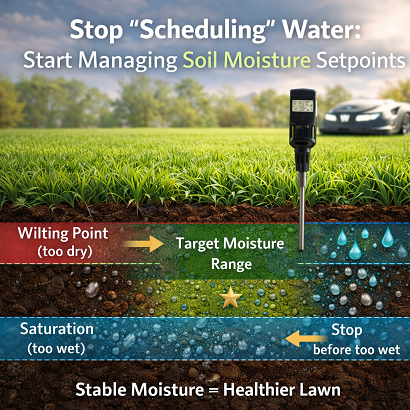
A setpoint is a target range you maintain.
Not “water Mondays and Thursdays.”
More like:
-
Keep the root zone between X% and Y% moisture
-
Only water when you drop below the low threshold
-
Stop when you reach the high threshold
That’s it.
When you manage a range, the lawn stops swinging between:
-
drought stress → panic watering → temporary green → stress again
And those swings are what cause most of the dysfunction people blame on “the heat” or “the seed” or “Colorado.”
Why minutes don’t mean anything
“Run zone 1 for 18 minutes” is meaningless without context, because minutes don’t tell you:
-
how compact your soil is
-
whether water is infiltrating or running off
-
what your precipitation rate actually is
-
how deep the water is going
-
what your roots are doing
-
how fast your soil is drying
Two lawns can run the same schedule and get opposite results.
Because the real variable is what the soil holds, not what the controller says.
The biggest enemy: moisture volatility
Lawns don’t hate drought.
They hate unstable moisture.
When your soil keeps bouncing between too dry and too wet, you create:
-
shallow roots (plants live near the surface where the “action” is)
-
compaction (especially in clay)
-
poor oxygen exchange
-
disease windows
-
nutrient movement problems
-
a lawn that becomes dependent on constant rescue
A stable moisture range solves more issues than most people realize.
Setpoints only work if infiltration works
Here’s the uncomfortable truth:
Some lawns don’t have a “watering problem.”
They have a soil acceptance problem.
Common Colorado constraints:
-
tight clay + poor structure
-
poor Ca:Mg balance (soil stays sealed and sticky)
-
low humus/carbon buffer (no sponge)
-
high pH lockout (nutrients present but unavailable)
If water can’t enter and distribute, scheduling becomes a guessing game and setpoints become hard to maintain.
That’s exactly why Trinity stacks:
-
Smart irrigation strategy (setpoints)
-
Biological soil building (structure + sponge)
-
Robotic mowing (dense canopy that reduces evaporation and stress)
Each one makes the other two easier.
What “setpoint watering” looks like in real life
Instead of asking, “What days do I water?” you start asking:
1) “What moisture range am I trying to maintain?”
Your target range depends on:
-
soil type
-
shade/sun
-
turf type
-
time of year
-
slope and exposure
2) “Am I actually hitting the root zone?”
You validate depth with:
-
a screwdriver test
-
a soil probe
-
a quick dig check
-
(best-case) a soil moisture sensor
3) “Am I keeping moisture stable without saturating?”
Stable doesn’t mean soggy. It means:
-
enough water to prevent stress
-
enough oxygen to prevent rot
-
consistent conditions for biology
The lawn upgrade nobody expects: less watering, better results
When you manage setpoints and build the soil, something counterintuitive happens:
You often use less water over time.
Because:
-
infiltration improves
-
the soil holds more
-
evaporation drops under a dense canopy
-
roots go deeper
-
stress spikes decrease
-
the lawn stops begging for constant attention
That’s the whole point: lower cost of ownership and fewer emergencies.
The Trinity takeaway
If you’re still living in “minutes and Mondays,” you’re not managing a lawn.
You’re gambling.
A high-performance lawn requires:
-
moisture stability (setpoints)
-
soil that can accept and store water (biology + structure)
-
mowing that supports density and reduces stress (robotic micro-mowing)
That stack is where the real wins come from.
Call to action
If you want help setting your lawn up with a real moisture strategy (not timer hope), reach out.
We’ll identify: