
Last Updated on August 3, 2025 by Brian Beck
When it comes to caring for your lawn, garden, or landscape, the truth is simple: if you don’t test, you’re just guessing. And guessing in lawn care usually comes with frustration, wasted money, and poor results.
Soil testing is one of the most valuable—and most overlooked—tools available to homeowners and professionals alike. It takes the mystery out of what’s happening beneath your feet and puts you in the driver’s seat to make real, measurable progress.
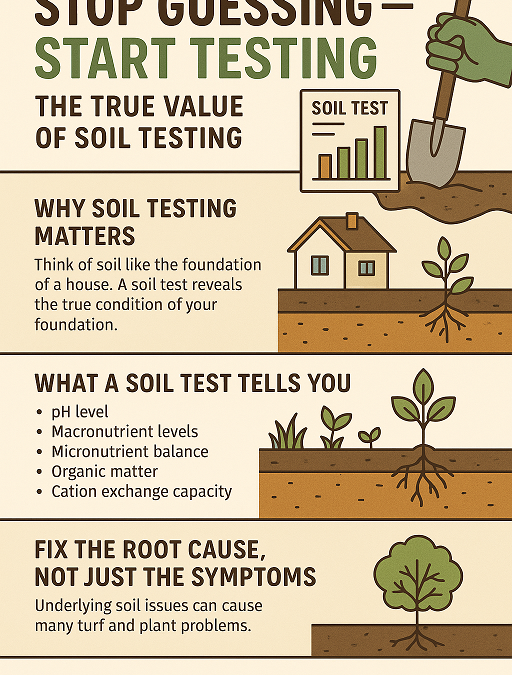
Why Soil Testing Matters
Think of soil like the foundation of a house. If the foundation is unstable, no matter how nice the exterior looks, it’s bound to develop problems. A soil test is the blueprint that reveals the true condition of your foundation—what’s strong, what’s weak, and what needs attention.
Without it, most people respond to symptoms on the surface:
-
Yellow grass? Throw some nitrogen at it.
-
Weeds? Kill them with chemicals.
-
Bare patches? Reseed and hope for the best.
But these are band-aids, not solutions.
What a Soil Test Tells You
A professional soil test provides insight into the exact conditions of your lawn or garden, including:
-
pH level – Is your soil too acidic or too alkaline? Either one can lock up nutrients.
-
Macronutrient levels – Nitrogen, phosphorus, potassium—how much is really in the soil?
-
Micronutrient balance – Iron, zinc, manganese, boron, and others may be missing or out of balance.
-
Organic matter – How alive is your soil?
-
Cation exchange capacity (CEC) – How well does your soil hold onto nutrients and make them available to plants?
This data becomes your action plan—not just a shot in the dark.
Fix the Root Cause, Not Just the Symptoms
So many turf and plant problems are tied directly to soil health:
-
Compaction leads to poor root growth and water retention.
-
Imbalances in calcium and magnesium create hardpan conditions.
-
Low organic matter reduces water efficiency and microbial life.
-
Excess nitrogen encourages disease and weakens root structure.
Rather than blindly applying more products, a soil test gives you clarity—so you apply only what is needed, when it’s needed, in the amount required.
It Pays for Itself
Soil testing is inexpensive, especially when compared to the money most people waste on:
-
Over-fertilizing
-
Over-watering
-
Re-seeding year after year
-
Treating recurring weeds or diseases that are only symptoms of deeper problems
By identifying and correcting imbalances, you can dramatically improve your results and spend less over time.
From Guesswork to Precision
If you’re serious about having a healthy, sustainable lawn or garden, soil testing should be your first step—not your last resort. It transforms your approach from reactive to proactive. From guesswork to precision.
And once you have the data in hand, working with a professional who understands how to interpret the results and create a biological or regenerative game plan can change everything.
Don’t settle for mediocrity. Test your soil, understand your foundation, and build your landscape on real knowledge—not guesswork.