Last Updated on May 11, 2024 by Brian Beck
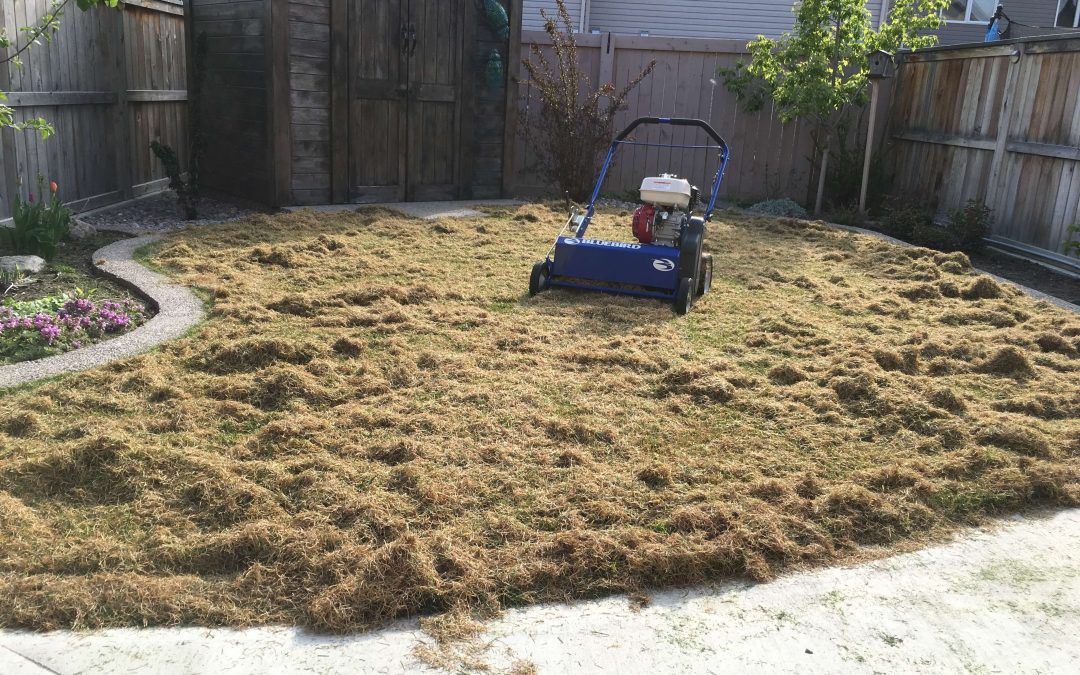
Power raking or dethatching to some are the same exact thing. It is a mechanical means of raking or combing the lawn with a high speed, rotating series of metal bars that reach down past the surface of the lawn, grab and pull out thatch. Thatch can be defined by the dead root growth that accumulates on top of the soil just under the crown of the turf. Thatch is normal and exists in a bluegrass lawn. It is not to be confused with grass clippings and is not the same material. It serves as a thermal and moisture barrier for the lawn when it is under 1/2″ thick. When it is above 1/2″, especially above 3/4″ (I’ve seen it over 3.5″ if you can believe that) it begins to impede air, water and nutrients from getting to the roots so it can get into the plant and utilize these resources to grow and heal. When it gets above a certain level it will prevent oxygen from getting to the roots which is very dangerous for the lawn as it will turn nutrients into volatile gasses, trigger pathogenic microbes that cause disease, cause the roots to grow upward and laterally, compounding the problem and wasting untold gallons of water in the process. The power rake has been used in the past to combat this.
So, does power raking work? It can only be done when the turf is dormant and dry, otherwise it will tear out the grass by the roots and create a lot of stress. Typically the lawn can only be power-raked after mid-February when there is no snow on the ground and before the first week of May when the grass is solid green. Power raking was all the rage from the 50’s well into the 90’s when it began to fall out of favor as it was found to be too stressful on the lawn. One question I would like to pose is this: If power raking was successful why would you need to do it year after year? Why does this seem normal? I use to do about 10-15 power raking jobs every year and I would only do jobs that qualified otherwise I would decline to do it as it would injure the lawn. Most of the people that called me, which was about 90% never needed it to be done. Typically what they were looking at was the dead grass blades on the surface of the lawn and confused it with thatch, which you cannot see from the surface. But getting back to the original question, does it really work? Well, the short answer is not really, or at least it does not permanently do so. So why is the thatch getting thick in the first place and what is the solution? I’m glad you asked.
Healthy soil will have an entire ecology in it of a diverse community of microbiology including bacteria, fungi, protozoa, nematodes, etc. Since the introduction of synthetic fertilizers in the 1930’s the soil has never been the same. Here is why: Synthetic fertilizers contain inorganic salts which are toxic to microbial life and kill them off. Due to this absence of microbial life there is nothing that will digest the thatch into humus and eventually topsoil and so it accumulates and in some lawn becomes a problem. Because the soil is compacted and there is not enough carbon in the soil that serves as an energy source of the microbes (and also helps the soil hold water). Synthetic fertilizers advance the loss of Carbon in the soil. Also, because there are no microbes to protect the roots (they provide immunity for the roots too).Due to the lack of protection the roots that the grass sends out to search for resources that would normally survive several weeks and grow down actually die off and grow upward compounding the problem and causing a huge financial drain for the owner, typically with water.
Because we are engaged in a biological fertility system as opposed to a synthetic one we take another route to thatch control, we use biology. We reestablish the biological ecosystem in the causes so much pain soil that reverses this lack of digestion so that it can begin to naturally aerate the soil (Oh yeah, microbes do that too), use atmospheric Nitrogen (Yup, that too), and provides stress and disease resistance. The basic reason why you have been power raking or have a thatch problem is because you have been using synthetic fertilizers. STOP! We can show you how and we can show you how to use a radical approach using biology to digest the thatch, without tools and return it to the soil as nutrients.
Call us it works.