
Last Updated on August 3, 2025 by Brian Beck
When we talk about lawn care, nitrogen usually steals the spotlight. But there’s another nutrient that deserves some serious recognition—phosphorus. This underappreciated element is a key player in the growth, health, and stress resilience of your grass, and knowing how to manage it (synthetically or biologically) could make the difference between a struggling lawn and one that thrives, especially when the pressure is on.
🌱 What Does Phosphorus Actually Do for Grass?
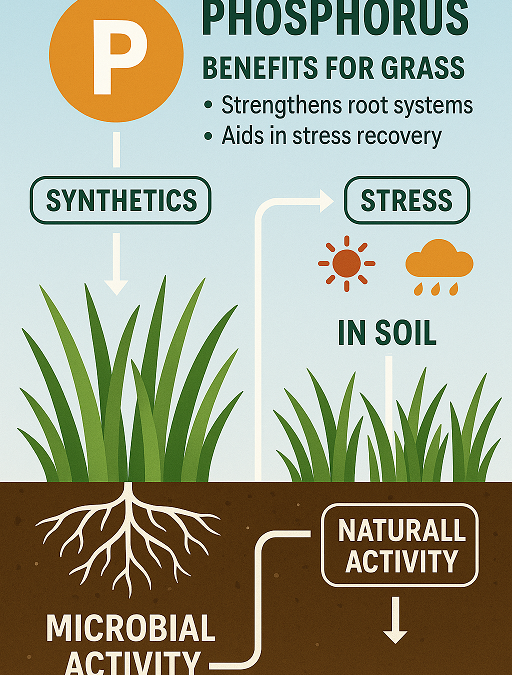
Phosphorus (P) is one of the three primary macronutrients plants need, alongside nitrogen (N) and potassium (K). While nitrogen is all about leafy green growth and potassium helps with overall durability and disease resistance, phosphorus plays a very specific and powerful role: it fuels root development and energy transfer.
In simpler terms:
-
It strengthens root systems, helping grass survive drought and heavy foot traffic.
-
It aids in seedling establishment, which is why it’s common in starter fertilizers.
-
It supports photosynthesis and energy movement, essentially helping the plant move its internal “fuel” where it’s needed most.
🌾 Phosphorus in Times of Stress
Stress comes in many forms for your lawn—heat waves, drought, compaction, disease, and even post-aeration recovery. During these times, your turf is running on fumes. Phosphorus helps:
-
Rebuild damaged roots
-
Accelerate recovery after mowing or mechanical disruption
-
Prepare for winter dormancy or bounce back in early spring
Think of phosphorus as a first responder—it doesn’t always get the credit, but it shows up when your lawn is on the ropes.
💊 Synthetics vs. What’s Already There
You can apply phosphorus synthetically, and in certain situations—like when establishing new turf or correcting a known deficiency—it may be necessary. However, many soils already contain phosphorus in abundance. The problem? It’s often locked up and unavailable to plants.
That’s where biology comes in.
🦠 Unlocking Phosphorus Naturally
Instead of dumping more synthetic P into the soil (which can lead to runoff and water pollution), a more sustainable and often effective method is to mobilize the phosphorus that’s already there.
Microbial life in the soil—particularly phosphate-solubilizing bacteria and mycorrhizal fungi—can:
-
Break down organic matter and mineralize phosphorus
-
Unlock phosphorus bound to soil particles
-
Transport phosphorus directly to plant roots
By feeding your soil biology and creating a healthy environment underground, you’re essentially turning on the taps to a previously sealed nutrient vault.
🚫 The Caution with Synthetic Overuse
It’s important to note that phosphorus runoff is a real environmental concern. When over-applied, synthetic phosphorus can leach into waterways and fuel harmful algal blooms. That’s why many regions now regulate phosphorus applications, especially in established lawns.
If you’re blindly applying synthetic fertilizers, you might be:
-
Wasting money
-
Contributing to pollution
-
Ignoring a deeper issue: poor soil biology
✅ What You Can Do
-
Test Your Soil – Don’t guess. A simple soil test can reveal whether you truly need to add phosphorus.
-
Focus on Root Health – In stressful times, prioritize biological inputs that feed the root system and microbes.
-
Use Starter Fertilizers Wisely – Only use phosphorus-rich fertilizers when establishing new turf or seeding.
-
Embrace Biology – Build a system that lets microbes do the heavy lifting. You may never need synthetic phosphorus again.
💬 Final Thoughts
Phosphorus might not be the flashy frontman of lawn nutrients, but when the going gets tough, it quietly comes to the rescue. Whether you choose to apply it synthetically or unlock what’s already in your soil, understanding how this element supports your grass—especially under stress—can elevate your lawn care game to a whole new level.
Healthy roots = healthy grass. And phosphorus is the bridge that connects the two.
Want to learn more about how biology can unlock phosphorus and boost your lawn’s performance? Reach out to us or check out our latest articles on soil health and microbial life.