
Last Updated on September 4, 2025 by Brian Beck
The Hidden Cost of Ownership: Why Your “Average” Lawn May Be the Most Expensive One on the Block
When most homeowners think about lawn care, they picture two extremes: the perfectly manicured golf course fairway and the average-looking, “good enough” lawn they already have. Many assume that achieving golf-course quality is unrealistic, and so they settle into mediocrity—spending money year after year just to maintain an expensive illusion of “average.”
The truth is, that average lawn may be costing you more than you realize. And the golf course you idolize? It’s not as far away as you think.
The Illusion of the Golf Course Standard
Golf courses have long been the benchmark for what a lawn “should” look like—lush, green, consistent. But there’s a misconception: homeowners believe those results are impossible without a massive budget, chemical cocktails, and a small army of workers.
In reality, golf courses often operate under stricter constraints than homeowners: limited budgets, strict water regulations, and a constant fight against compaction and stress. Their success isn’t because they pour endless money into the turf—it’s because they follow principles of soil health, consistency, and biology. Ironically, most homeowners aren’t very far behind this standard; they just lack the right approach.
Why a Mediocre Lawn is Expensive
An “average” lawn usually means it’s stuck in a dysfunctional cycle:
-
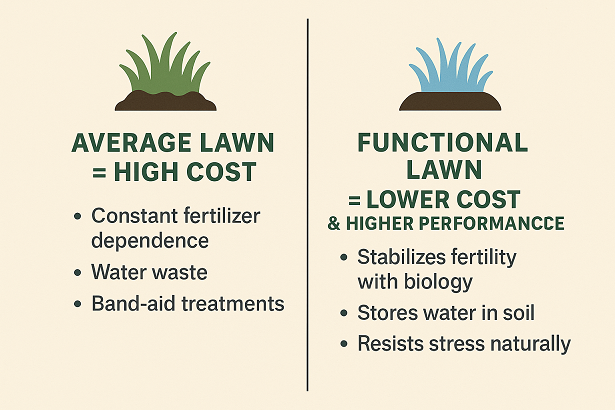
Constant fertilizer dependence – Applying synthetic nitrogen two to four times a season isn’t cheap. Worse, it creates peaks and crashes in color and growth that require even more inputs.
-
Water waste – Poor soil structure and low carbon levels mean your lawn can’t hold water. That forces you to water more often, sending your monthly bill soaring.
-
Band-aid treatments – Fungicides, grub control, aeration, and dethatching are all symptoms of imbalance. Each one is another expense stacked on top of an already high cost of ownership.
What’s worse? These costs don’t improve the system; they just maintain the dysfunction. Over a few years, the “average” lawn quietly drains thousands of dollars without ever delivering consistent beauty or resilience.
Function vs. Appearance
Here’s where the confusion lies: people believe a better-looking lawn requires more expense. In reality, the real distinction is not between an average lawn and a golf course lawn—it’s between a dysfunctional lawn and a functional lawn.
A functional lawn:
-
Uses biology and soil health to stabilize fertility.
-
Stores water in the soil, reducing irrigation needs.
-
Requires fewer chemical band-aids because it resists stress naturally.
-
Delivers both beauty and performance at a lower long-term cost.
This is the paradox: the lawn that looks mediocre is often the most expensive, while the lawn that is functional—sometimes even better looking than a golf course—is actually the most cost-effective.
Rethinking Lawn Ownership
If you’ve ever balked at a proposal to improve your lawn because it seemed like “too much,” consider this: the proposal isn’t asking you to spend more money for vanity—it’s inviting you to break free from an expensive cycle of mediocrity.
Your lawn doesn’t need to be a golf course. But it also doesn’t need to be an endless money pit that still leaves you disappointed. With the right program—one focused on soil function, water efficiency, and biology—you can have both: a lawn that looks better and costs less to own.