
Last Updated on March 13, 2026 by Brian Beck
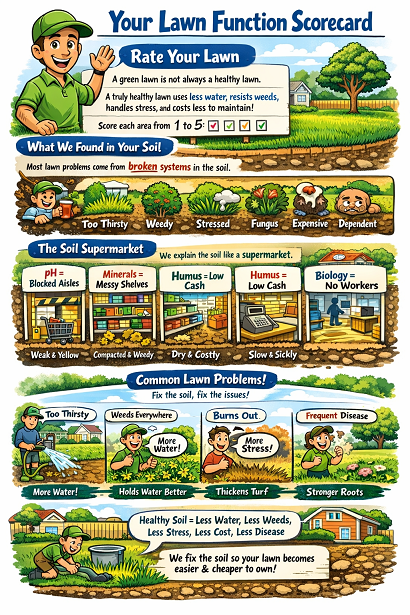
A green lawn is not always a healthy lawn.
A truly healthy lawn should do more than look good. It should use less water, resist weeds better, handle stress, recover faster, and require fewer inputs.
Score each area from 1 to 5:
1 = Poor
2 = Weak
3 = Average
4 = Good
5 = Excellent
1) Water Efficiency
Does your lawn stay hydrated without constantly needing more water?
Score: ___ / 5
2) Weed Resistance
Does your lawn naturally crowd out weeds, or are weeds always trying to move in?
Score: ___ / 5
3) Stress Tolerance
How well does your lawn handle heat, drought, heavy traffic, and changing weather?
Score: ___ / 5
4) Disease Resistance
Does your lawn stay clean and stable, or is it prone to fungus, discoloration, and decline?
Score: ___ / 5
5) Soil Structure
Does water soak in well, or does it run off, puddle, or dry out too fast?
Score: ___ / 5
6) Root Performance
Is your lawn feeding from deep in the soil, or is it dependent on constant outside help?
Score: ___ / 5
7) Biological Activity
Does your soil act alive and responsive, or does the lawn seem tired and dependent?
Score: ___ / 5
8) Cost of Ownership
Are you spending more and more to hold the lawn together?
Score: ___ / 5
Total Score: ___ / 40
Score Meaning
32–40: Strong functional lawn
24–31: Decent lawn, but hidden inefficiencies are likely present
16–23: The lawn may look acceptable, but the system is struggling
8–15: High dysfunction, high cost, and the lawn is likely working against you
What We Often Discover Before a Soil Test
If you have never had a soil test, we can still explain what is commonly happening beneath the surface.
Most lawn problems are not random. They usually come from broken systems in the soil.
A lawn may be green, but still be:
-
using too much water
-
vulnerable to weeds
-
stressed in summer
-
prone to disease
-
dependent on repeated inputs
-
expensive to maintain
That usually means the soil is not functioning correctly.
The Supermarket Analogy
We explain the soil like a supermarket because it makes the whole system easy to understand.
1) pH = The Aisles
pH determines whether the plant can get to what it needs.
If the aisles are blocked, it does not matter how much food is in the store. The lawn still cannot access it efficiently.
What this looks like above ground:
-
yellowing
-
weak growth
-
stress
-
poor response
-
constant need for correction
2) Base Saturation = The Shelves
This is the mineral balance in the soil, especially things like calcium, magnesium, potassium, and sodium.
If the shelves are poorly stocked or stocked out of order, the lawn struggles.
What this looks like above ground:
-
compaction
-
poor drainage
-
shallow roots
-
weak density
-
more weeds
-
more stress
3) Humus/Carbon = The Currency
Humus is like money in the system. It helps the soil hold nutrients, buffer problems, and keep the system stable.
Without currency, even a store with products cannot function well.
What this looks like above ground:
-
inconsistent performance
-
poor moisture holding
-
higher fertilizer dependency
-
faster burnout
-
more cost over time
4) Biology/Microbes = The Workers
Microbes are the stockers, delivery drivers, and support staff of the soil.
They help cycle nutrients, support roots, and keep the whole system moving.
Without workers, the store stops functioning even if the building is still standing.
What this looks like above ground:
-
slow recovery
-
low efficiency
-
poor nutrient cycling
-
more disease pressure
-
weak resilience
Common Lawn Problems and What They Usually Mean in the Soil
Problem: The lawn needs too much water
What may be happening in the soil:
-
poor structure
-
compaction
-
too much magnesium
-
not enough calcium
-
low humus
-
weak biology
Why it costs more:
The soil cannot hold and move water properly, so you have to keep replacing what the system should have managed itself.
What fixing it does:
-
improves infiltration
-
improves water holding
-
encourages deeper rooting
-
reduces waste
Problem: Weeds keep coming back
What may be happening in the soil:
-
thin turf from poor mineral balance
-
shallow roots
-
weak biology
-
low density
-
stress openings in the canopy
Why it costs more:
A weak lawn leaves open space. Nature fills open space fast, and weeds are specialists at exploiting weakness.
What fixing it does:
-
improves density
-
strengthens turf competition
-
closes gaps
-
reduces the conditions weeds prefer
Problem: The lawn burns out under stress
What may be happening in the soil:
-
low calcium
-
poor rooting
-
weak nutrient access
-
low humus
-
poor sulfur support
-
biology not cycling efficiently
Why it costs more:
The lawn has no reserve system. It can only survive while conditions are easy.
What fixing it does:
-
improves plant strength
-
improves root function
-
improves reserve capacity
-
helps the lawn recover faster
Problem: The lawn is prone to disease
What may be happening in the soil:
-
weak biological balance
-
excessive softness from poor nutrition
-
poor air/water balance
-
nutrient lockout
-
stress and poor recovery
Why it costs more:
A weak plant is a vulnerable plant. Disease pressure rises when the system is out of balance.
What fixing it does:
-
strengthens plant tissue
-
improves biological competition
-
reduces chronic stress
-
lowers disease pressure naturally
Problem: The lawn only looks good when something is constantly applied
What may be happening in the soil:
-
the soil is not functioning on its own
-
nutrient cycling is poor
-
microbial life is weak
-
storage and buffering are low
-
the lawn is dependent instead of efficient
Why it costs more:
You are paying to prop up a broken system instead of repairing it.
What fixing it does:
-
lowers dependence on repeated rescue inputs
-
improves efficiency
-
reduces waste
-
lowers long-term ownership cost
What the Biological Program Is Really Doing
Our biological program is not just “feeding the grass.”
It is working to repair the systems underneath the grass:
-
open the aisles so nutrients are accessible
-
stock the shelves correctly so the mineral balance makes sense
-
restore the currency so the soil can hold and buffer resources
-
bring back the workers so biology can cycle and deliver what the lawn needs
When those systems improve, the lawn becomes:
-
more efficient with water
-
more resistant to weeds
-
less stressed
-
less vulnerable to disease
-
less dependent on constant correction
-
less expensive to own over time
A lawn should not have to be forced to perform.
When the soil is functioning correctly, the lawn becomes easier to own, cheaper to maintain, and better able to protect itself.
That is why we focus on the soil first.
Because when you fix the system underneath, many of the symptoms above begin to calm down naturally.
If you have never had a soil test, this scorecard is a starting point.
It helps identify whether your lawn is truly functioning well or simply being held together.
A soil test allows us to confirm exactly what is happening in the “supermarket” beneath your lawn so we can target the real problems, not just chase symptoms.
If you want, I can turn this into a polished 1-page customer scorecard and a 2-page brochure version in Word.
Engage with us: