
Last Updated on January 27, 2026 by Brian Beck
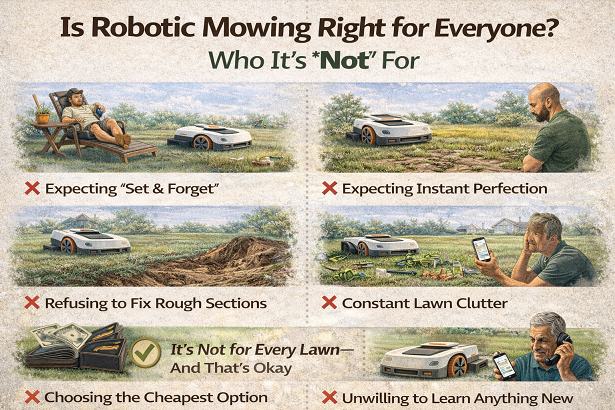
Who It’s Not For (And Why That’s Okay)
By now, you’ve probably gathered something important:
Robotic mowing isn’t a gimmick.
It’s not experimental.
And it absolutely works.
But here’s the truth most companies won’t say out loud:
Robotic mowing is not right for everyone.
And that’s not a weakness of the system.
It’s a strength—when it’s understood correctly.
This blog is about who robotic mowing is not for, why mismatches happen, and how knowing this upfront saves everyone time, money, and frustration.
First: Technology Doesn’t Fix Misalignment
Robotic mowing is a system upgrade—not a magic wand.
It works best when:
-
the property is qualified
-
expectations are realistic
-
the homeowner is engaged
When those things aren’t true, disappointment follows—no matter how good the technology is.
Robotic Mowing Is Probably Not for You If…
1. You Want “Set It and Forget It” With Zero Involvement
Robotic mowing dramatically reduces effort—but it doesn’t eliminate responsibility.
If you expect:
-
to never look at the lawn
-
to never move obstacles
-
to never think about mowing again
That mindset usually leads to frustration.
Robotic mowing works best when homeowners treat their lawn like a system—not a chore they want to forget exists.
2. You Expect Instant, Synthetic-Speed Results
Robotic mowing is about consistency, not shock-and-awe.
If you expect:
-
overnight perfection
-
dramatic visual change in days
-
results without process
You’re still thinking in a synthetic, weekly-mow paradigm.
Robotic mowing compounds results over time.
That’s where the value is.
3. Your Lawn Is Severely Uneven—and You’re Not Willing to Fix It
Robotic mowers are smart, not magical.
If your lawn has:
-
deep ruts
-
sinkholes
-
exposed roots
-
broken edges
And you’re unwilling to address them, the mower will simply expose those issues faster.
That’s not failure—that’s feedback.
4. You Constantly Leave the Lawn Cluttered
Robotic mowers don’t guess.
Toys, sticks, tools, dog bones, hoses—these aren’t technology problems.
They’re lifestyle problems.
If the lawn is treated like a storage area, robotic mowing will feel annoying.
If the lawn is treated like a maintained space, robotic mowing feels effortless.
5. You Want the Cheapest Option, Not the Best System
Robotic mowing is about cost of ownership, not lowest upfront price.
If your priority is:
-
cheapest monthly option
-
no upfront investment
-
“just make it green”
Traditional mowing may be a better fit.
Robotic mowing rewards people who think in systems and long-term value.
6. You Don’t Want to Learn Anything New
Robotic mowing is simple—but it’s still new.
If learning:
-
a basic app
-
notifications
-
scheduling
Feels like a burden rather than a benefit, the experience won’t be enjoyable.
The learning curve is small—but it exists.
Who Robotic Mowing Is Perfect For
Robotic mowing is an excellent fit if you:
-
value consistency over spikes
-
hate scheduling friction
-
want fewer inputs and lower stress
-
like systems that quietly work in the background
-
care about lawn health, not just appearance
-
are open to better ways of doing things
These homeowners don’t just like robotic mowing.
They wonder why they waited so long.
Why We Talk About This Openly
We’re not interested in:
-
forcing technology onto the wrong property
-
selling to people who won’t be happy
-
dealing with frustration that could have been avoided
Our goal is alignment.
Because when robotic mowing is installed for the right homeowner, it doesn’t feel like a risk.
It feels like relief.
Final Thought
Robotic mowing isn’t the future because it’s flashy.
It’s the future because:
-
it reduces friction
-
it improves consistency
-
it lowers long-term ownership cost
-
it fits how people actually live
But only when it’s matched correctly.
If it’s not right for you today, that’s okay.
The right system at the right time always beats the wrong system right now.
—Brian
Blade to Blade / Front Range Autmow