
Last Updated on January 27, 2026 by Brian Beck
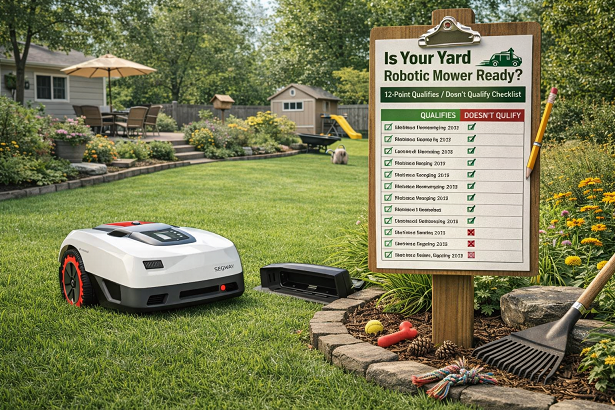
The 12-Point “Qualifies / Doesn’t Qualify” Checklist
Robotic mowing is one of those upgrades that feels like cheating—your lawn stays maintained without you living on a weekly schedule. But not every property is a perfect fit without a little prep.
This blog is your fast, no-fluff way to answer the question:
“Will a robotic mower work in my yard?”
Use the checklist below. Be honest. A robotic mower doesn’t need a “perfect” lawn… it needs a qualified lawn.
The 12-Point Qualification Checklist
1) Lawn Size
✅ Qualifies: Your mowing area fits within a mower’s rated coverage (we can size the mower correctly).
⚠️ Needs planning: Very large lots, multiple separated zones, or unusual shapes may need multi-zone setup or more than one unit.
Rule of thumb: Most “typical” suburban lawns are great candidates.
2) Slope and Steep Transitions
✅ Qualifies: Moderate slopes and smooth grades.
❌ Doesn’t qualify (until fixed): Steep hills, sharp drop-offs, or abrupt transitions where wheels lose traction.
Why it matters: Traction + stability = reliability.
3) Narrow Passages and “Pinch Points”
✅ Qualifies: Clear pathways between front/back or side yards that a mower can pass through.
⚠️ Needs planning: Tight corridors, gates, or weird choke points might require a defined route, zone settings, or a small landscape tweak.
If you’ve ever had a push mower feel awkward there, the robot will too.
4) Boundary Quality
✅ Qualifies: Clean edges like concrete, pavers, mow strips, rock borders, or defined beds.
⚠️ Needs attention: Mushy edges, crumbling soil lines, open mulch edges, or areas where grass bleeds into beds.
Robots love clear “this is lawn / this is not lawn.”
5) Obstacles and Clutter (Toys, Sticks, Pinecones, Dog Bones)
✅ Qualifies: You can keep the lawn reasonably “robot clean.”
❌ Doesn’t qualify (for sanity): Constant clutter that changes daily.
Truth: The mower doesn’t fail—our habits do. A 60-second yard scan can prevent 90% of issues.
6) Tree Roots, Holes, and Uneven Ground
✅ Qualifies: Normal unevenness is fine.
⚠️ Needs repair: Ruts, exposed roots, deep holes, sink spots, loose edging, or broken sprinkler trenches.
Robots don’t like surprise potholes.
Fixing these usually improves the lawn too, not just the mowing.
7) Irrigation Heads and Sprinkler Layout
✅ Qualifies: Heads are flush and not sticking up; the lawn isn’t soggy all the time.
⚠️ Needs adjustment: Heads that sit proud, broken nozzles, constant muddy zones, or runoff areas.
If a sprinkler head can get nailed by a traditional mower, it can get tagged by a robot.
8) Pets and Pet “Zones”
✅ Qualifies: Dogs are fine if you manage timing and keep the yard clean.
⚠️ Needs planning: Heavy pet traffic, lots of waste left in the mowing area, or dogs that treat the mower like a new enemy.
Simple solution: Run the mower at night/early morning, keep pet zones clean, and establish a routine.
9) Leaves, Debris, and Seasonal Cleanup
✅ Qualifies: You’re willing to do basic seasonal cleanup (especially fall).
⚠️ Needs effort: If the lawn becomes a leaf landfill every October, you’ll need a leaf plan.
Robotic mowers are not leaf vacuums.
But with reasonable cleanup, they handle normal leaf drop just fine.
10) Connectivity (App, Wi-Fi, GPS/Signal Where Needed)
✅ Qualifies: You have normal smartphone coverage and basic home internet.
⚠️ Needs evaluation: Dead zones, dense trees, tricky layouts, or properties where certain navigation methods struggle.
This isn’t a dealbreaker—just something we check early so you don’t waste money.
11) Security and Visibility
✅ Qualifies: You can place a dock in a smart spot and follow basic anti-theft best practices.
⚠️ Needs planning: High visibility front-yard docks, easy street access, or areas with frequent theft.
Good news: Most installs can be made low-profile and secure with the right placement and habits.
12) Expectations (This One Matters More Than People Think)
✅ Qualifies: You want a lawn that stays consistently maintained and improves over time.
❌ Doesn’t qualify: You expect “synthetic-speed perfection” overnight, while changing nothing else (watering, bumps, clutter, etc.).
Robotic mowing is a system upgrade. It’s reliable when the property and the owner are on the same team.
Quick Scorecard: Are You a “Yes” Right Now?
-
10–12 checks = Strong YES. You’ll love it.
-
7–9 checks = Yes, with a little prep. Still a great candidate.
-
0–6 checks = Not yet. But we can usually turn it into a YES with simple fixes.
The 5 Most Common “Easy Fixes” That Turn a Maybe into a Yes
-
Level a few potholes / fill sink spots
-
Trim/define messy edges (add mow strip or border cleanup)
-
Set a simple “robot clean yard” habit (toys, sticks, bones)
-
Fix or adjust sprinkler heads that sit too high
-
Create a clean path through narrow passages / gates
These are the kind of fixes that make any mowing easier—and improve the look of the property.
Want the Fastest Answer? Do a 2-Minute Qualification
If you’re in our service area, we can usually qualify your lawn quickly with:
-
a few photos (front/back/side + tight areas)
-
basic square footage
-
notes on slope and obstacles
If it’s a fit, robotic mowing can eliminate most of the pain of the traditional method while improving consistency and lowering cost of ownership over time.
Reach out to Blade to Blade / Front Range Autmow and we’ll help you figure out if your lawn qualifies—straight talk, no pressure.