
Last Updated on July 6, 2025 by Brian Beck
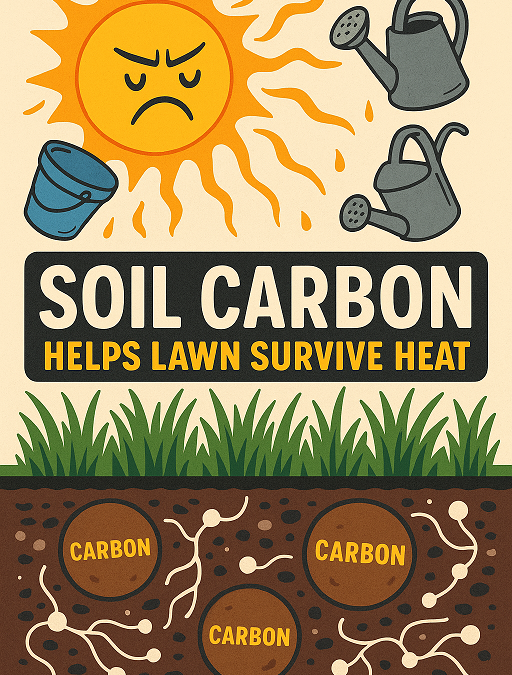
🌿 The Carbon Key: Why Soil Needs It to Survive the Summer
When summer hits hard, and your lawn starts to suffer, most people blame the sun, the heat, or not enough watering. But the real issue may lie deeper—in the soil’s carbon content.
That’s right. Carbon. The unsung hero of healthy, heat-resilient lawns.
While it’s often misunderstood or villainized in discussions around climate, in your soil, carbon is one of the most valuable assets you can build—and it all starts with biology.
🧱 What is Carbon in Soil, Really?
Soil carbon comes from decomposed plant matter, root exudates, and microbial byproducts. Think of it as the organic memory of every good thing your soil has ever absorbed.
There are two main types:
-
Active carbon – fresh inputs like compost or root sugars that feed microbes.
-
Stable carbon – long-term humus and organic matter that holds structure and moisture.
Together, they improve nearly every function in your soil: water retention, nutrient exchange, microbial life, and temperature regulation.
💧 How Carbon Helps Conserve Water
One of the most powerful properties of soil carbon is its ability to increase the water-holding capacity of your soil. Here’s how:
-
Spongy structure: Organic matter rich in carbon acts like a sponge, soaking up and holding water where roots can access it.
-
Improved infiltration: Microbes stimulated by carbon-rich environments create pore spaces that let water soak in rather than run off.
-
Reduced evaporation: Covered, carbon-rich soils stay cooler and moist longer—even during scorching summer days.
In short, carbon helps your lawn hold onto water longer and use it more efficiently.
🔬 Biology: The Engine Behind Carbon Growth
So how do we build carbon in the soil? We apply it directly AND, We grow it—by activating the biological life beneath the surface.
Microorganisms like bacteria and fungi:
-
Break down plant material
-
Convert nutrients into usable forms
-
Exude glues that build soil structure
-
Store carbon in their biomass and byproducts
This microbial activity builds stable, long-lasting carbon pools in the soil.
But—and here’s the catch—synthetic fertilizers and chemicals destroy the very life forms that make this possible. They may deliver quick green-up, but they leave the soil lifeless and starved of long-term resilience.
☀️ Carbon-Rich Soil = Summer-Ready Lawn
Lawns supported by high-carbon, biologically active soil can:
-
Go longer between waterings
-
Resist heat stress more effectively
-
Grow deeper roots
-
Require fewer inputs to stay healthy
In contrast, low-carbon, compacted soils demand constant watering and synthetic fixes. It’s the difference between sustainable health and seasonal survival.
🌎 Regenerate, Don’t Just Repair
If you want a lawn that survives summer—not just this one, but all the ones to come—the answer isn’t found in the fertilizer aisle. It’s in building soil carbon through regenerative, biological practices.
-
Test your soil
-
Apply compost or humates
-
Use microbial inoculants
-
Stop sterilizing your soil with chemicals
-
Feed the biology, not just the grass
Because when you build soil, you’re not just preparing for this season—you’re investing in the long-term sustainability of your landscape.
🌱 The Takeaway:
Carbon is the cornerstone of resilient soil.
And resilient soil makes all the difference in the heat of summer.
Don’t just water your lawn. Heal your soil. Build the biology. Capture the carbon. And let nature do the heavy lifting.