
Last Updated on August 17, 2025 by Brian Beck
Hot Weather and Its Effects on Turf: Why Heat Exposes Hidden Soil Problems
When temperatures climb, turf doesn’t just “get thirsty.” Heat reshuffles how plants move water and nutrients, and it amplifies any weak link in your soil system—thatch, pH imbalances, compaction, poor soil composition, low CEC, even the slope of your yard. Here’s how the puzzle pieces fit together, why your lawn can look tired or patchy in hot spells, and what to do about it.
What Heat Does Inside the Plant
Stomata and water loss. In hot, dry, or windy conditions, grass opens its stomata to cool itself, which accelerates transpiration (water loss). If soil moisture can’t keep pace, stomata close to conserve water—slowing photosynthesis and root growth.
Nutrient flow stalls. Most mineral nutrients ride the “water highway” (mass flow) to the root. Less water movement = less nutrient delivery (especially N, K, Ca, Mg). Heat stress also diverts plant energy into survival chemistry (osmotic adjustment, protective proteins), leaving less for growth and color.
Root–shoot imbalance. High canopy temperatures with shallow or heat-damaged roots create a mismatch: leaves demanding water/nutrients from roots that can’t supply them. Result: wilting, chlorosis, thin density, and greater pest/disease vulnerability.
Water Use & Nutrient Delivery Are Tied Together
Think of water as the conveyor belt. When the belt slows (dry soil, closed stomata), nutrient delivery slows, even if the nutrients are technically “there.” Conversely, wasteful watering that never penetrates deeply keeps roots shallow, making heat damage worse and feeding a cycle of frequent stress.
Site & Soil Factors That Change Water Efficiency (and Nutrient Flow)
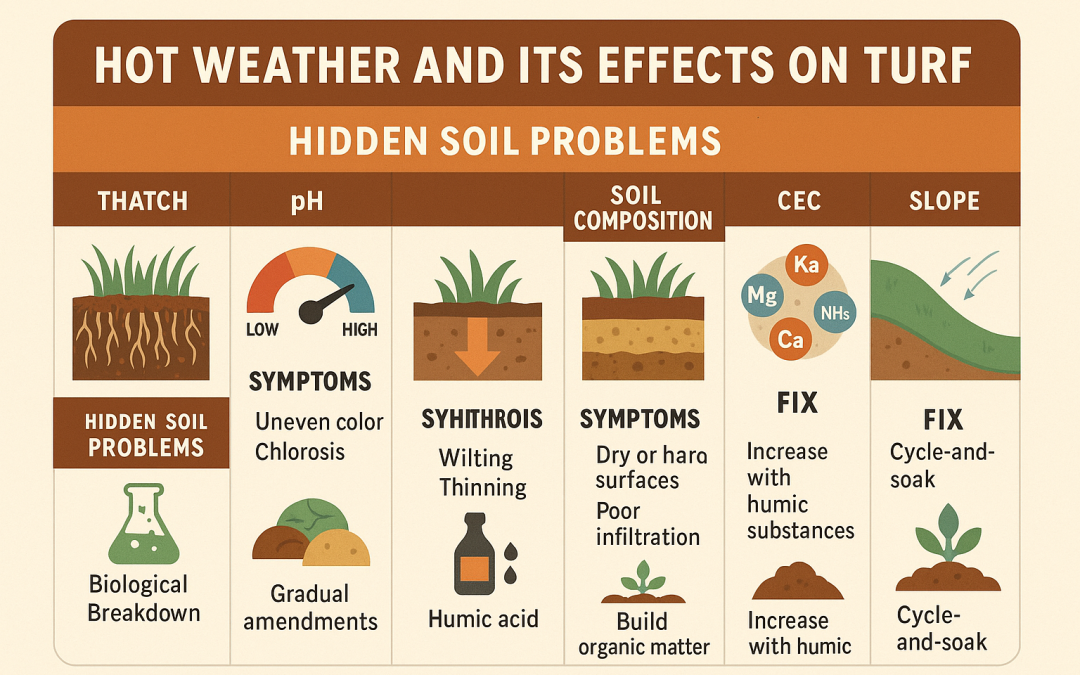
1) Thatch
-
What it is: A tight, spongy layer of undecomposed stems/roots.
-
Heat impact: Acts like a hydrophobic sponge that sheds light irrigation; roots may live in the thatch where it’s hot, dry, and nutrient-poor.
-
Symptoms: Runoff, hot spots, inconsistent color, rapid dry-out.
-
Fix: Promote biological breakdown (humic substances, compost extracts, proper N source, adequate moisture), robotic/frequent mowing for fine clippings that decompose readily rather than mat.
2) pH (Soil Reaction)
-
Why it matters: pH governs nutrient solubility and microbe activity. Heat stress magnifies any deficiency or toxicity caused by off-target pH.
-
Too low (acidic): Ties up Ca, Mg, and P; can increase aluminum issues.
-
Too high (alkaline): Ties up Fe, Mn, Zn, and P.
-
Fix: Amend gradually (lime for low pH, sulfur/acidifying inputs for high pH). Recheck after 8–12 weeks; don’t swing wildly.
3) Compaction
-
Effect: Squeezes out air, slows infiltration and drainage, and limits rooting depth.
-
Heat impact: Shallow, oxygen-starved roots lose the race during hot afternoons. Water ponds or runs off instead of soaking in.
-
Fix: Apply humic acid rather than relying only on mechanical aeration. Humic acid improves soil structure at a microscopic level, creating better aggregation so water can infiltrate more evenly. Over time, humic substances increase the soil’s cation exchange capacity (CEC)—its ability to hold and exchange positively charged nutrients like potassium, calcium, magnesium, and ammonium. A higher CEC means nutrients are less likely to leach during irrigation or rain and more available to turf when the plant calls for them. This not only relieves compaction indirectly (by fostering better aggregation and root growth) but also ties nutrient efficiency directly to water management.
4) Soil Composition (Texture & Structure)
-
Sandy soils: Drain fast, low water-holding; heat dries them in hours.
-
Clayey soils: Hold water but can seal on top and go anaerobic below; surface bakes and repels water in heat.
-
Loams with organic matter: Best balance—store water, drain excess, support biology.
-
Fix: Build organic matter (humus), use wetting agents where appropriate, and adjust irrigation volumes to match texture (lighter, more frequent cycles for sand; slower, longer cycles for tight soils).
5) Cation Exchange Capacity (CEC)
-
What it is: The soil’s ability to hold and exchange positively charged nutrients (K⁺, Ca²⁺, Mg²⁺, NH₄⁺).
-
Heat impact: Low CEC soils (sand) can’t retain nutrients during heavy irrigation; leaching increases, causing “mystery deficiencies” in hot periods. High CEC soils hold nutrients but can be slow to release if biology is weak or soil is compacted.
-
Fix: Increase stable organic matter and humic substances to raise effective CEC in sandy soils; keep biology active (moisture, balanced carbon:nitrogen inputs). Spoon-feed nutrients during heat waves to match the soil’s holding capacity.
6) Slope & Microtopography
-
Effect: Water runs off before it soaks in, especially with thatch or compacted surfaces.
-
Heat impact: Slopes dry first, creating hot spots that reveal “striping” or patchiness.
-
Fix: Cycle-and-soak irrigation (short, repeated runs), contour-friendly sprinkler placement, soil surfactants, terracing or micro-swales where feasible, and improving infiltration with humic acid and organic topdressing.
How These Problems Impede Nutrient Flow—and Change How Turf Looks
-
Reduced infiltration → fewer nutrients reach roots. Water that never penetrates can’t carry N, K, Mg, Ca, or micros into the root zone.
-
Shallow roots → chronic deficiency look. Pale green/yellow, tip burn, and slow recovery after mowing are classic signs.
-
pH lockout → uneven color. Interveinal chlorosis on newer leaves often points to iron/manganese unavailability in alkaline conditions; purple/red hues can signal P issues in cool nights/hot days.
-
Compaction + heat → wilt and thinning. You’ll see traffic patterns and mower lines persist because the plant has no cushion to rebound.
Practical Playbook for Hot Weather
-
Water deeper, then rest. Aim to wet the root zone (6–8 inches on many lawns). Use cycle-and-soak to avoid runoff, especially on slopes and thatchy/compacted spots. Let the surface dry between events to keep oxygen in the root zone.
-
Irrigation audit. Check coverage, nozzles, and run times by zone. Sandy areas may need shorter, more frequent cycles; tighter soils need slower application rates. Early morning (pre-dawn) is best.
-
Build soil CEC with humic acid. Apply humic substances to loosen compacted areas, increase soil aggregation, and boost CEC so nutrients stick around longer and stay available during heat stress. This is especially powerful in sandy or heavily irrigated soils where leaching risk is high.
-
Feed in a way your soil can handle.
-
Low CEC or sandy? Use lighter, more frequent N/K feedings.
-
High pH? Include iron/manganese sources.
-
Emphasize potassium during heat periods to support stomatal function and stress tolerance.
-
-
Support soil biology. Maintain moisture (not saturation), return clippings, consider humic substances and compost/topdressing to build humus. Biology drives thatch breakdown and improves aggregation for better infiltration.
-
Manage thatch. Encourage decomposition biologically and mechanically. If thatch exceeds ~½ inch, plan for corrective steps when weather allows.
-
Dial in pH over time. Make measured adjustments. Re-test seasonally if you’re actively correcting.
-
Grow root depth with mowing and moisture. Keep blades sharp, avoid scalping, and maintain consistent height. Robotic/frequent mowing helps retain a uniform canopy that resists heat and uses water efficiently.
The Big Picture
Hot weather doesn’t create new problems—it spotlights existing ones. When water infiltration is good, roots are deep, pH is in range, CEC matches your feeding strategy, and thatch/compaction are controlled, turf can ride out heat with fewer symptoms and lower costs. Treat water management and nutrient delivery as a connected system, and summer becomes manageable instead of miserable.