
Last Updated on March 9, 2026 by Brian Beck
One of the most common objections people make when their lawn gets challenged is this:
“But it’s green.”
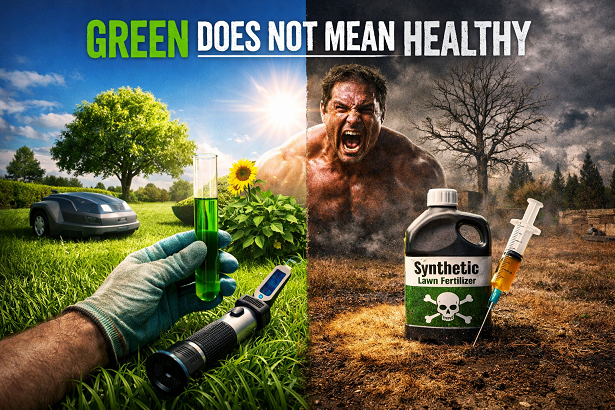
That sounds convincing until you stop and think about what green actually tells you. Green tells you there is chlorophyll in the blade. It tells you the plant has color. But color alone does not prove health. Plants use chlorophyll, sunlight, water, and carbon dioxide to produce carbohydrates through photosynthesis, and a Brix reading is commonly taken with a refractometer to estimate dissolved sugars in plant sap.
That is where people get fooled.
There is appearance, and then there is functionality.
Most homeowners judge their lawn by appearance because that is what they can see from the sidewalk. They see green and assume health. They see a quick response and assume strength. They see color and assume success. But they cannot see efficiency. They cannot see whether that lawn is actually functioning the way it was designed to function. They cannot see whether it is naturally cycling nutrients, building sugar, resisting stress, and operating with real strength, or whether it is simply being propped up.
And that is exactly what synthetic fertilizer does.
Synthetic programs can make a lawn look impressive in a hurry. They create a visible surge. They push a response. They can make a lawn appear dark, rich, and powerful even when the system underneath is weak, compacted, dependent, and inefficient. It is the difference between a body that is truly healthy and a body that has been artificially pushed for performance.
In other words, green does not equal health.
It just means the lawn has enough chlorophyll to look the part.
A truly healthy lawn is measured by function. How efficiently does it convert sunlight into sugar? How well does it hold up under heat? How deep are the roots? How little water does it need? How much weed pressure does it resist on its own? How much disease does it invite or avoid? How much money does it take to keep it from falling apart?
Those are the real questions.
Because most lawns, if we are being honest, are fake.
They are cosmetically enhanced. They are dressed up. They are dependent. They are not strong on their own. They are not resilient. They are not efficient. They are being carried by repeated force, and the moment that force is removed, the weakness begins to show.
That is why I compare synthetic fertilizers to steroids.
As a Bronco fan, I remember Lyle Alzado. He was a monster on the field. Fierce. Violent. Dominant. He looked like power personified. But Lyle Alzado died of brain cancer on May 14, 1992, at just 43 years old. Before he died, he publicly said he believed nearly 20 years of steroid use was a major contributing factor, and he warned “the kids of America” to stay away from steroids because he did not want anyone else to suffer what he was suffering. Jack LaLanne, by contrast, became the face of disciplined health and lived to 96.
What does that have to do with lawns?
Everything.
Synthetic fertilizer is the steroid program of lawn care.
It can create a dramatic look. It can create a fast response. It can make a lawn look powerful, dark, and impressive. But just like steroids can create the image of strength while doing damage underneath, synthetic fertilizers can create the appearance of lawn health while quietly producing dependency and side effects.
And those side effects are expensive.
Weeds. Compaction. Stress. Disease. Excessive thatch. Shallow rooting. Water inefficiency. Constant correction. Repeated inputs. These are not random events. These are often symptoms of a system that has been pushed instead of built.
That is why cost matters.
A lawn that only looks good because it is constantly being forced is not a healthy lawn. It is a dependent lawn. A lawn that needs repeated cosmetic stimulation is not strong. It is fragile. A lawn that cannot regulate itself, cannot cycle what is already in the soil and atmosphere, and cannot hold up under pressure without being propped up is not a success story. It is a liability.
People do not just need a green lawn.
They need a lawn that works.
They need a lawn that can go longer between waterings. They need a lawn that can handle heat. They need a lawn that does not live on the edge of stress. They need a lawn that stops inviting weeds, stops collapsing into compaction, stops building up thatch, and stops costing a fortune to keep alive.
That is where the biological system changes everything.
A biological program is not about propping up appearances. It is about restoring function. It is about building the kind of soil system that allows the plant to operate as it was designed to operate. It is about cycling nutrients properly, improving structure, feeding microbes, strengthening roots, buffering extremes, and creating genuine resilience instead of cosmetic dependency.
That is why this works.
We are seeing lawns with little to no weed pressure. We are seeing very little stress. We are seeing almost no disease. We are seeing thatch stay in check. We are seeing lawns that can handle being watered once every 10 to 12 days in 90-degree heat and still hold together.
That is not fake.
That is not paint.
That is not a temporary chemical illusion.
That is functionality.
And functionality lowers the cost of ownership.
That is the point.
We are not interested in selling people a temporary color response. We are interested in helping them build a system that performs better, costs less over time, uses less water, avoids unnecessary chemical exposure, and becomes more stable instead of more dependent.
So yes, your lawn may be green.
But that is not the question.
The question is whether it is healthy, or whether it is just being held together.
Because those are not the same thing.
And if you are tired of paying for appearance while your lawn quietly struggles underneath, it may be time to move to a biological system that is real, functional, and built to last.
Start a program with us, and let’s build a lawn that is not just green, but genuinely healthy.
Engage with us: