
Last Updated on January 5, 2026 by Brian Beck
Grass is not stupid.
Microbes are not confused.
And neither one is waiting on us to tell them how to live.
Both grass and the microbes beneath it carry DNA—coded instructions refined over millions of years. Long before spreaders, sprayers, and seasonal “programs,” these two had already worked out a relationship. A partnership. A rhythm.
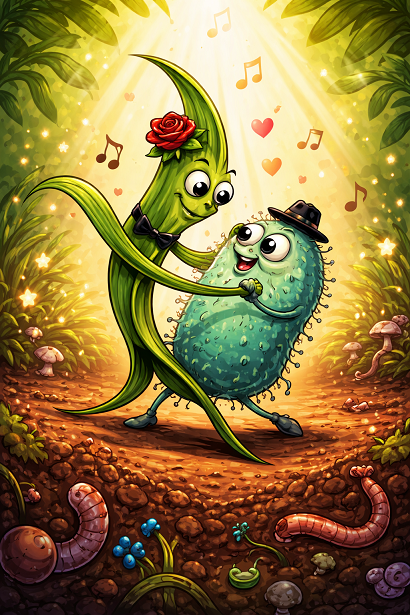
I like to say they know how to dance with each other.
And most of our problems start when we walk onto the dance floor with muddy boots and start yelling instructions.
The Dance Beneath Your Feet
Grass plants don’t grow alone. They never have.
Their roots release sugars—carbon compounds created through photosynthesis—into the soil. Those sugars are not waste. They are payments. Invitations. Signals.
Microbes respond by gathering nutrients, unlocking minerals, fixing nitrogen from the air, building soil structure, holding water, and feeding the plant back exactly what it needs, when it needs it.
This exchange is intentional. Coordinated. Elegant.
That’s the dance.
Grass leads.
Microbes follow.
Then they switch.
Where We Get It Wrong
The problem isn’t that nature forgot how to function.
The problem is that we interrupt it constantly.
We force-feed plants with salts.
We sterilize soil in the name of “control.”
We flood soils that were designed to breathe.
We compact, slice, oxidize, and strip carbon—then wonder why everything feels fragile and expensive.
It’s like walking into a beautifully choreographed ballroom dance and shouting,
“STOP — everyone eat this protein shake right now.”
Sure, something happens.
But it isn’t grace.
Biology Isn’t Passive — It’s Precise
This is the part people miss.
Letting biology work does not mean doing nothing.
It means doing less of the wrong things.
It means feeding microbes instead of bypassing them.
It means protecting fungal networks instead of shredding them.
It means understanding that soil is not dirt — it’s a living engine.
When we step back and stop interfering, the system doesn’t fall apart.
It organizes.
When the Dance Is Allowed
When grass and microbes are allowed to function together:
-
Roots grow deeper instead of wider and weaker
-
Water stays where it lands instead of running away
-
Nutrients cycle instead of leaching
-
Weeds lose their job as indicators
-
Inputs go down instead of up
-
Stability replaces dependency