
Last Updated on January 23, 2026 by Brian Beck
How plant life fuels clouds, cools neighborhoods, and why “rock yards” are the opposite of water-wise
A lot of longtime Colorado Springs residents remember a certain summer rhythm: warm mornings, clouds building by early afternoon, and then—almost like clockwork—a brief rain that cooled everything off. I’m not saying it was literally every day, and I’m not pretending one factor explains a whole climate system. But I am saying this:
We don’t talk enough about how much plant life influences local moisture, local cooling, and the “feel” of summer weather—especially in a semi-arid place like ours.
And here’s the irony: the more we fear “water waste,” the more we keep removing the very living systems that reduce heat, increase efficiency, and stabilize the water cycle right where we live.
The part of the water cycle most people ignore: plants
Most people picture the water cycle like it’s just oceans → evaporation → clouds → rain → rivers. True… but incomplete.
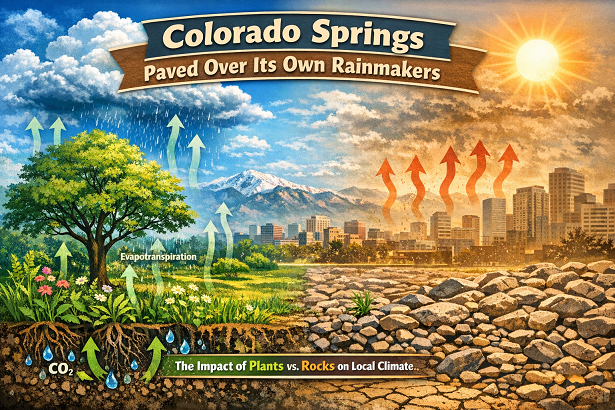
Over land, a massive share of atmospheric moisture comes from evapotranspiration—a combination of:
-
Evaporation from soil and surfaces
-
Transpiration from plants (water pulled from the soil and released as vapor through leaves)
That plant vapor becomes part of the local humidity “bank account.” Under the right conditions, that humidity helps air parcels reach condensation and cloud formation. Again: it doesn’t guarantee rain tomorrow at 4pm. But plants absolutely feed the atmosphere with water vapor—and the science is clear that changes in evapotranspiration can influence precipitation patterns and sensitivity over land.
Translation:
When you remove leaf area, you don’t just remove shade—you remove a moisture pump.
The daily-rain “monsoon” feeling wasn’t your imagination
Colorado has a real late-summer pattern where afternoon thunderstorms can become frequent—people literally call it “the monsoon” in casual conversation.
And Colorado Springs climatology shows late summer is typically among the wetter parts of the year.
So if it felt like storms used to be more regular in certain decades or neighborhoods, you’re not crazy. What’s tricky is pinning that feeling on one cause—because weather is a big machine.
But we can say something confidently:
Land cover changes (more pavement, fewer plants, different heat patterns) change the near-surface energy and moisture story that storms feed on.
Urban sprawl doesn’t just use water — it changes heat and moisture
As cities expand, we get:
-
More roofs, roads, and compacted ground (less infiltration, more runoff)
-
More stored heat (hotter afternoons, warmer nights)
-
Less canopy, less evapotranspiration (less local cooling + less local vapor)
This is the urban heat island effect—and vegetation is one of the most proven tools to counter it through shade and evapotranspiration cooling.
Colorado Springs has recognized urban heat island impacts in parts of the city and has planning resources specifically addressing it.
Now here’s where it gets interesting: cities don’t just get hotter—they can also modify rainfall (sometimes enhancing it, sometimes shifting it, sometimes reducing it downwind depending on geography and storm type). A major meta-analysis found urbanization changes rainfall patterns around cities.
And other research/case studies show urbanization can reduce precipitation downwind in some contexts.
Bottom line: the built environment moves the goalposts on storms.
The “water-wise” scam: ripping out plants and dumping rock
Let’s talk about the trend I see everywhere:
Remove living plant systems → install rock → call it xeriscape → act shocked when it’s hotter, uglier, and full of weeds.
Rock landscapes often:
-
Increase heat storage and raise near-surface temperatures compared to vegetated ground
-
Create harsh microclimates that stress any remaining plants
-
Become “weed magnets” because wind-blown seed + dust + organic debris eventually make a growth medium anyway
Gravel/rock mulches measurably change surface energy balance and can increase daytime air temperature in certain setups.
So we end up with neighborhoods that are hotter, and homeowners who still have to spray, torch, or hand-pull weeds… in the name of “saving water.”
That’s not wisdom. That’s panic dressed up as landscaping.
The real solution isn’t “more water.” It’s better water economics
Colorado Springs doesn’t need everyone flooding lawns.
We need people to understand a different equation:
Healthy soil = a water battery
When soil has biology and carbon (humus), it:
-
Holds more moisture per inch
-
Absorbs irrigation faster (less runoff)
-
Delivers water to roots longer (less frequent watering)
-
Buffers heat at the surface
That’s the missing link between the water cycle above ground and the carbon cycle below ground.
When you build the “humus engine,” you stop fighting water like it’s an enemy—and you start using it efficiently.
Why “conventional wisdom” is failing us
Most modern landscape “wisdom” is basically:
-
spray inputs
-
push growth
-
mow infrequently
-
water shallow
-
fight the symptoms
That approach is new compared to the systems it’s trying to override. Weather patterns, soil ecology, plant physiology—those forces have been running the planet for a long time.
And when people refuse biological methods because it’s “not conventional,” they’re often defending a tradition that’s barely old enough to have a pension.
What education changes: from restriction to regeneration
If we want cooler neighborhoods, lower water waste, and landscapes that don’t collapse under restrictions, the trend has to flip:
1) Plant more strategically, not recklessly
-
Trees where they shade hard surfaces
-
Perennials and groundcovers that protect soil
-
Mixed plantings instead of exposed dirt and rock
2) Water deeper, less often
Train roots downward. Stop feeding evaporation.
3) Build soil biology and carbon
Stop sterilizing the soil and then wondering why it can’t manage water.
4) Reduce reflective/heat-storing dead zones
Less rock-as-default. More living cover. More mulch where appropriate.
5) Use technology as a partner
Smart irrigation + real soil function is the combo that actually works.
The punchline: planting isn’t “wasting” water when the soil is right
In a living system, water isn’t just “used.”
It’s cycled:
-
into plants
-
into the air (evapotranspiration)
-
into local cooling
-
into soil storage
-
into healthier microclimates
And yes—into the atmospheric moisture stream that helps clouds exist in the first place.
If we want Colorado Springs to feel less like a heat slab and more like a functioning ecosystem, the answer isn’t to remove life.
It’s to manage life correctly.
Call to action
If you want a landscape that stays resilient under restrictions—without turning your yard into a hot rock pan—I can help you build a system that works with the water cycle and the carbon cycle instead of fighting both.
That’s the whole mission behind my biological soil program and the automation side of what we do (robotic mowing + consistent management).
personal_dna
If you’re ready, book a consult and I’ll show you what to change first so you get less waste, more cooling, and a landscape that actually holds up in Colorado Springs.