
Last Updated on September 15, 2025 by Brian Beck
If you’ve ever walked out into your yard, noticed a patch of brown, thinning grass, or even a whole section that seems “off,” you’re not alone. Many homeowners feel a wave of anxiety when they see their lawn struggling. The good news? Almost every lawn problem is fixable—and often, it’s not nearly as bad as it first appears.
Grass is an incredibly resilient plant. It has survived droughts, floods, heat waves, and countless cycles of stress and recovery over the centuries. Your lawn has the same ability—what it needs is the right kind of support.
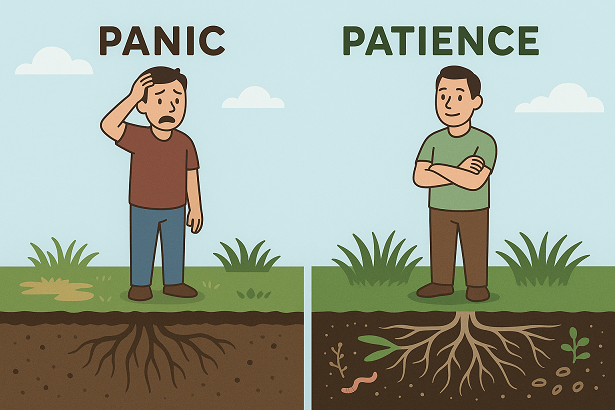
Why Panic Doesn’t Help
The instinct to panic usually leads people to chase quick fixes: dumping on extra fertilizer, overwatering, or buying whatever product a big box store is promoting that season. While these approaches may give the illusion of improvement, they often just mask the real issue. Worse, they can create long-term problems like soil compaction, thatch buildup, or nutrient imbalance.
Instead, the key is to slow down, look at the bigger picture, and address the actual cause of the stress.
Focus on Biology, Not Band-Aids
Modern lawn care has shifted away from just “feeding” the grass with synthetics. Instead, we now know that the real magic happens underground—in the soil. When we nurture the biology of the soil, the lawn above responds in powerful ways:
-
Microbial life thrives – Healthy bacteria and fungi work together to unlock nutrients that are already in the soil.
-
Humus is created – This miracle material improves structure, stores water, and feeds plants slowly and steadily.
-
Resilience increases – A biologically active lawn can bounce back from stress, heat, and even damage much faster.
Once soil biology is balanced, your lawn doesn’t just survive—it flourishes. Problems that seemed huge just weeks before often fade into the background.
A Healthier Perspective
If you’re worried about your lawn, take a deep breath. Remember: everything is fixable. What you’re seeing on the surface is often just a symptom of an underlying imbalance, and that imbalance can be corrected with the right approach.
The truth is, lawns that embrace biological systems require less water, fewer chemical inputs, and less labor over time. They become self-sustaining engines of health and beauty—without constant anxiety or panic.
The Bottom Line
Don’t let stress over a few rough patches ruin your relationship with your lawn. With modern biological techniques, patience, and the right focus on soil health, you’ll find that your grass is tougher and more forgiving than you ever realized.
Your lawn doesn’t need a band-aid. It needs biology. And once it has that, you’ll discover just how resilient it can be.