
Last Updated on January 14, 2026 by Brian Beck
For nearly two decades, I did what everyone else in this industry does.
I ran routes.
I pushed gas mowers.
I applied fertilizers the way I was taught.
I adjusted irrigation and hoped for the best.
And for a long time, I accepted that this was just “how lawn care works.”
But eventually, I couldn’t ignore a simple, uncomfortable truth:
The system itself was broken.
Not broken in a small way.
Broken at its foundation.
And once you see that, you can’t unsee it.
Two Decades In… and Something Didn’t Add Up
I’ve spent the better part of my adult life in the lawn care business. I didn’t come to this from theory, a book, or a trend. I came to it from repetition—doing the same things, year after year, watching customers spend more money while getting diminishing returns.
More water.
More fertilizer.
More equipment.
More frustration.
And yet, the problems never actually went away.
That’s when I stopped asking how to do things better and started asking a much more dangerous question:
“What if the entire approach is wrong?”
That question led me down a path that eventually became what I now call The Trinity System.
The Three Pillars — and the Three Failures
Modern lawn care is built on three core functions:
-
Mowing
-
Fertility
-
Irrigation
All three are deeply flawed as they’re traditionally practiced.
-
Mowing: The Route-Based Fallacy
The route-based mowing system is one of the most inefficient service models still in use today.
Two people.
A large truck.
Multiple gas-powered machines.
Traffic, weather, fatigue, breakdowns, scheduling chaos.
In many cases, 50% of the time and cost is wasted just getting to the lawn, not improving it.
And once the mower leaves? The lawn immediately starts declining again.
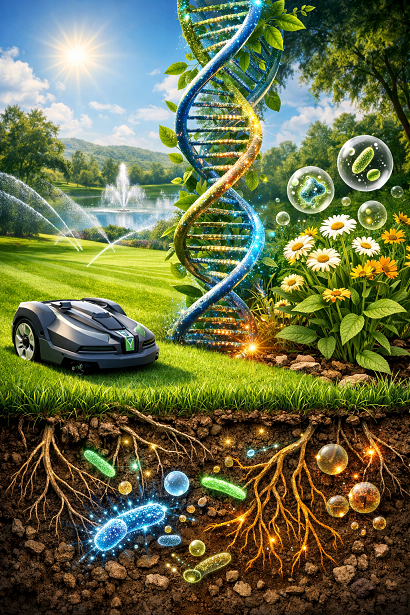
Robotic mowing changes this entirely.
Instead of “showing up to cut,” we manage an already-cut lawn. There’s no downtime. No peaks and valleys. No noise, fumes, or missed weeks.
Most importantly, the grass itself is healthier—because frequent, light cutting was always the correct biological answer. We just never had the technology to do it efficiently… until now.
-
Fertility: Chasing Symptoms, Not Solutions
Where I live, we start with poor soils. Compacted. Alkaline. Low in biology.
For years, I followed the synthetic fertility playbook—because that’s what the industry taught.
What I learned through studying soil biology since 2018 is this:
Synthetic systems don’t fix soil. They mine it.
They increase water demand.
They suppress microbial life.
They drive dependency.
They expose people and pets to unnecessary toxins.
Worst of all, they lock you into a cycle where you are always treating symptoms instead of healing the system.
Biological fertility flips that model.
We don’t force-feed plants.
We rebuild soil function.
Healthy soil grows grass with less input, not more.
And once that system is established, ownership costs begin to fall—not rise.
-
Irrigation: Guesswork at Scale
Water is often the single largest long-term expense of lawn ownership—and the most misunderstood.
Most people:
-
Water too often
-
Too shallow
-
With compacted, biologically inactive soil that can’t accept or store water
Even if water does get in, there’s nowhere for it to stay. Without humus, soil has no battery.
The result?
Massive waste.
I would confidently argue that 30–50% of residential irrigation water is wasted, and in extreme cases, far more.
Healing soil increases infiltration and storage.
Robotic mowing reduces stress and demand.
Modern moisture-based technology replaces guessing with data.
Each piece reinforces the others.
Trinity Isn’t a Product. It’s a System.
The Trinity System exists because each of these problems cannot be solved in isolation.
-
Efficient mowing without healthy soil still wastes water
-
Healthy soil without proper watering still fails
-
Smart irrigation on broken soil is just expensive denial
Trinity integrates all three.
Robotic mowing.
Biological soil systems.
Intelligent water management.
Not to make lawns complicated—but to make them finally make sense.
Owning vs. Renting Your Lawn
Most people don’t own their lawn.
They rent it.
They pay every year just to keep it alive, never building equity, never improving the asset, never reducing the cost.
Trinity is about changing that relationship.
It’s about efficiency.
Self-preservation.
And refusing to accept outdated systems simply because “that’s how it’s always been done.”
If you’ve ever felt like lawn care costs too much, wastes too much, or asks too little of modern technology—there’s a reason.
Ready to Stop Renting Your Lawn?
If you’ve read this far, one thing is clear:
You already know the old system isn’t working.
The question isn’t whether your lawn can be managed better—it’s whether you’re ready to stop wasting time, water, and money on an outdated model that was flawed from the beginning.
The Trinity System is not for everyone.
It’s for people who want:
-
Lower long-term ownership costs
-
Healthier soil and grass with fewer inputs
-
Less noise, less disruption, less waste
-
Technology and biology working together—not against each other
If that sounds like you, the next step is simple.
👉 Request more information about the Trinity System
👉 See if your property qualifies
👉 Learn what it would actually cost to own your lawn—not rent it
Spots are limited by design.
Efficiency requires intention.
If you’re ready to move forward, we’re ready to show you how.
Own your lawn.
Don’t keep renting it.
Is the Trinity System Right for You?
Trinity is a fit if you:
-
✔️ Want your lawn to cost less to own over time, not more
-
✔️ Are open to automation, biology, and modern systems
-
✔️ Care about efficiency, water use, and long-term soil health
-
✔️ Prefer solving root causes, not chasing symptoms
-
✔️ Are willing to follow a proven system instead of micromanaging it
Trinity is not a fit if you:
-
❌ Want the cheapest short-term option with no long-term plan
-
❌ Expect instant cosmetic results without addressing soil health
-
❌ Prefer weekly gas mowing, loud equipment, and exhaust fumes
-
❌ Believe more fertilizer and more water is always the answer
-
❌ Aren’t interested in learning why your lawn works—or doesn’t
One Last Thing
We don’t oversell Trinity.
We qualify for it.
Not because it’s exclusive—but because it only works when all three pieces are respected and implemented correctly.
If you see yourself in the first list and not the second, you’re exactly who this system was built for.
👉 Request more information
👉 See if your property qualifies
Stop renting your lawn.
Start owning it.
And there’s a better way forward.
If this resonates, explore further.
Ask questions.
Challenge assumptions.
That’s how Trinity was built—and that’s who it’s for.
— Brian Beck
Get in touch with us here:
https://my.serviceautopilot.com/viewform.html?rk=ca7c62a1-42a8-4278-9d40-996a10f4c3da&Type=new&Source=web