
Last Updated on October 11, 2026 by Brian Beck
There is something peculiar about the way lawn care is often sold.
The lawn struggles. Another application is recommended.
The weeds return. Another treatment is scheduled.
The grass dries out. The sprinkler runs longer.
Eventually, the homeowner accepts the whole cycle as normal. Fertilize, spray, water, repeat. Pay the lawn company. Pay the water company. Occasionally pay someone else to address whatever problem appeared between the last two payments.
But here is the question that deserves more attention:
Is your lawn becoming healthier and more independent—or simply becoming better supplied with things it needs to keep struggling?
At Front Range Biological & Lawn Automation, that question drives our biological program. We seek to identify what is limiting the lawn, correct those conditions, and reduce its dependence on unnecessary inputs.
We call that monetizing efficiency.
When the Application Becomes the Business Model
Much of the conventional lawn care market is organized around recurring applications. Customers buy a certain number of visits, and companies build their revenue around delivering those visits.
That arrangement makes applications easy to count. It makes progress harder to define.
Six treatments tell you how often someone showed up. They do not tell you whether your soil absorbs water better, whether your roots are reaching deeper, or whether the lawn can maintain its condition with fewer resources.
A fertilizer application can supply needed nutrients. A weed treatment can control a specific weed. Neither, by itself, establishes why the grass was struggling or why the weeds found an opportunity.
A symptom can disappear while the underlying limitation remains.
When that happens, next year’s program can look remarkably like this year’s program—and the homeowner keeps buying relief from the same recurring problems.
The Bill You See Is Only Part of the Cost
Most people judge lawn care by the price on their service invoice.
That leaves a considerable part of the picture outside the frame.
Along the Front Range, irrigation can be a major expense. Depending on lawn size, water rates, weather, and watering practices, it may rival or exceed the treatment bill.
Then come the additional costs: weed treatments, disease treatments, reseeding, aeration, power raking, and the time spent trying to keep everything looking acceptable.
These services can have legitimate uses. The concern is when they become recurring responses to conditions nobody has adequately investigated.
For example, excessive fertilization can increase irrigation and mowing demands and contribute to thatch buildup. Colorado State University Extension explicitly identifies these consequences of overfertilization. A product meant to improve appearance can therefore increase the work and expense required to maintain it.
That is why the cheapest application does not necessarily produce the least expensive lawn.
The meaningful number is the total cost of keeping the lawn healthy over time.
Green Is an Appearance. Health Is a Function.
A lawn can turn green after fertilization without gaining better soil structure, improved water infiltration, or a more effective root system.
Color matters. We all want a beautiful lawn. But color alone is an incomplete report card.
We want to know what happens between applications.
Does water enter the soil where it is needed? Can roots explore enough soil to support the plant? Does the lawn recover from ordinary stress? Are its needs becoming more manageable?
A healthy lawn should have a functional foundation beneath its appearance.
Otherwise, we are repeatedly repainting a house while ignoring the foundation.
Rebuilding the Relationship Beneath Your Feet
Grass grows within a living system.
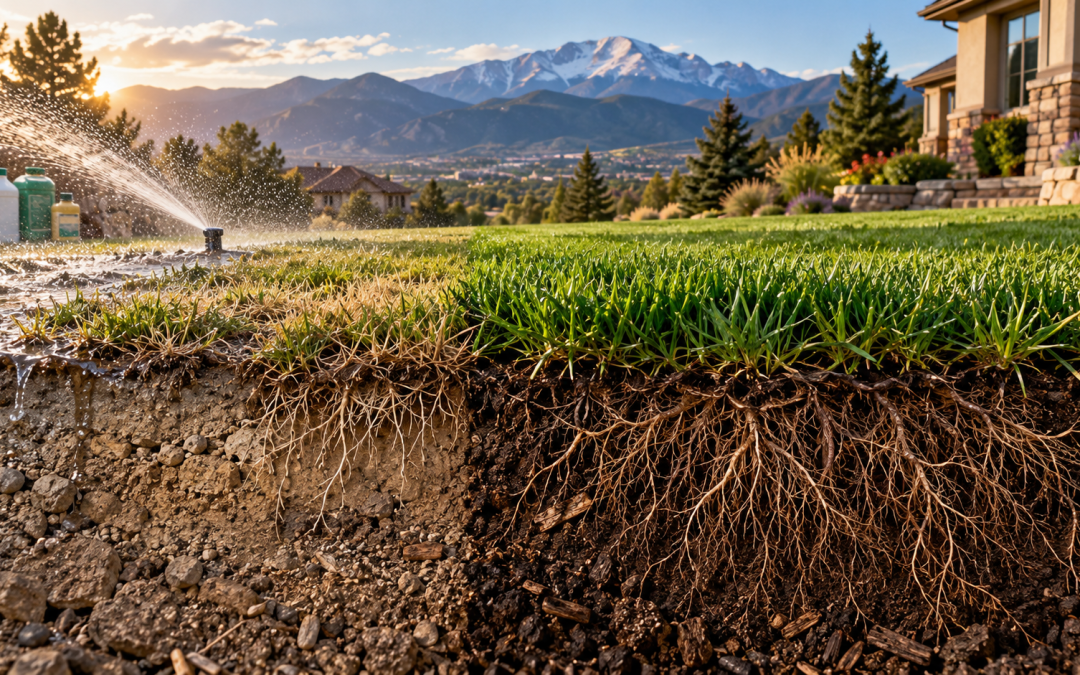
Roots, microorganisms, organic matter, minerals, water, and air interact below the surface. Soil organisms help decompose organic material and cycle nutrients, influencing what plants can access and use. USDA’s Soil Biology Primer describes these processes as central functions of the soil food web.
That relationship is one of the foundations of our approach.
A soil may contain nutrient reserves while the lawn still has difficulty accessing them. Availability depends on soil chemistry, root health, moisture, oxygen, and biological processes—not simply whether an element is present.
But we do not assume every lawn already contains everything it needs. Deficiencies are real. Physical limitations are real. Irrigation problems are real.
We investigate before deciding what to add.
Our diagnostic sequence begins with soil structure and gas exchange, then considers biological function, mineral balance, and the fertility inputs justified by those findings.
The aim is to remove obstacles and build the soil’s capacity to support the lawn.
More Product Can Become More Overhead
It is too broad to claim that every synthetic application destroys soil biology. Product, dose, frequency, and growing conditions matter.
What deserves scrutiny is a program that repeatedly pushes growth or treats symptoms without correcting the conditions underneath them.
If water cannot infiltrate properly, another fertilizer application does not remove that barrier. If watering practices encourage poor rooting, another treatment does not redesign the irrigation strategy.
The same principle applies to mechanical services. Aeration can be valuable for compacted soil and can improve movement of water and air into the root zone. It should be prescribed because the lawn needs it, with a clear purpose—not treated as proof that the underlying problem has been permanently solved.
Our objective is to reduce recurring corrective work where the lawn’s condition allows it.
Every input should have a reason. Every recurring problem should prompt a closer look.
We Want to Earn Our Value Through Efficiency
Our program starts with a different definition of success.
We want the lawn to become more capable of supporting itself.
That can require meaningful work at the beginning: testing, correcting limiting conditions, supporting biology, and improving how the lawn is watered and managed.
As those conditions improve, our goal is to move toward maintenance inputs that replenish demonstrated needs, with fewer unnecessary interventions.
We are not promising a lawn that never needs water, nutrients, or attention. We are building toward a lawn that uses those resources more effectively.
Our value is the improvement in the system—not the volume of product applied to it.
That is what we mean by monetizing efficiency.
The Savings Should Show Up Beyond Our Invoice
The intended benefit extends beyond fewer applications.
It can include less wasted irrigation, fewer avoidable corrective treatments, and a lawn that handles ordinary stress more effectively.
Our organic biological approach also seeks to reduce reliance on routine synthetic pesticide treatments, reducing opportunities for exposure. Product selection and proper use still matter; an organic label alone does not guarantee that a product is harmless.
The financial results depend on the property, its starting condition, and the homeowner’s management practices. They should be evaluated through actual water use, treatment needs, and lawn performance over time.
Transparency means showing what changed.
A lawn that looks better while using resources more effectively gives the homeowner something more meaningful than a treatment receipt.
It gives them evidence of progress.
Own Your Grass. Don’t Rent It.
A lawn care program should have a direction.
It should move your lawn toward better function, greater resilience, and fewer unnecessary expenses.
If the plan never progresses beyond another application, it is reasonable to ask what is actually improving.
At Front Range Biological & Lawn Automation, we seek to understand the problems, correct the limitations, and rebuild the relationships that help a lawn thrive.
We want beauty supported by function—and a homeowner who understands what they are paying for.
Own your grass. Don’t rent it.
Ready to find out what is keeping your lawn dependent on repeated treatments? Let’s evaluate the soil and build a plan around what your lawn actually needs.
Front Range Biological & Lawn Automation
Call 719-380-0136 or request a lawn evaluation.