
Last Updated on September 23, 2026 by Brian Beck
The Two Water Magic Tricks: Getting It Into the Soil and Keeping It There
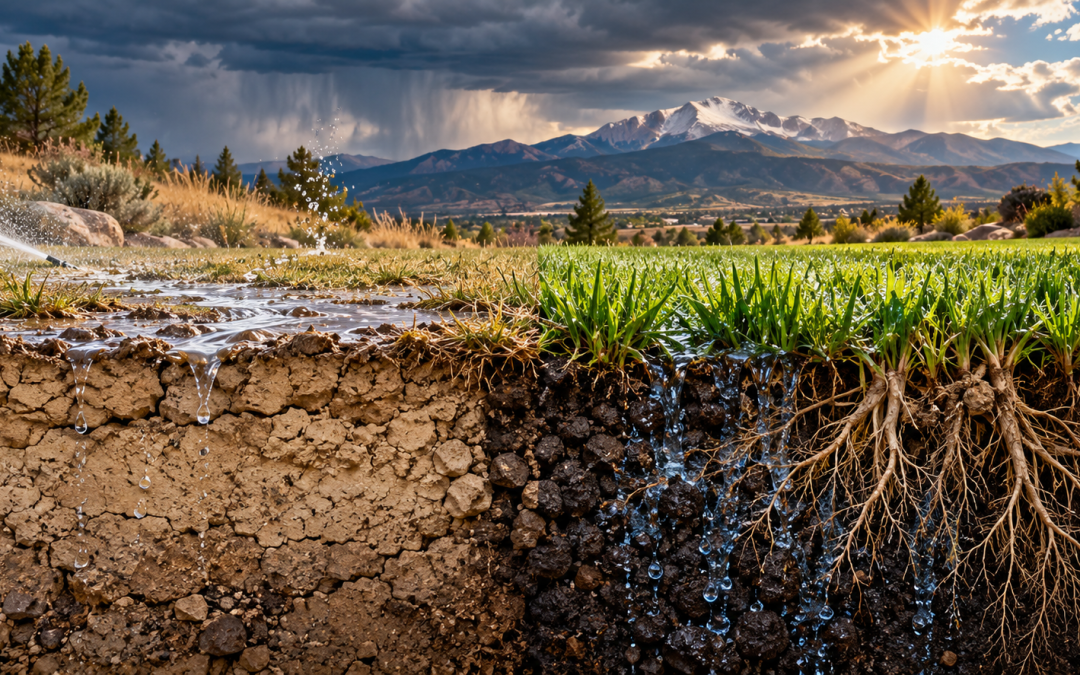
For much of my career, I’ve thought about two water problems as magic tricks: getting water into the soil and keeping it there.
They sound simple. Turn on the sprinklers, water the lawn, and let the soil do its job.
But a surprising amount of irrigation never reaches the roots in a useful way. Some water is lost to evaporation and wind. Some runs across the surface, pools in low spots, or moves below the root zone. And sometimes the soil is so compacted that water struggles to get in at all.
A water bill tells you how much water passed through the meter. It doesn’t tell you how much reached the roots. You can spend hundreds of dollars watering a lawn and still lose much of that water to poor timing, poor coverage, runoff, or soil that cannot hold the moisture your grass needs.
Magic trick number one: Get water into the soil
Many lawns are watered by habit: the timer runs for the same number of minutes on the same days, whether the weather, soil, or grass needs it or not. Sprinkler heads may be misaligned, blocked, or unevenly spaced. A long cycle can put water down faster than the soil can absorb it, sending it onto a sidewalk or driveway.
The soil itself can make the problem worse. Compaction reduces the larger pore spaces that allow air and water to move through the ground. Roots need those spaces, too. Along the Front Range, compacted and clayey soils can make it harder for water to infiltrate and for roots to grow deeply. CSU Extension
Healthy soil structure develops as roots and soil organisms interact with organic matter. Microorganisms help bind small soil particles into aggregates. Those aggregates create a network of spaces where water can enter and move, and where roots can grow. It takes ongoing care; one quick treatment cannot build lasting soil structure overnight. CSU Extension
When water is running off, pooling, or soaking in unevenly, adding more minutes to the timer may simply waste more water. CSU Extension recommends checking irrigation output and using shorter cycles with soak periods on compacted, sloped, or clay-heavy lawns. That gives water time to enter the ground before the next cycle begins. Colorado State University Extension
Magic trick number two: Keep water where roots can use it
Getting water into the soil is only half the job. The soil also needs to hold a useful reserve of moisture.
Soil organic matter—including humus—helps with that. It supports soil structure and can improve water-holding capacity. The goal is not to make soil stay wet forever. Roots need both water and air. The goal is a soil that accepts water, stores a portion of it in the root zone, and releases it as plants need it. CSU Extension
When soil has little organic matter and weak structure, water may either rush through too quickly or have trouble moving into the root zone. The lawn then dries out sooner, and the response is often to water again. That cycle can leave homeowners paying for more irrigation without fixing why the soil is failing to make good use of it.
Poor watering and poor soil multiply the waste
These are not separate problems. Poor watering technique wastes water before it reaches the ground. Compacted soil can prevent water from entering. Low organic matter and weak structure can limit how much useful moisture stays available near the roots.
Together, those problems can make a lawn look thirsty even while the sprinkler system is running regularly. The instinct is to increase watering. But if the system is applying water poorly or the soil is not functioning well, a higher bill may be the only sure result.
Colorado can’t treat water as an afterthought
Water is part of the future of every Colorado landscape. Colorado Springs Utilities currently reports that Colorado Springs is in its Water Shortage Preparation stage because of drought risks to local supplies. In August 2026, the city received 37% of its normal precipitation, while customer water demand was about 9.7% higher than in August 2025. csu.org
That is a serious reason to look closely at how we use water at home. Every homeowner should follow current local watering rules. Beyond that, we can ask a practical question: How much of the water we pay for is actually helping the landscape?
The answer starts with the sprinkler system, the soil, and the roots together. Check whether the sprinklers cover the lawn evenly. Watch for water running off. Learn how quickly your soil accepts water and how deeply it becomes moist. Then address the conditions that limit infiltration and water storage.
A lawn’s water bill should not be a measure of how much water disappeared into waste. We can do better by getting water into the soil—and helping the soil keep it where the roots can use it.
If your lawn needs more water every year to get the same result, it may be time to look below the surface. Front Range Biological & Lawn Automation can help assess the soil and irrigation conditions that affect how efficiently your lawn uses water.
Stop Paying for Water Your Lawn Cannot Use
If water runs off, dries out too quickly, or never reaches the roots, increasing irrigation can raise your bill without fixing the problem. Our Biological Soil Program focuses on improving the soil conditions that affect water infiltration and retention.
Find out what’s keeping your soil from making better use of the water you’re already paying for.