
Last Updated on September 9, 2026 by Brian Beck
The “One-Time Fix” Fantasy
A few years ago, I was standing in the backyard of a prospective client’s home, discussing what it would take to improve his lawn.
He could afford the work. That was not the issue.
What he really wanted to know was whether there was one thing we could do—one time—that would make the lawn look good for the rest of the year.
I told him no.
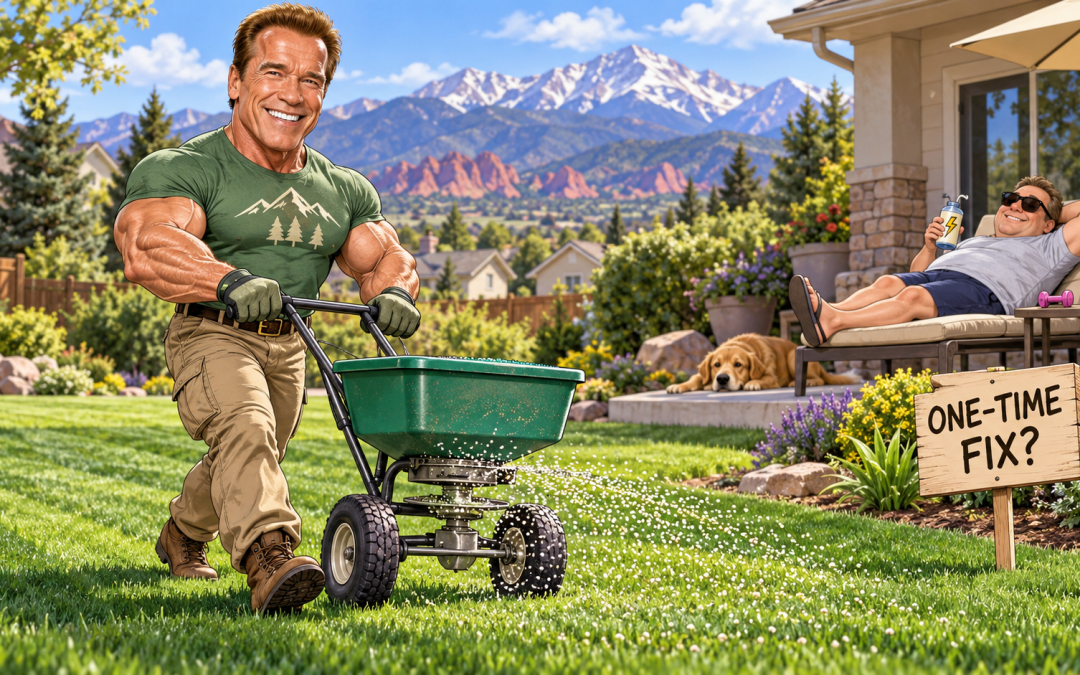
Then I asked him, “Did Schwarzenegger go to the gym just once and call it good?”
He looked at me for a second. He was not offended. He understood exactly what I meant.
Because the answer is obvious when we talk about a body. You do not build strength, health, endurance, or a great appearance with one visit to the gym, one salad, one vitamin, or one magic pill. Yet people routinely expect a lawn—an actual living ecosystem exposed to heat, drought, wind, irrigation problems, compaction, weeds, insects, and poor soil chemistry—to be permanently repaired with one application.
That is not how living things work.
We have been conditioned to expect shortcuts. Take this pill. Buy this bottle. Spray this product. Fix it by Friday. The problem is that a shortcut may create a temporary visual improvement without actually solving what caused the problem in the first place.
A green lawn is not automatically a healthy lawn.
You can push color with fertilizer. You can knock down weeds with a spray. You can water the surface until the lawn looks better for a few days. But if the soil is compacted, biology is weak, carbon is low, nutrients are locked up, roots are shallow, or the irrigation is inefficient, the underlying problem is still sitting there waiting for the next stretch of heat or stress.
That is why we do not pretend there is one magic treatment that can replace a program.
Real improvement takes observation, testing, correction, and follow-through. It takes time because we are rebuilding the conditions that allow the lawn to function: soil structure, gas exchange, microbial life, nutrient availability, deeper rooting, and better water efficiency.
That may not be the answer everyone wants to hear. But it is the honest one.
If someone wants a one-time cosmetic touch-up, there are plenty of companies willing to sell one. If you want to understand why your lawn struggles and build a system that becomes more resilient over time, that is a different conversation.
And frankly, it is the conversation worth having.
A healthy lawn is not a pill. It is a process.
Ready to stop guessing and start building a lawn that functions better from the soil up? Request a Biological Lawn Evaluation here: