
Last Updated on September 6, 2026 by Brian Beck
Lawn Anxiety: Why Panic Is Costing Homeowners Money
There is a kind of anxiety that comes with owning a lawn that nobody really talks about.
The grass starts turning brown.
A few strange patches show up.
The weather gets hot.
The lawn doesn’t seem to respond the way it used to.
And suddenly the homeowner begins asking:
What do I do now?
Unfortunately, that is often where the trouble begins.
Most homeowners have never been given a reliable way to diagnose what is actually happening beneath their lawn. Instead, they fall back on conventional wisdom, advice from neighbors, something they heard years ago, a recommendation from the internet, or simply whatever seems logical in the moment.
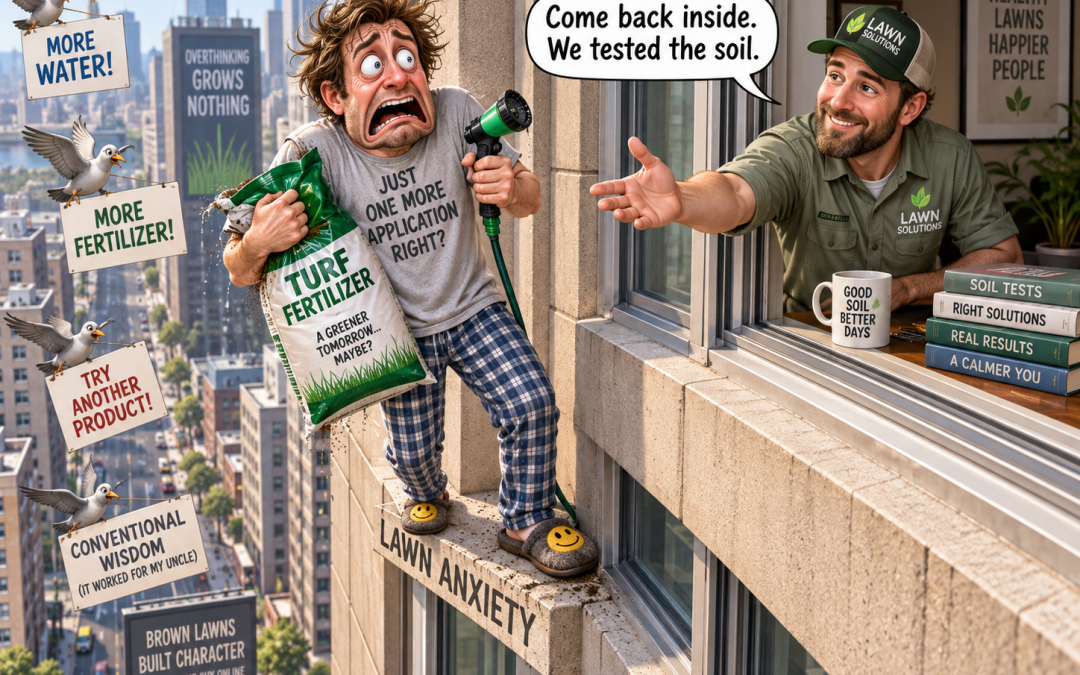
More water.
More fertilizer.
Another treatment.
Another product.
Another guess.
It becomes a cycle of reaction.
And when the lawn doesn’t improve, the natural response is often to do even more.
That is what I call lawn anxiety.
The Problem Isn’t That People Don’t Care
Most people care very much about their lawns.
In fact, that is part of the problem.
When something starts going wrong, they want to fix it quickly.
But urgency without information often produces bad decisions.
If a lawn looks dry, the assumption is that it needs more water.
If it looks pale, the assumption is that it needs more fertilizer.
If weeds appear, the assumption is that weeds are the problem.
If disease appears, the assumption is that the disease itself must be attacked.
But what if those symptoms are trying to tell you something deeper?
What if the soil cannot move air effectively?
What if water is present but cannot penetrate or remain where the roots need it?
What if biological activity is weak?
What if nutrients are present but unavailable because the chemistry is out of balance?
In those situations, adding more water or fertilizer may not solve anything.
Sometimes it can actually make the situation worse.
We Have Been Conditioned to Treat Symptoms
Traditional lawn care has trained people to think primarily in terms of inputs.
Grass isn’t green enough?
Add something.
Grass isn’t growing?
Add something.
The lawn looks stressed?
Water it.
Weeds appear?
Spray them.
The problem is that a lawn is not simply a surface that needs products applied to it.
It is a living system.
And that system depends on the relationship between soil structure, air, water, microorganisms, minerals, roots, and plant activity.
When those pieces work together, the lawn becomes more stable.
When they don’t, the lawn becomes increasingly dependent on intervention.
And dependency creates anxiety.
You are constantly wondering what the lawn needs next.
The Goal Should Be Stability
A healthy lawn should not feel like a permanent emergency.
You should not have to stand at the edge of your yard every July wondering whether it is about to collapse.
You should not have to constantly increase watering because the grass looks stressed.
You should not have to continually buy another fertilizer, another chemical, or another miracle product hoping this one finally fixes the problem.
The goal should be something much different.
Stability.
A soil that accepts water.
A root system that can explore deeper into the ground.
Better air movement through the soil.
Improved biological activity.
More efficient nutrient cycling.
A lawn that can tolerate difficult weather without immediately falling apart.
That does not mean the lawn will never experience stress.
Colorado weather alone makes that unrealistic.
But it does mean the lawn can become much more resilient when stress arrives.
And resilience creates something homeowners rarely associate with lawn care:
Peace of mind.
Stop Guessing
One of the most expensive phrases in lawn care might be:
“I’ve always heard you’re supposed to…”
That statement has probably resulted in millions of dollars of unnecessary fertilizer, excessive irrigation, chemical treatments, and failed lawn renovations.
We believe there is a better approach.
Before assuming what the lawn needs, gather information.
Look at the soil.
Look at its structure.
Understand whether air and water can move through it.
Evaluate biological activity.
Understand the mineral relationships.
Determine what is actually limiting the plant.
Then make decisions.
That changes lawn care from superstition into management.
It replaces reaction with strategy.
And it replaces anxiety with confidence.
You Don’t Need to Become a Soil Scientist
Homeowners sometimes hear us talking about soil biology, mineral balance, carbon, compaction, gas exchange, and water efficiency and assume they need to understand all of it themselves.
You don’t.
That is our job.
Our goal is to simplify the complicated parts and help homeowners understand what matters for their individual property.
Instead of throwing products at symptoms, we want to identify the obstacles preventing the lawn from functioning properly and begin removing those obstacles.
Over time, the lawn becomes less dependent on constant rescue.
And the homeowner can finally get off the treadmill.
Lawn Care Shouldn’t Feel Like a Rat Race
There will always be another hot week.
Another dry spell.
Another strange weather pattern.
Another weed.
Another disease.
Another piece of advice telling you to apply something immediately.
You can spend the rest of your life reacting to every one of those things.
Or you can begin improving the system they are happening in.
That is the shift we want homeowners to make.
Not from one fertilizer to another.
Not from one irrigation schedule to another.
But from reaction to understanding.
From dependency to resilience.
From lawn anxiety to lawn confidence.
Because the ultimate goal isn’t simply greener grass.
It is knowing that your lawn has a foundation capable of supporting it.
And knowing that when problems appear, you don’t have to panic.
You have a process.
You have information.
And you have a plan.
We don’t guess with soil. We understand it first.
Stop Guessing. Start Understanding.
If you’re tired of wondering whether your lawn needs more water, more fertilizer, another treatment, or something completely different, it’s time to stop reacting and start getting answers.
Our biological soil approach is designed to identify the underlying conditions that create stress, inconsistency, and unnecessary expense.
The goal isn’t to make your lawn more dependent on treatments.
The goal is to make it more stable, resilient, and predictable.
If you’re ready to get out of the lawn-care rat race and start building a healthier foundation beneath your grass, we can help.
Let’s find out what your lawn actually needs.
Get started here: https://my.serviceautopilot.com/viewform.html?rk=ca7c62a1-42a8-4278-9d40-996a10f4c3da&Type=new&Source=web
Less guessing. Less anxiety. More confidence in your lawn.