
Last Updated on September 3, 2026 by Brian Beck
Nine Years Later: Why This Is the Best Time Ever to Go Biological
In 2017, we made a decision that would completely change the direction of our company.
We turned our backs on the conventional synthetic approach to lawn care.
At the time, we knew something was wrong with the system. We had spent years watching lawns become increasingly dependent on fertilizer, herbicides, fungicides, insecticides, excessive watering and constant intervention.
The lawn might look green.
But that didn’t necessarily mean it was healthy.
Nine years later, we understand that distinction better than ever.
And over the past two to three years, our biological program has evolved more aggressively than at any other point in its history.
Today, I believe this is the best time we have ever had to engage with our biological lawn program because we have finally brought nearly a decade of experience, observation, soil testing and field results together into one clear protocol:
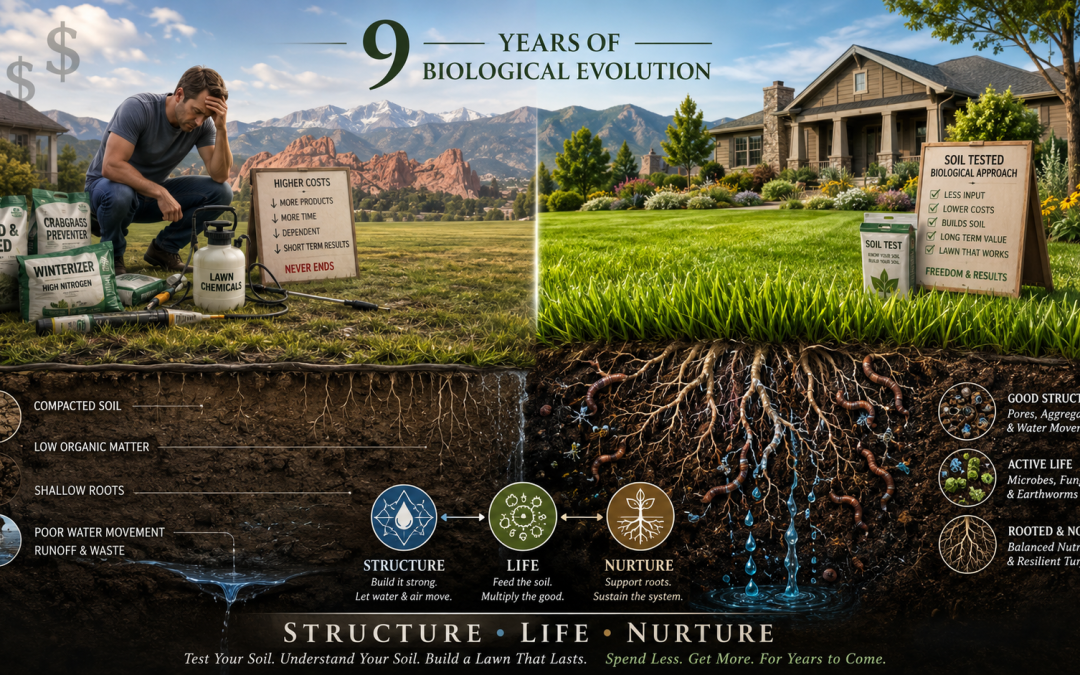
Structure. Life. Nurture.
We Used to Look at the Grass. Now We Look Underneath It.
One of the biggest lessons we’ve learned is that most lawn problems don’t actually begin with the grass.
The grass is simply where the problem becomes visible.
The real story is happening underneath it.
Soil compaction.
Poor gas exchange.
Weak microbial activity.
Low organic matter.
Mineral imbalances.
Poor water movement.
Nutrients that may exist in the soil but aren’t functioning properly.
These conditions are invisible from the surface.
And that is one reason homeowners can spend thousands of dollars trying to fix a lawn without ever addressing what is actually wrong.
They fertilize.
They spray weeds.
They add more water.
They aerate.
They buy another treatment.
They replace grass.
Then they repeat the process again the following year.
That is the lawn-care rat race.
And the biggest problem isn’t necessarily that homeowners aren’t spending enough money.
In many cases, they’re spending too much money because they don’t have enough information.
You Can’t Manage What You Can’t See
This is where soil testing changed everything for us.
A quality soil test allows us to begin seeing what the lawn cannot tell us from the surface.
Instead of asking:
“What product should we put down?”
We can begin asking:
“Why isn’t this soil functioning properly?”
Those are two entirely different approaches.
Traditional synthetic lawn care tends to respond to symptoms.
Our biological approach is increasingly designed to identify and remove the conditions creating those symptoms.
That distinction matters.
Because if we can improve how the soil functions, we can often reduce the amount of intervention required to maintain the lawn.
Our Protocol: Structure, Life and Nurture
After nine years of working through this evolution, we have simplified our philosophy into three priorities.
1. Structure
Before worrying about fertilizer, we need the soil itself to function.
Roots require more than water.
They need oxygen.
The soil needs pore space.
Water needs somewhere to move.
Carbon dioxide produced by roots and microorganisms needs somewhere to escape.
If the soil is severely compacted or poorly structured, throwing more fertilizer at it doesn’t solve the fundamental problem.
So structure comes first.
2. Life
Healthy soil is alive.
Bacteria, fungi and other microorganisms participate in nutrient cycling, decomposition and the incredibly complex relationship between the plant and the soil.
If that biological engine is weak, the lawn becomes much more dependent upon outside inputs.
Our goal isn’t simply to feed grass.
It is to help rebuild the biological machinery that allows the soil and plant to work together.
3. Nurture
Once structure and biological function are improving, we can begin supporting the system intelligently.
This is where minerals, carbon, biological inputs, irrigation practices and other amendments become tools rather than guesses.
Instead of forcing the lawn to respond, we are trying to create the environment that allows it to perform.
That is a very different philosophy from simply feeding grass every few weeks.
A Better Lawn Should Work Better, Not Just Look Better
This may be the most important distinction of all.
A great lawn shouldn’t merely be greener.
It should become more functional.
It should use water more efficiently.
It should develop stronger roots.
It should tolerate stress better.
It should recover more effectively.
It should require fewer rescue treatments.
It should become less dependent upon constant intervention.
That is ultimately what biological lawn care should accomplish.
Appearance matters.
But performance matters more because improved performance is what can eventually reduce the cost of owning the lawn.
Stop Renting Your Lawn
For decades, the traditional lawn-care model has trained homeowners to continually purchase inputs just to keep the system functioning.
Fertilizer.
Weed control.
Insecticides.
Fungicides.
Extra irrigation.
Corrective treatments.
Then another round the following year.
You can spend a tremendous amount of money maintaining the appearance of health without ever building much underlying resilience.
That’s why I often describe the alternative this way:
Quit renting your lawn and start owning it.
Invest in understanding the soil.
Correct the underlying limitations.
Build function.
Build resilience.
Then allow the lawn to begin doing more of the work itself.
There may be an upfront investment in testing and correction, but the objective is not to create another endless treatment cycle.
The objective is to gradually reduce unnecessary dependency.
Nine Years Changed Our Thinking
Our program today is not the biological program we started with in 2017.
And I’m glad it isn’t.
We’ve learned.
We’ve tested.
We’ve made mistakes.
We’ve questioned assumptions.
We’ve watched lawns respond.
We’ve seen treatments succeed and treatments fail.
And every year has helped reveal another part of the system.
The greatest evolution has happened during the past few years as our understanding of soil structure, biology, mineral relationships, carbon and plant function has finally begun coming together.
We aren’t claiming that we’ve discovered every answer.
Soil is far too complicated for anyone to make that claim.
But we understand this system today at a dramatically different level than we did nine years ago.
And that is exactly why I believe there has never been a better time to enter our biological program.
Before You Spend More Money on Your Lawn, Get Better Information
If your lawn continually requires more water, more fertilizer, more chemicals and more rescue treatments just to remain acceptable, don’t automatically assume it needs another product.
Find out what is happening underneath it.
Because some of the most important information about your lawn is completely invisible until you test the soil.
Once you can see the problem, you can begin making intelligent decisions.
And once you begin correcting the system instead of repeatedly treating the symptoms, lawn care can start becoming simpler instead of more complicated.
Structure. Life. Nurture.
That is where our program has arrived after nine years.
And we’re just getting started.
Ready to Find Out What Your Lawn Is Actually Telling You?
Before spending another season guessing, let us take a deeper look at what’s happening beneath the grass.
Start with a conversation about our biological program and soil-testing options.
Call: 719-380-0136
Request information or schedule here:
https://my.serviceautopilot.com/viewform.html?rk=f46718fb-afd7-45de-ba84-1d66e8212dc2&Type=new&Source=web
We don’t guess with soil. We test it.
I deliberately made this an evolution/authority story rather than an anti-chemical rant. It positions 2017–2026 as nine years of learning and makes soil testing the doorway into escaping the expense cycle—which should speak especially well to the more engaged, higher-value homeowner you’re targeting.