
Last Updated on August 23, 2026 by Brian Beck
If you’re exhausted with your lawn right now, you’re probably not alone.
You spent more money watering it.
You watched your water bill climb.
You tried to keep everything alive through weeks of heat.
And after all that effort, you may still be looking at brown spots, thinning turf, weeds, and areas of the lawn that simply didn’t perform the way you expected.
It is very easy to blame the heat.
But I want to challenge that assumption.
The Heat May Not Be the Culprit
The heat is certainly part of the story.
Kentucky bluegrass is a cool-season grass. Once temperatures begin climbing through the mid-80s and beyond, the plant starts operating outside of the conditions where it performs most efficiently.
That creates stress.
Water demand increases.
Root function becomes more difficult.
Photosynthesis becomes less efficient.
The movement of water, nutrients, and gases through the soil-and-plant system becomes increasingly important.
But here’s the distinction:
Heat doesn’t necessarily create all of the problems you see. It reveals them.
Think of the heat as a stress test.
A lawn may look perfectly acceptable in May when temperatures are mild, water demand is low, and the plant doesn’t have to work very hard.
Then July arrives.
Now the lawn is being asked to operate under tremendous pressure.
And suddenly the imperfections begin showing themselves.
The brown spots.
The weak areas.
The places that need twice as much water.
The areas where weeds take over.
The sections that thin out every summer.
Those aren’t simply ugly spots.
They’re information.
The Brown Grass Is the Symptom
This is one of the most important concepts homeowners need to understand.
You can see brown grass.
You cannot see what is happening six inches underneath it.
The discoloration is the manifestation of something happening within the system.
It may involve water.
But it may also involve:
- Poor soil structure
- Compaction
- Inadequate pore space
- Limited oxygen movement
- Weak microbial populations
- Low humus or organic matter
- Poor rooting
- Mineral deficiencies
- Mineral excesses
- Chemical antagonisms
- pH-related availability problems
- Nutrients that are present but unavailable to the plant
This is why looking at a brown spot and automatically saying, “It needs more water,” can be misleading.
Sometimes it does.
Sometimes that’s only part of the problem.
And sometimes adding more water to poorly functioning soil can actually create another problem.
What If Your Lawn Needs Air?
Most homeowners think about water constantly.
Very few think about air.
But roots and soil microorganisms require oxygen too.
Healthy soil has structure.
That structure creates pore space.
Some of that pore space holds water.
Some of it holds air.
When soil becomes compacted, structurally weak, biologically inactive, or overloaded with water, the exchange of gases can become restricted.
Now imagine asking bluegrass to operate during a 90-degree afternoon under those conditions.
It needs tremendous amounts of water.
It needs functioning roots.
It needs nutrients.
It needs oxygen.
It needs biology working around those roots.
It needs the entire system communicating and moving resources effectively.
If any of those pathways are restricted, the plant runs into resistance.
That’s what I’ve described before as The Headwind.
The Headwind Gets Stronger When It’s Hot
The Headwind is all of the resistance your lawn has to overcome just to function.
Compaction is a Headwind.
Poor structure is a Headwind.
Low biology is a Headwind.
Low humus is a Headwind.
Mineral imbalance is a Headwind.
Poor nutrient availability is a Headwind.
Restricted water movement is a Headwind.
Restricted airflow is a Headwind.
In mild weather, grass may be able to compensate for those problems.
Under severe heat, it can’t hide them anymore.
That’s why I don’t necessarily look at this summer and say:
“The heat ruined everybody’s lawns.”
I look at it and say:
“The heat showed us where the lawns were already vulnerable.”
That’s a completely different way of looking at the problem.
And it’s good news, because many of those vulnerabilities can be addressed.
Your Hot Spots Are a Map
Walk around your lawn and look at where it struggled.
Where did it brown first?
Where did you have to water the most?
Where did the grass thin?
Where did weeds take advantage?
Where does the same problem seem to show up year after year?
Those areas are telling us something.
The worst thing we can do is wait for cooler weather, watch everything green back up, and assume the problem disappeared.
It may simply have become invisible again.
The underlying dysfunction can still be there.
And the next time we get extended heat, drought, or another environmental stress event, the same area may fail all over again.
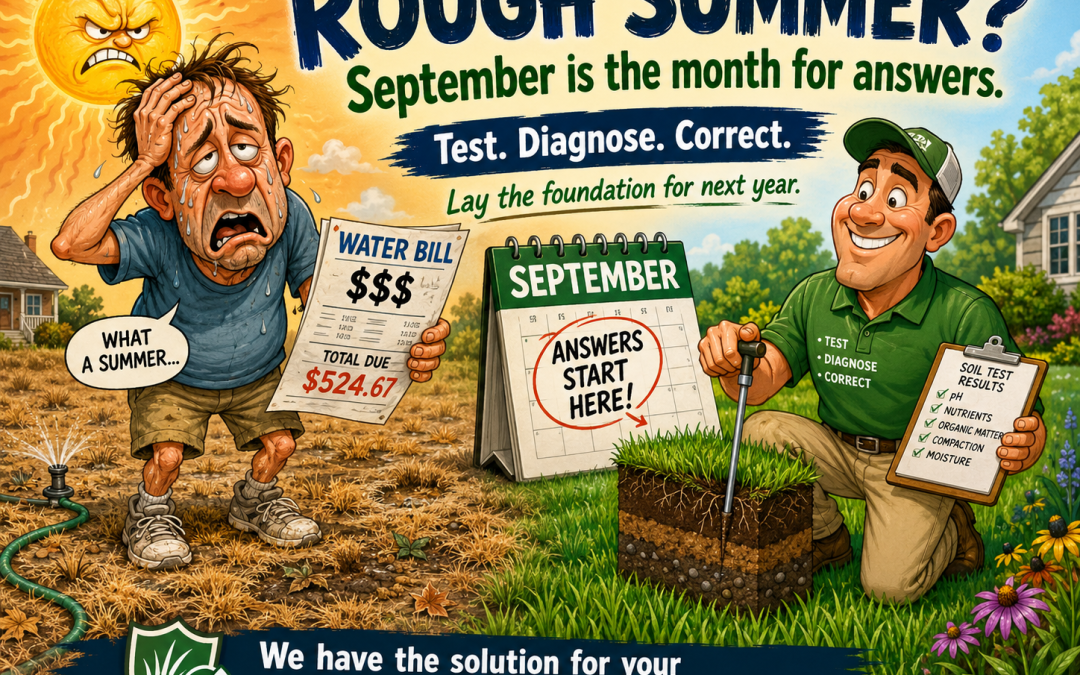
This Is Why We Test the Soil
We don’t want to guess at these problems.
We want information.
That means combining three things:
Empirical soil data.
Observation of the lawn.
Physical examination of the soil itself.
A soil test gives us information we simply cannot get by staring at the grass.
It helps us look at nutrient levels, mineral relationships, pH, organic matter and other chemical characteristics that can influence how effectively the soil functions.
Then we compare that information with what we’re seeing above ground.
Where did the lawn fail?
How deep are the roots?
What does the soil structure look like?
Is the soil tight?
Is water infiltrating?
Is there adequate pore space?
What happens when we physically get into the soil?
That’s how diagnosis should work.
We don’t guess. We collect evidence.
A Soil Test Can Save You From Buying the Wrong Solution
This is where soil testing can easily pay for itself.
Consider how much money homeowners routinely spend trying to fix lawns without knowing what is wrong.
More fertilizer.
More water.
More weed control.
More seed.
More aeration.
Another product.
Another application.
Another repair.
But if the problem isn’t what you think it is, you’re simply spending money compensating for dysfunction.
If the soil has poor structure, fertilizer doesn’t fix structure.
If roots are oxygen-starved, more irrigation may not solve it.
If nutrients are chemically unavailable, simply adding more nutrients may accomplish very little.
If biology is weak, continuing to feed only the plant may leave the underlying system unchanged.
Information allows us to direct money toward the actual constraint.
That’s the difference between maintenance by habit and management by evidence.
September Is the Opportunity
And this is why the coming month is so important.
September may be one of the most valuable months of the entire lawn-care year.
Temperatures begin moderating.
Bluegrass returns to conditions it prefers.
Root activity becomes critically important.
The plant begins preparing itself for winter and for the following spring.
This is the time to take what the summer showed us and do something with it.
Not next July.
Not when the lawn is already brown again.
Now.
If we enter winter with an already compromised lawn and then experience another dry winter, the consequences can become much more serious next season.
The lawn can begin spring already carrying the Headwind.
And people who are exhausted now could find themselves spending even more next year trying to recover from problems that could have been identified earlier.
The Goal Is Efficiency
This is the philosophy behind our biological method and our larger Trinity approach.
We are not simply trying to make grass green.
We are trying to improve how the system functions.
Better biology.
Better soil structure.
Better movement of air and water.
Better nutrient availability.
Better rooting.
Better irrigation efficiency.
And ultimately, fewer resources wasted fighting against obstacles that never should have been there in the first place.
Because a lawn that requires excessive water, excessive fertilizer, excessive intervention and excessive money isn’t really functioning efficiently.
It’s fighting a Headwind.
Don’t Blame the Thermometer. Learn From It.
The heat was real.
The stress was real.
But don’t stop the diagnosis there.
Heat may have pulled the trigger, but the soil determined where the damage showed up.
The brown grass is what you can see.
The real question is:
What happened underneath it that you can’t see?
That’s where the answers are.
And that’s why the first step isn’t another product.
It’s information.
Test the soil. Observe the lawn. Physically investigate the problem. Then correct what the data tells us is wrong.
That’s how we stop guessing.
That’s how we begin removing the Headwind.
And that’s how we build a lawn that is better prepared the next time Colorado turns up the heat.
Find Out What Your Lawn Is Fighting
If your lawn struggled this summer despite all of the water, fertilizer and effort you’ve put into it, don’t assume the answer is simply more water next year.
Start by finding out why it struggled.
Our soil-testing and diagnostic process helps identify the hidden constraints working beneath the surface so we can build a corrective strategy around what your lawn actually needs.
Test. Diagnose. Correct.