
Last Updated on August 18, 2026 by Brian Beck
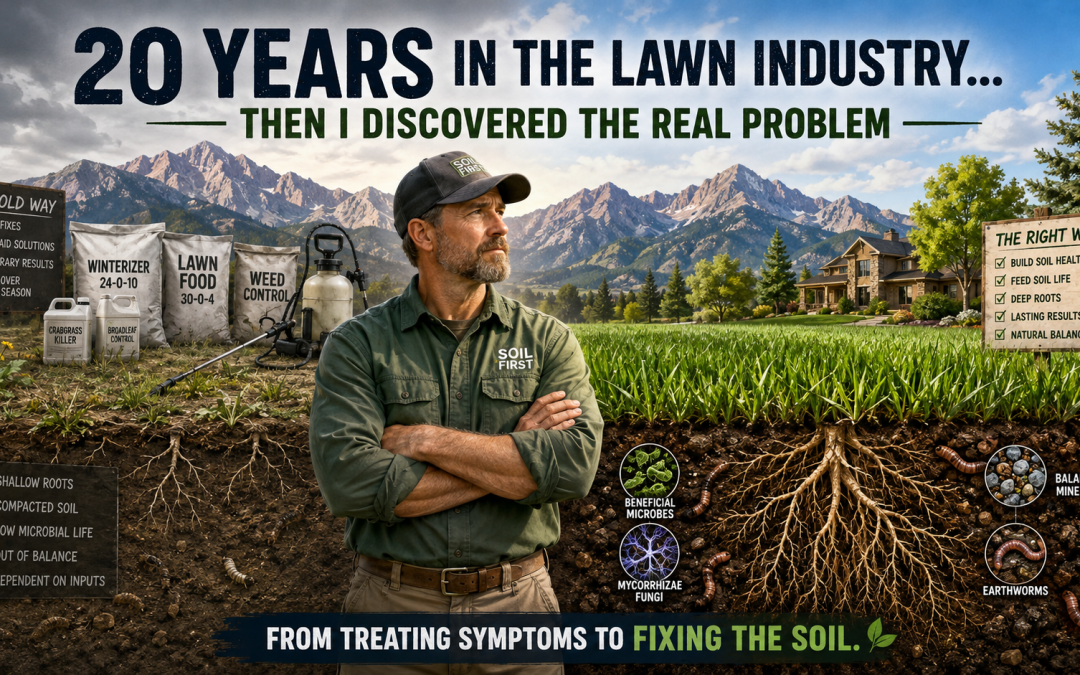
For more than 20 years, I worked in the lawn and landscape industry doing largely what the industry taught me to do.
Fertilize the lawn.
Control the weeds.
Kill the insects.
Aerate it.
Water it.
Mow it.
And when something went wrong, apply something else.
I didn’t think there was anything particularly unusual about that approach. It was simply how lawn care was done.
And to be fair, the system didn’t develop because people were stupid, dishonest, or intentionally trying to damage lawns.
It developed out of necessity.
The lawn care industry needed a system that could be taught, repeated, scheduled, scaled and sold. Products solved immediate problems. Fertilizer made grass greener. Herbicides killed weeds. Insecticides killed insects. Irrigation replaced missing rainfall.
For decades, that became the model.
The problem was that nobody spent much time asking a different question:
Why were all of those problems occurring in the first place?
I Started Getting Frustrated
Eventually, something began bothering me.
We could make lawns look better, but many of the same problems kept coming back.
Weeds returned.
Lawns became dependent on frequent irrigation.
Thatch accumulated.
Soils became harder.
Disease showed up.
Grass struggled during heat and drought.
And year after year, customers needed another round of products to correct many of the same symptoms.
After more than two decades in the industry, I had to confront an uncomfortable possibility:
What if we were becoming really good at treating symptoms without understanding the system producing them?
That question changed everything for me.
My frustration with the status quo eventually became greater than my loyalty to it.
So I started looking elsewhere.
The Alternative Changed What I Could See
When I began studying soil biology, mineral balance, carbon, microbial populations, water movement and the relationship between the plant and the soil, lawn care suddenly looked very different.
The grass wasn’t an isolated plant sitting on top of dirt waiting for us to feed it.
It was part of an ecosystem.
The soil wasn’t merely something that held the roots upright.
It was supposed to be alive.
Bacteria, fungi and other microorganisms were supposed to cycle nutrients, break down organic matter, help construct soil structure and participate in the exchange between the plant and the soil.
Minerals interacted with one another.
Carbon mattered.
Water infiltration mattered.
Root depth mattered.
Photosynthesis mattered.
Suddenly I began seeing something I hadn’t recognized during much of my career:
Many of the problems we were treating above ground were symptoms of dysfunction occurring below ground.
That changed the questions I asked.
Instead of:
“What product kills this weed?”
I began asking:
“What conditions are allowing this weed to dominate?”
Instead of:
“What fertilizer will make this lawn green?”
I began asking:
“Why isn’t this plant efficiently accessing and cycling the nutrients already available to it?”
Instead of:
“How often should we water?”
I began asking:
“Why can’t this soil accept, hold and effectively use water?”
Those are very different questions.
And different questions lead to very different solutions.
I Had Been Looking Through the Wrong Lens
One of the hardest things to admit after spending decades in an industry is that experience doesn’t automatically mean understanding.
In some cases, experience can actually reinforce a system because you become extremely proficient at doing what you’ve always done.
I wasn’t intentionally doing something wrong.
I simply hadn’t been given another lens through which to see the problem.
Once I had that lens, I couldn’t unsee it.
I began to realize that a lawn shouldn’t have to live permanently dependent upon repeated chemical intervention simply to function.
The goal shouldn’t be to endlessly rescue the plant.
The goal should be to remove the obstacles preventing the natural system from working.
That means rebuilding biological activity.
Correcting mineral imbalances.
Improving soil structure.
Building carbon.
Managing water differently.
Encouraging deeper roots.
And creating an environment where the plant and soil begin doing more of the work themselves.
That Became Our Mission
This discovery fundamentally changed the direction of my business.
We aren’t trying to create another lawn treatment program.
We are trying to create a different lawn management system.
A system that asks why before reaching for another product.
A system that uses testing and observation to identify dysfunction rather than guessing.
A system designed to reduce unnecessary inputs, reduce chemical exposure, improve water efficiency and ultimately create a lawn that becomes less dependent on us—not more.
That might sound strange coming from someone who makes a living caring for lawns.
But I believe that’s where this industry has to go.
The best lawn program shouldn’t be the one that sells the homeowner the most products.
It should be the one that removes the most problems.
More Than 20 Years Led Me Here
I don’t regret my years in the traditional lawn industry.
Quite the opposite.
I needed those years.
They allowed me to see the problems.
They allowed me to experience the limitations firsthand.
And eventually, they gave me enough frustration to start asking questions I probably should have asked much earlier.
Today, I look at lawns completely differently than I did when I started.
I don’t just see grass.
I see soil.
I see biology.
I see minerals.
I see carbon.
I see water.
I see roots.
I see an interconnected system.
And when that system begins working the way nature designed it to work, something remarkable happens:
We stop fighting the lawn and start helping it function.
That is the journey that brought me here.
And after more than 20 years doing things the traditional way, I believe the next chapter of lawn care isn’t about finding a better chemical.
It’s about finally understanding the system underneath our feet.
Want to Find Out What’s Really Happening Under Your Lawn?
If you’re tired of treating the same problems year after year, let’s stop guessing and start looking at the soil.
Front Range Biological & Lawn Automation
Learn how our biological soil program can help uncover the underlying problems affecting your lawn and create a path toward lower inputs, better water efficiency and a healthier landscape.