
Last Updated on February 13, 2026 by Brian Beck
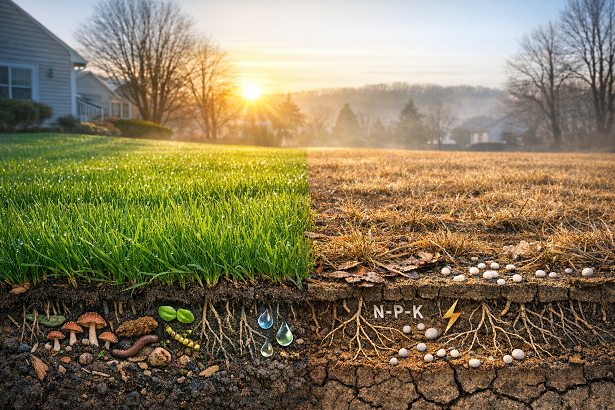
Every year, right about the time most lawns are still wearing that dull winter face, mine starts changing.
Not a little. Not “maybe it’s kind of waking up.”
I’m talking noticeably green—often a full month before the neighborhood catches up, and sometimes the gap is even bigger.
Now, let’s be clear: green-up is inevitable. The calendar will eventually force it.
But the manner in which it happens? That part is not inevitable at all.
Because my lawn doesn’t green up from a spring “kick in the teeth.”
It greens up from readiness.
And readiness is a completely different game.
Two Ways People “Do” Spring
Most people fall into one of two camps:
1) The Passive Crowd: “I’ll Deal With It Later”
They’re not doing anything wrong… they’re just not doing anything at all.
The lawn is on autopilot, problems get ignored, and then spring shows up and they’re immediately playing catch-up.
That’s when the panic starts:
-
“It’s thin…”
-
“It’s yellow…”
-
“It’s not growing like it should…”
-
“What do I throw at it?”
2) The Force Crowd: “Make It Green Now”
This is the other extreme: heavy inputs, big fertilizer pushes, quick fixes, mechanical aggression, and the classic “just add more” strategy.
It works—sort of—because inorganic salts can force plant response by rapidly changing electrical behavior in the soil solution. It’s the reason synthetic fertilizer feels like a shot of adrenaline.
But there’s a cost:
-
short-lived results
-
dependency
-
instability
-
more “problems” that aren’t problems at all… just symptoms of dysfunction
Both approaches—passive and forceful—are inefficient.
One wastes time.
The other wastes money, energy, water, and long-term soil performance.
My Lawn Greens Up Early… Without Stimulation
Here’s the part that makes people squint:
My lawn greens up early without a spring fertilizer blast.
No “wake-up” treatment. No steroid shot.
The only “stimulation” is this:
✅ Maintaining a consistent moisture range.
That’s it. That’s the lever.
And that should tell you something important:
When a lawn greens up early without being forced, it means the system underneath it is already functioning.
The Real Engine Isn’t Grass—It’s the Relationship
A healthy lawn isn’t “grass plus inputs.”
A healthy lawn is a relationship between the root and the soil.
And that relationship is built by life—microbial life.
Bacteria, fungi, protozoa, and the whole underground workforce are constantly doing something most people never account for:
They take resources from:
-
the soil
-
organic matter
-
the atmosphere
-
moisture and temperature swings
…and they convert those resources into biologically available forms the plant can use when it needs them.
This is what “living soil” means in real-world terms:
It produces usable currency.
It doesn’t just sit there waiting for you to inject it with something.
Synthetic Lawns Don’t Run on Relationships—They Run on Chemistry
When you build a lawn around synthetic structure, you aren’t feeding a system.
You’re driving a machine.
You’re relying on:
-
quick soluble reactions
-
spikes in electrical conductivity
-
fast uptake that looks like health
That’s why I call it narcotic. Or steroids.
It creates the illusion of strength, but it doesn’t create resilience.
And when that illusion fades, what happens?
People say:
-
“I’ve got fungus.”
-
“I’ve got thatch.”
-
“I’ve got weeds.”
-
“I’ve got compacted soil.”
-
“I’ve got dry spots.”
But those aren’t isolated issues.
They’re the receipt from a system that’s being forced instead of built.
Why Biology Greens Up Early
Early green-up isn’t magic. It’s physics + biology + readiness.
1) Porosity: Air and Heat Can Actually Enter the Soil
Living soils tend to be more porous because the soil isn’t glued shut by dysfunction.
More pore space means:
-
more oxygen movement
-
better gas exchange
-
heat moves differently
-
roots behave differently
-
microbial activity ramps up faster when temps shift
When the air starts warming, that soil can respond.
2) Humus: The Storage Tank Most Lawns Don’t Have
Humus is a byproduct of organic matter being processed by biology. It’s not “mulch.” It’s not “compost.”
It’s stabilized carbon—and it’s priceless.
Humus helps:
-
hold water without becoming soggy
-
buffer temperature swings
-
buffer nutrient swings
-
increase cation exchange and nutrient holding capacity
-
create a more stable environment for microbes (and roots)
So when spring tries to arrive early (and it often does), a humus-rich soil doesn’t freak out.
It responds smoothly.
3) Water Infiltration + Water Holding = Readiness
Most lawns lose spring because they don’t hold the right moisture long enough to stay active.
Either:
-
water runs off
-
water pools and suffocates
-
water evaporates too fast because the soil is open and empty
A biological soil holds water like a tuned sponge—not a brick, not a swamp.
So when warmth hits and the plant is ready to transpire and build chlorophyll, the resources are already there:
-
moisture
-
oxygen
-
microbial conversion
-
nutrient access
The lawn doesn’t need a whip.
It needs a green light.
The Economics of Early Green
Here’s the question I want people to ask themselves:
Why are you spending so much energy to force something that could happen naturally?
If your lawn requires:
-
constant stimulation
-
constant correction
-
constant rescue missions
…then you’re not maintaining a lawn.
You’re maintaining a dependency.
A biological lawn is different:
-
fewer inputs
-
fewer reactions
-
less water waste
-
less mechanical trauma
-
less guessing
And you still get the result—usually a better one.
Because you’re not buying green.
You’re building the system that produces it.
The Beginning-of-Year Transformation Isn’t Just Color
The early green is exciting, yes.
But what it represents is bigger than color.
It’s proof that:
-
the soil is breathing
-
the water is moving correctly
-
the roots are functioning
-
the biology is online
-
the lawn is ready before you “do anything”
And that’s the whole point.
You can either play the game of:
-
panic
-
stimulation
-
waste
-
symptom-chasing
…or you can build a lawn that behaves like it was designed to behave.
A lawn that greens up because it’s healthy—not because you shocked it into compliance.
If This Matters to You, Here’s the Move
If you want the “month early” green-up, don’t start with fertilizer.
Start with the system:
-
get serious about soil function
-
build porosity and stability
-
increase humus over time
-
keep moisture in the right range
-
let the biology do what it’s built to do
If you’re ready to stop guessing and start building efficiency, reach out. I’ll show you what your soil is doing, what it’s missing, and what’s blocking the relationship your lawn needs to thrive.
Because spring is coming either way.
The question is:
Are you going to force it… or be ready for it?
Engage with us: