
Last Updated on January 31, 2026 by Brian Beck
A chemical lawn program creates “waste” in two layers at once:
-
Upstream waste (what it took to make and deliver the products)
-
Downstream waste (what happens in the soil after you apply them — gases, losses, lockups, runoff)
Here’s how that shows up in real life.
1) The “embedded carbon” in synthetic fertilizer is huge
Most conventional lawn programs lean heavily on nitrogen. Manufacturing nitrogen fertilizer is energy-intensive (industrial ammonia production), so a lot of CO₂ is emitted before the bag ever hits the spreader.
One well-cited life-cycle analysis found that manufacturing and using nitrogen fertilizer can be associated with very large CO₂-equivalent emissions per ton of N (the exact number varies by region, energy source, and efficiency).
So even if a lawn looks “fine,” a conventional schedule can carry a big carbon bill just from production + transport + packaging + distribution.
2) Once applied, nitrogen can literally turn into gas and leave
This is the part most homeowners (and honestly a lot of companies) don’t connect:
If nitrogen isn’t captured by biology + roots, it doesn’t politely wait. It moves and transforms.
A) Volatilization (ammonia loss)
Surface-applied urea can convert to ammonia gas (NH₃) and blow off into the atmosphere — meaning you paid for nitrogen that never fed the plant. Extensions and peer-reviewed summaries commonly describe meaningful losses depending on temperature, moisture, residue, and pH.
That’s waste in the purest form: purchased fertility becoming air pollution.
B) Nitrous oxide (N₂O)
Even when nitrogen stays in the soil, microbes can convert it to nitrous oxide, especially when soils swing between wet/low-oxygen and oxygenated conditions (classic lawn scenario: irrigation + compaction + thatch + clay).
The U.S. Environmental Protection Agency states that nitrogen fertilizer application accounts for the majority of U.S. nitrous oxide emissions, and reducing or improving fertilizer application reduces emissions.
N₂O matters because it’s a very potent greenhouse gas — so small losses can equal big climate impact.
3) Chemical programs can reduce your lawn’s carbon “income”
A healthy lawn can be a carbon sink if the soil biology is building stable organic matter (humus) and aggregating soil.
But chemical-heavy programs often:
-
prioritize top growth over root depth
-
discourage the biological engine that creates aggregation and carbon storage
-
create dependency (more inputs needed to maintain the same appearance)
Modern turf literature and management reviews increasingly frame this as: turf can sequester carbon, but emissions from management inputs (especially fertilizer and fuel) can offset the gains and better practices can reduce inputs/emissions.
So the “waste” isn’t only what gets emitted — it’s also the lost opportunity to bank carbon.
4) Chemicals + irrigation + compaction can push soil anaerobic
When soils go oxygen-poor (compaction, excess moisture, heavy thatch, poor structure), biology shifts. That’s when you can get more “waste gases” pathways — and you also increase the odds of nitrogen converting to N₂O through denitrification pathways.
Research and synthesis on soil greenhouse gases consistently points to oxygen status / saturation as a major control point.
This is why I keep saying: oxygenated soil = efficient soil.
Anaerobic soil is where energy and nutrients leak out as gases.
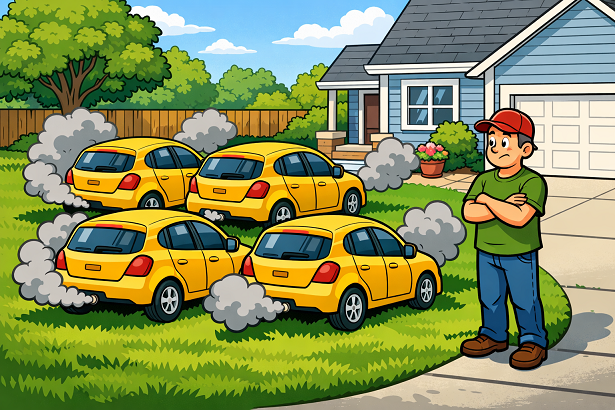
5) Why that “4 compact cars” comparison feels true
I’m not going to pretend I can verify that exact equivalency from the transcript alone — it’s likely a rule-of-thumb that bundles multiple contributors:
-
embedded emissions in fertilizer (production + shipping)
-
emissions after application (NH₃ volatilization, N₂O losses)
-
carbon “missed” by not building soil organic matter
-
plus often other program components (repeat visits, fuel, etc.)
So the comparison isn’t magic — it’s shorthand for:
“The conventional schedule is expensive for the atmosphere because you’re fighting soil physics and soil biology instead of fixing them.”
The clean explanation in one line
Chemical programs create waste because they push nutrients through the system faster than the soil can hold and cycle them — and whatever the soil can’t hold will leave (as gas, runoff, or lockup).
What I’d want you to do next
Post the rest of the transcript whenever you’re ready. I can pull the strongest lines from Moyer’s “one ton per lawn” claim and convert it into:
-
a tight blog section,
-
a simple diagram (“Where the waste goes”),
-
and a clean argument for soil-first programs (oxygen + carbon + biology) that sequester instead of emit.
If you want, I can also rewrite the “4 compact cars” line into something legally safer and still punchy (so you can use it publicly without getting dragged into a numbers debate).
Four Compact Cars in Your Yard
How lawn chemicals create invisible waste — and how soil-first care flips your lawn from emitter to sponge
Most people think the “waste” in lawn care is the obvious stuff: a noisy mower, a bag of clippings, a plastic fertilizer jug in the trash.
But the real waste is the stuff you can’t see.
I heard Robert Gaunt talk about this on the Soil Talks from Rocky Mountain BioAg, and the analogy lands like a punch:
A conventional, chemical lawn program can carry the climate impact of leaving four compact cars running on your yard for a year.
Is it exactly four for every lawn? No — it depends on the products, rates, weather, and how the lawn is managed. But the point is dead-on:
A “normal” chemical schedule can create a ton of hidden waste — upstream and underground — even if the lawn looks green.
And once you see where the waste comes from, you can’t unsee it.
The biggest myth in lawn care: “Green means healthy”
We’ve been trained to treat lawns like paint.
If it fades? Add more nitrogen.
If something shows up? Spray it.
If it gets stressed? Push growth harder.
That mindset creates two problems:
-
It makes lawns dependent on repeated chemical inputs.
-
It ignores the real system that decides everything: the soil.
Color is a lagging indicator. Soil function is the leading indicator.
How lawn chemicals create waste (3 major ways)
1) The carbon is baked into the bag before it ever touches your grass
Most conventional programs lean heavily on synthetic nitrogen.
The problem is that industrial nitrogen (ammonia-based fertilizer) is energy-intensive to manufacture, and it’s commonly tied to fossil energy. So a meaningful chunk of the emissions happen before the technician even arrives. Ammonia production itself is a major global emissions source in multiple analyses.
That means a “perfect” lawn can carry a carbon footprint simply because of what it takes to manufacture and deliver the products used to maintain that look.
2) After application, nitrogen can literally turn into gas and leave
Here’s the part most homeowners never get told:
If nitrogen isn’t captured by roots + biology, it doesn’t patiently sit there. It transforms.
Ammonia volatilization (NH₃): Surface applications of urea-containing fertilizers can result in significant nitrogen losses as ammonia gas, depending on conditions like moisture, pH, and wind.
And in turf specifically, research has long noted that urea applied to turf (especially into thatch) can drive volatilization risk.
Nitrous oxide (N₂O): This is the heavyweight. N₂O is produced by soil microbes during nitrogen cycling (including denitrification in low-oxygen conditions).
The U.S. Environmental Protection Agency notes that nitrogen fertilizer application accounts for the majority of U.S. nitrous oxide emissions, and that emissions can be reduced by applying nitrogen more efficiently.
And here’s why that matters: N₂O has a 100-year global warming potential of 273 compared to CO₂.
So even “small” nitrogen losses as N₂O are a big climate deal.
3) Chemical schedules can push soil toward anaerobic conditions — and that’s when “waste gases” show up
When soil loses structure (compaction, poor aggregation, thatch, overwatering), oxygen can’t move well.
That’s when the underground biology shifts.
-
In oxygen-starved conditions, methane production becomes possible (methanogenesis is an anaerobic process).
-
Under anaerobic pathways, sulfur-reducing microbes can produce hydrogen sulfide (that classic “rotten egg” smell).
So if you’ve ever smelled a sour, swampy odor after irrigation or a rain event — that’s not “normal lawn smell.” That’s your soil telling you it’s not breathing.
And that’s the core of the waste issue:
When soil can’t breathe, nutrients don’t cycle efficiently — they leak.
As gas, as runoff, as lockup, as disease pressure… as dependency.
So what’s the fix?
Rob’s framing was simple, and I agree with it:
We’re not treating grass. We’re treating soil.
When you build a lawn around a calendar of chemical hits, you’re treating symptoms.
When you build a lawn around soil function, you get a different outcome:
-
More oxygen in the root zone
-
More microbial cycling
-
Better water infiltration
-
Deeper roots
-
Fewer “panic” inputs
-
More carbon stored in stable organic matter over time
That’s what people mean when they say “carbon sequestration” in turf: not a slogan — a soil process.
And this is where Rob made a second big claim in the transcript you shared: their goal is to reduce a lawn’s carbon footprint meaningfully (he referenced up to a ton per lawn per year) by changing what’s applied, when it’s applied, and by breaking the dependency loop.
Whether a specific lawn hits that number will vary — but the direction is correct:
reduce unnecessary inputs, improve soil function, and you reduce emissions.
What soil-first lawn care looks like in real life
Here’s the part that matters to homeowners: what to do differently.
Stop buying “more green” at the expense of the system
A forced green lawn can be a shallow-rooted lawn. A resilient lawn is built from below.
Use nature cues — not just a date on the calendar
Soil temperature, moisture, and growth stage matter. Spraying or feeding “because it’s April” is how waste happens.
Keep the soil oxygenated
Oxygen comes from structure: aggregation, pore space, roots, biology. Compaction kills that.
Don’t over-apply nitrogen
If you’re applying nitrogen into a system that can’t hold/cycle it, you’re funding loss pathways. (Ammonia volatilization + N₂O are the big ones.)
Reduce dependency
Rob mentioned the industry shift: moving from “treat symptoms” to “build soil health” and reducing herbicides/pesticides dramatically when the soil system becomes resilient.
That’s the long game — and it’s the only game that actually improves over time.
The bottom line
Traditional chemical lawn care creates waste because it pushes nutrients through the system faster than the soil can manage — and whatever the soil can’t manage will leave.
-
It leaves as upstream emissions (manufacturing).
-
It leaves as gases (NH₃, N₂O — and sometimes methane in low-oxygen situations).
-
It leaves as dependency (more inputs required to keep the same look).
So if you want a lawn that’s actually “green” in the real sense — healthier for your family, tougher in weird weather, and lighter on the environment — stop shopping for turf color and start building soil function.
Healthy soil turns your lawn into a carbon bank — not a gas leak.
— Brian Beck