
Last Updated on January 30, 2026 by Brian Beck
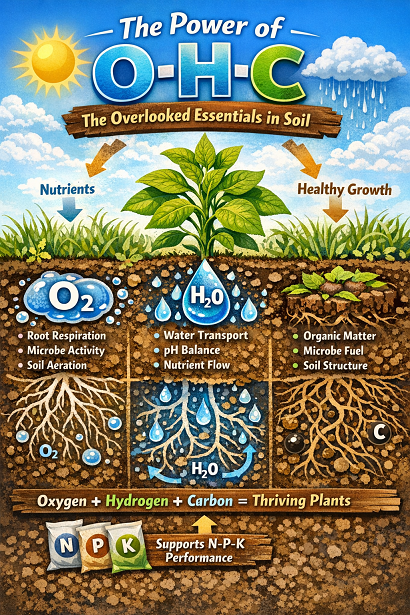
Why Oxygen, Hydrogen, and Carbon decide whether N-P-K even works
If you’ve spent any time around lawn care, farming, or gardening, you’ve heard the gospel of N-P-K: nitrogen, phosphorus, potassium. They’re the “big three” because they’re easy to measure, easy to sell, and easy to apply.
But here’s the uncomfortable truth:
Most plant failure isn’t because you didn’t add enough N-P-K.
It’s because the system that allows plants to use those nutrients is broken.
And that system is built on three elements almost nobody talks about as “soil nutrients”:
-
Oxygen (O) – the difference between living soil and suffocating soil
-
Hydrogen (H) – the engine inside water, pH, and nutrient movement
-
Carbon (C) – the fuel, the structure, and the long-term savings account
If you’re in a service program or DIY biology program, getting your head around O-H-C is like finding the map before you start building the puzzle.
Why N-P-K is “popular” (and why it’s incomplete)
N-P-K is important. No argument there. But N-P-K is a supply conversation.
Oxygen, hydrogen, and carbon are a system conversation.
You can have “enough” nitrogen on a soil test and still have a yellow lawn.
You can apply phosphorus and still have weak roots.
You can throw potassium at stress and still lose turf in summer.
Because nutrients don’t matter if:
-
roots can’t breathe,
-
water can’t move,
-
microbes can’t function,
-
and the soil can’t store and cycle what you apply.
That’s O-H-C.
Oxygen: The “nutrient” your roots are starving for
Plants don’t just need oxygen above ground. Roots need oxygen too.
Roots respire—just like you do. They take in oxygen and release CO₂. That process powers:
-
root growth
-
nutrient uptake
-
energy production inside the plant
What oxygen does in the soil
Oxygen is primarily delivered through soil pore space—the air pockets created by good structure and aggregation. When those pores collapse (compaction) or fill with water (poor drainage/overwatering), oxygen disappears.
When oxygen is low:
-
roots weaken and shallow out
-
beneficial aerobic microbes slow down
-
pathogens often gain an advantage
-
nutrient cycling stalls
-
nitrogen can be lost to the air via denitrification (especially in wet, compacted conditions)
The hidden cost of low oxygen
A lot of lawns are managed like the goal is “green at any cost.” So people keep feeding nitrogen to force color—while the soil stays compacted and oxygen-poor.
That can “work” short term, but it builds a fragile lawn that needs constant inputs.
Oxygen is the gatekeeper. If oxygen is wrong, the rest becomes expensive.
Practical oxygen wins:
-
Reduce compaction (traffic management, core aeration when appropriate, correcting structure)
-
Water for infiltration, not for surface wetness (deep, less frequent when possible)
-
Build aggregation (that’s carbon + biology working together)
Hydrogen: The element hiding inside water and pH
Hydrogen sounds abstract until you remember one thing:
Hydrogen is what makes water water (H₂O).
And water is not just “wet.” Water is:
-
the transport system for nutrients
-
the medium where chemistry happens
-
the link between biology and minerals
-
the lever that determines oxygen availability (too much water = no air)
Hydrogen’s role in soil chemistry (without the headache)
Hydrogen shows up as H⁺, and H⁺ is a major driver of:
-
pH
-
nutrient availability
-
microbial behavior
-
mineral reactions
When pH is off, nutrients don’t disappear—they often become chemically unavailable. That’s why people can “feed the lawn” and still see deficiency symptoms. The nutrients are present, but locked up or not moving properly.
Hydrogen’s role in nutrient movement
Nutrients don’t teleport into plants. They move through the soil solution by:
-
mass flow (carried with water as plants transpire)
-
diffusion (moving from high concentration to low)
-
root interception (roots growing into new zones)
If water is poorly managed—either droughty/hydrophobic or waterlogged—uptake becomes erratic. That’s not a fertilizer problem. That’s a hydrogen/water system problem.
Practical hydrogen wins (water wins):
-
Water deep enough to encourage deeper roots (not daily sips)
-
Improve infiltration so water goes in instead of off
-
Avoid salt-heavy inputs that wreck water behavior and microbial function
Carbon: The currency of biology and the foundation of soil structure
If you want a biological lawn (and a lower cost of ownership over time), carbon is the deal.
Carbon is not just “organic matter.” Carbon is:
-
microbe fuel
-
soil glue
-
nutrient buffering
-
water holding capacity
-
the pathway to humus
Carbon’s two big jobs
1) Carbon feeds the soil food web
Plants leak carbon-rich compounds (root exudates) to “hire” microbes to do work for them—like solubilizing nutrients and protecting roots.
When carbon is consistently supplied:
-
microbes multiply
-
nutrient cycling accelerates
-
aggregates form
-
roots explore more soil
-
stress tolerance improves
2) Carbon builds structure and storage
As biology processes carbon, you get stable organic compounds (including humus) that help the soil:
-
hold nutrients (think: reduced leaching, better efficiency)
-
hold water while still draining well
-
resist compaction
-
stay resilient through heat/cold/drought
This is why carbon is the long-term play:
it makes the soil better at being soil.
Practical carbon wins:
-
Return clippings (free carbon input)
-
Use compost/topdressing strategically (not endlessly, but intelligently)
-
Feed microbes (consistent, gentle carbon sources vs. harsh synthetics)
-
Reduce practices that burn biology down (excess salts, overuse of quick-hit nitrogen, broad-spectrum “kill everything” approaches)
How O-H-C makes N-P-K work (the synergy everybody misses)
Here’s the simplest way to picture it:
-
Oxygen allows roots + aerobic microbes to function (cycling, nitrification, disease suppression)
-
Hydrogen (water) carries nutrients and enables the chemistry that releases them
-
Carbon powers biology and builds structure so air and water behave correctly
Now N-P-K becomes efficient instead of wasteful.
In plain language:
If your soil can’t breathe (O),
and water can’t infiltrate or move correctly (H),
and biology is starved of fuel (C),
then N-P-K is like pouring premium gasoline into a car with a clogged fuel line and a dead battery.
Quick self-check: Signs you’re actually short on O-H-C
Oxygen problems look like:
-
spongy, waterlogged areas
-
shallow roots, weak recovery
-
moss, algae, or chronic disease pressure
-
runoff even when you “water enough”
Hydrogen/water problems look like:
-
water beads up and runs off (hydrophobic soil)
-
hard crusting after irrigation
-
inconsistent green-up (some areas pop, others lag)
-
symptoms that change fast with weather swings
Carbon problems look like:
-
compacted feel, poor crumb structure
-
poor response to inputs (needs “more and more” every year)
-
weed pressure that keeps returning (opportunity soil)
-
that “dead dirt” look—no life, no sponge, no resilience
The real takeaway: Stop chasing the bag—fix the system
N-P-K matters, but O-H-C decides the ceiling of your results.
If you’re in a service program, this is why the “spray-and-pray” model stays expensive and frustrating: it’s mostly chasing supply, not building function.
If you’re DIY, this is the shortcut to sanity:
build air, manage water, fuel carbon—then everything else becomes simpler and cheaper.
Action steps to start this week
-
Do an infiltration check
Put a tuna can in the soil, fill it with water, and watch how fast it disappears. That tells you a lot about oxygen and water dynamics. -
Water like you’re training roots
Less frequent, deeper (within your turf type and season), and always with the goal of infiltration—not surface wetness. -
Start a carbon habit
Return clippings, feed biology, and add carbon sources that build—not burn—your system. -
Measure, don’t guess
A good soil test + a biological lens beats random applications every time.
Call to action
If you want a lawn that gets healthier while the cost of ownership goes down, stop starting with N-P-K and start with the system: oxygen, hydrogen, and carbon.
If you want help:
-
Service clients: we can evaluate your soil constraints and build a correction + biology plan that makes your inputs work harder.
-
DIY folks: we’ll teach you how to read the soil like a system and make steady progress without chasing trends.
That’s the whole point of building authority in biology: we fix the causes, not just the symptoms.
personal_dna