
Last Updated on January 27, 2026 by Brian Beck
Recently, I saw a lawn care ad floating around social media that stopped me in my tracks.
The message was simple and seductive:
“If you want a golf course lawn, give us a call.”
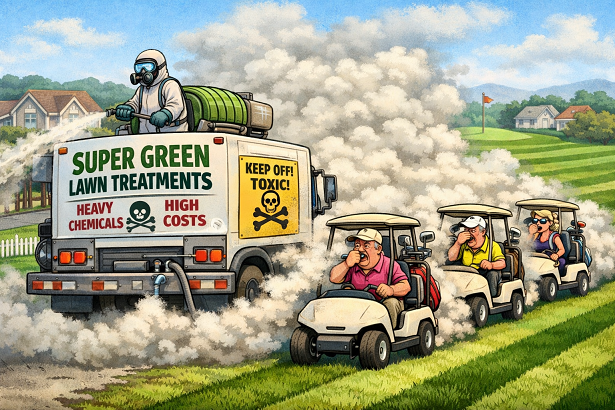
The visuals were slick — golf carts, perfect stripes, professional vibes, and the implied promise that your home lawn could (and should) look like a fairway.
Here’s the problem:
Most homeowners do not want a golf course lawn — and if they did, they wouldn’t want to pay for what it actually costs.
The Golf Course Myth
Golf courses are not models of efficiency.
They are models of intensive input.
Golf turf is:
-
Highly synthetic
-
Chemically dependent
-
Constantly force-fed
-
Maintained under extreme stress
-
Propped up by aggressive fertility, fungicides, growth regulators, and labor
That system exists for one reason: playability under abuse, not long-term soil health.
Trying to replicate that model on a residential lawn is like buying a race car to commute in rush-hour traffic. It’s the wrong tool, built for the wrong environment, at a massive ongoing cost.
Why Golf Courses Cost So Much
Golf courses don’t “look good naturally.”
They look good because they never stop intervening.
-
Daily mowing
-
Constant chemical corrections
-
Tight nutrient windows
-
Heavy fungicide reliance
-
Soil that is managed, not healed
That level of control costs real money — and when homeowners are promised “golf course results” without golf-course budgets, something has to give.
What gives is usually:
-
Soil health
-
Root depth
-
Water efficiency
-
Long-term sustainability
The Trap Homeowners Fall Into
Most homeowners aren’t actually asking for a golf course.
What they want is:
-
A healthy lawn
-
Fewer weeds
-
Predictable performance
-
Lower long-term costs
-
Less toxicity around their home
But the industry keeps selling them a visual fantasy, not a functional system.
And when things don’t work?
-
More chemicals
-
More applications
-
More “fixes”
-
More money
The lawn never stabilizes — it just becomes dependent.
Biology vs. Chemistry
A biological lawn program flips the entire model.
Instead of:
-
Forcing growth
-
Masking symptoms
-
Reacting to problems
Biology focuses on:
-
Soil structure
-
Carbon and humus
-
Microbial nutrient cycling
-
Deep roots
-
Efficient water use
This is how you reduce inputs over time, not increase them.
A biologically active lawn:
-
Holds nutrients longer
-
Requires less fertilizer
-
Needs less water
-
Resists disease naturally
-
Doesn’t rely on constant chemical rescue
The Real Savings Nobody Talks About
The biggest savings don’t come from mowing or skipping one product.
They come from:
-
Reduced water use
-
Fewer corrective treatments
-
Less weed pressure
-
Eliminating “panic applications”
-
Stopping the cycle of chemical dependency
Golf-course systems lock you into spending.
Biological systems unlock efficiency.
The Honest Truth
If someone truly wants a golf course lawn — chemically, visually, and operationally — they should be prepared to pay golf course prices.
But most people don’t want that.
They want a lawn that:
-
Works with nature, not against it
-
Gets better every year
-
Costs less to maintain over time
-
Is safer for kids, pets, and the environment
And that doesn’t come from chasing a fantasy sold in a 30-second ad.
It comes from fixing the soil, correcting habits, and letting biology do what it’s always done best — work quietly, efficiently, and long-term.