
Last Updated on January 27, 2026 by Brian Beck
If you’ve only ever known the “weekly mow,” robotic mowing can feel like a magic trick. You look out at the yard and it just… stays clean. No clumps. No scalping. No “jungle week” when life gets busy. And the lawn starts looking more like a carpet over time, not less.
That’s not hype—it’s the result of a completely different mowing model.
Let’s break down how robotic mowers actually cut grass, why the lawn often looks better, and what you should expect in real life.
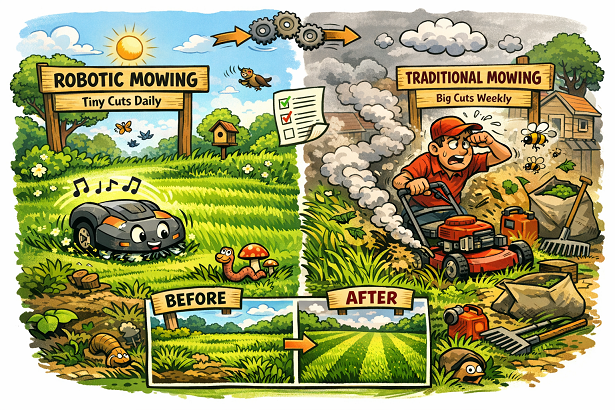
The Big Difference: Weekly Haircut vs Daily Maintenance
Traditional mowing is like getting a haircut once a week and asking for it to look perfect every day.
Robotic mowing is like grooming—small, frequent maintenance that prevents the lawn from ever getting “behind.”
Traditional mow (1x/week):
-
Cuts a lot of growth at once
-
Leaves visible clippings (or forces bagging)
-
Increases stress on the plant
-
Creates ruts and scalping risk
-
Your lawn looks best for 24–48 hours… then fades
Robotic mow (often daily or near-daily):
-
Cuts a tiny amount each session
-
Clippings are microscopic and disappear
-
Less stress on the grass
-
More consistent height = more uniform look
-
Lawn stays “fresh cut” all the time
How the Cut Works (It’s Not a Mini Lawn Tractor)
Most robotic mowers don’t use a big spinning blade like a traditional mower. Instead, they typically use a small rotating disc with razor blades (think: tiny, replaceable blades).
That matters because:
-
The mower takes tiny bites instead of hacking off big chunks
-
Clippings are fine and fall into the canopy/soil instead of piling up
-
You don’t see “windrows” of clippings across the lawn
“But is it powerful enough?”
Power isn’t the point. Frequency is.
Robotic mowers win by mowing often, not by mowing hard.
Patterns: “Random” vs “Systematic” (And Why Both Can Look Great)
People worry when they hear a robot “mows randomly.” They picture chaos.
In reality, there are two common approaches:
1) Random / semi-random coverage
The mower changes direction when it hits a boundary or obstacle. Over many short sessions, it covers the whole area.
Why it works:
-
Frequent mowing smooths out any “missed” spots quickly
-
The lawn doesn’t have time to surge upward between cuts
-
It naturally avoids creating ruts/track marks
2) Systematic striping / planned paths
Some models use mapping and planned routes.
Why it works:
-
Efficient coverage
-
Can look very “intentional”
-
Great for complex lawns when dialing in zones
Bottom line: If the mower is properly set up and scheduled, both styles can produce a lawn that looks consistently manicured.
Why the Lawn Often Looks Better
1) Micro-mulching feeds the system
Robotic mowers “mulch” by default—constantly. But because the clippings are so small, they disappear fast and cycle nutrients back into the lawn.
That usually means:
-
Less visible debris
-
More consistent color
-
Less need to “chase” the lawn with inputs
2) The grass gets denser
When you cut a little, often, the grass tends to tiller (create more shoots). More shoots = thicker turf.
Thicker turf = fewer open gaps for weeds and stress.
3) Less scalping, fewer stress events
Weekly mowing creates big stress swings—especially if someone cuts too low to “buy time” before the next mow.
Robots live in the sweet spot:
-
Less height shock
-
Less heat stress
-
Less drought stress
-
Less “oops, it got away from me” mowing
4) Your lawn looks good all the time
This is the underrated part. People don’t realize how much the “weekly mow” is a compromise until they see a lawn that stays clean every day.
What You Should Expect in the First 2–3 Weeks
Robotic mowing isn’t instant perfection on Day 1. Here’s what’s normal at the start:
-
Edges may need dialing in (how close it trims to borders)
-
A few missed tufts can show up early on (schedule solves this)
-
You’ll tweak the mow frequency based on growth
-
You’ll stop thinking in “mow days” and start thinking in “always maintained”
Once the schedule is matched to your lawn’s growth rate, it becomes boring—in the best way.
The “Secret Sauce” Is Schedule + Height
Robotic mowing is simple, but it’s not lazy.
Two levers matter most:
1) Cutting height
Too low = stress and thin turf
Too high = can look puffy and less refined (depending on grass type)
We typically aim for the height that matches:
-
grass type
-
sun/shade
-
irrigation habits
-
heat season vs cool season
-
how “tight” you want the finish to look
2) Frequency
This is where the robot wins.
When growth surges (spring), the mower runs more.
When growth slows (mid-summer heat), it runs less.
You’re not forcing the lawn into a weekly timetable. You’re matching nature.
What Robotic Mowing Does Not Do
Let’s keep it honest.
A robot mower is not:
-
A leaf vacuum
-
A stick pickup crew
-
An edge trimmer (you may still do occasional touch-up edging)
-
A miracle for severely uneven soil without some prep
But for the right lawn, it replaces the most annoying part of ownership: the recurring mow obligation.
Why This Matters for Health (And Why I Love Pairing It With Biology)
Robotic mowing is one of the cleanest “inputs” you can give a lawn:
-
no gas
-
no fumes
-
no weekly disruption
-
consistent clipping return
-
fewer stress cycles
And when you pair that with a biological soil approach, you’re stacking the odds in your favor: better structure, better cycling, better resilience.
Robotic mowing isn’t just a convenience upgrade—it’s a system upgrade.
Quick FAQ
Will it mow in the rain?
Some do; some pause automatically. Even if it skips, frequent schedules make recovery easy.
Will it get stuck?
A well-qualified lawn and a good setup eliminate most “stuck events.” Most problems come from holes, steep transitions, and clutter.
Is it safe around kids and pets?
Modern robots have multiple safety systems, but common sense still applies. Like any equipment, you use it responsibly.
Will it look like I never mow?
No—it tends to look like you just mowed… almost every day.
Want to Know If Your Lawn Qualifies?
If you’re curious, the fastest path is a quick qualification: slope, layout, obstacles, and expectations. If it’s a fit, robotic mowing can remove a major headache while improving the finish of your lawn long-term.
If you’re in our area, reach out to Blade to Blade / Front Range Autmow and we’ll help you figure out the right approach—without the pressure.