
Last Updated on January 23, 2026 by Brian Beck
If you’ve been living in the synthetic system, you already know the deal: quick hits, constant inputs, and a lawn that looks “fine” until it doesn’t. Then you’re chasing problems—dry spots, disease, weeds, compaction, thatch—while paying more every season for less stability.
A biological lawn is the opposite. It’s not a paint job. It’s an operating system.
And here’s the truth that most people don’t want to hear (but need to): the visible turf change is usually the last thing that happens. The first wins show up in the soil—water infiltration, root function, nutrient movement, and resilience. If you follow an arbitrary timetable instead of a process, you’ll sabotage the transition.
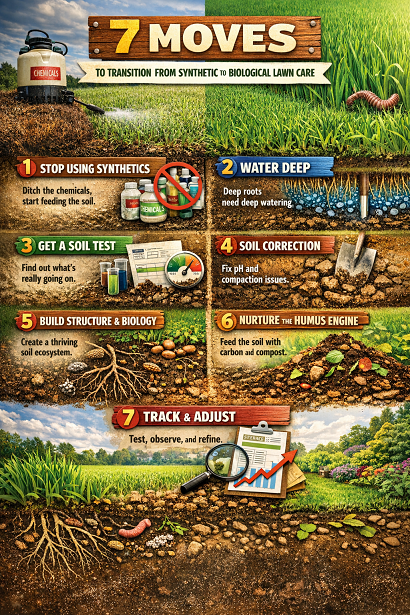
These are the 7 things I’ve identified that consistently help homeowners get out of dysfunction and move from a synthetic dependency to a biological system that actually lasts.
1) Stop Using Synthetics (Yes, Stop)
You cannot “biology” your way out of a system you’re still chemically feeding.
The synthetic model is built on:
-
Salts and spikes (fast green, fast crash)
-
Microbial disruption (especially with repeated broad-spectrum applications)
-
Artificial dependency (the lawn can’t regulate itself anymore)
If you’re serious about transitioning, you stop the inputs that keep the soil stuck in survival mode.
What to do instead (during the transition):
-
Replace “quick-release” thinking with slow, stable nutrition
-
Use biological inputs that support microbes rather than override them
-
Accept that you may lose some “spray-day shine” for a short window while the soil resets
What to expect:
A lawn coming off synthetics often looks confused for a bit—because it was being carried. That’s not failure. That’s withdrawal.
2) Water Deep (Stop Spraying the Surface)
Most lawns aren’t “dry.” They’re hydrating incorrectly.
Shallow watering trains shallow roots. Shallow roots create:
-
Heat stress
-
Disease pressure
-
Thin turf
-
Weed invasion
-
Massive water bills with weak results
Deep watering is how you build a root system that can actually access the soil’s resources.
A simple deep-water framework:
-
Water long enough to reach 4–6 inches deep (use a screwdriver test or soil probe)
-
Use cycle/soak if you get runoff (short cycles with breaks)
-
Reduce frequency as roots deepen (you’re training the plant)
The goal: fewer water events, deeper hydration, better oxygen balance, stronger roots.
If you do only one thing besides quitting synthetics, do this. You can’t build biology in a soil that’s constantly swinging between swamp and dust.
3) Get a Soil Test (The Right One)
Most soil tests people buy are basically fortune cookies:
-
“Add nitrogen.”
-
“Add phosphorus.”
-
“Add potassium.”
That’s not a strategy. That’s guessing.
A useful soil test should help you see the real constraints, like:
-
pH and nutrient lockout
-
Calcium to magnesium balance (huge in clay soils)
-
Base saturation / CEC
-
Organic matter / carbon buffering
-
Micros that quietly limit performance
-
Trends over time (the whole point)
If you don’t test correctly, you’ll spend money confidently… in the wrong direction.
Non-negotiable: your soil test should be good enough that you can run it again later and actually compare meaningful progress.
4) Soil Correction (Fix What’s Physically Blocking Performance)
This is where most people get it wrong: they think the lawn is the problem.
Usually the lawn is just reporting what the soil is doing.
In Colorado-style conditions (alkaline tendencies, clay, compaction, irrigation mistakes), the most common constraints I see are:
-
Low carbon/humus buffer (no “battery”)
-
Poor calcium-to-magnesium ratio (tight, sticky, sealed-off soil)
-
High pH lockout (nutrients present but unavailable)
-
Compaction + poor aggregation (water can’t move right)
Correction is not “throw stuff down.” Correction is addressing the limiting factor.
A common example (when the test supports it):
-
Split gypsum applications (2–3 passes, spaced ~3–4 weeks apart) to help push structure and infiltration forward without shocking the system
This is also where targeted minerals and micros come in—because biology thrives when the physical and chemical environment stops fighting it.
5) Build Structure and Biology (Stop Treating Soil Like Dirt)
Soil isn’t a plant stand. It’s a living system.
When structure improves, everything improves:
-
Water infiltration increases
-
Roots explore deeper
-
Nutrients cycle instead of leach
-
Disease pressure drops
-
The lawn becomes more “forgiving”
How structure actually gets built:
-
Microbes + carbon + time
-
Aggregation (soil crumbs) replaces dust and plates
-
Roots and fungi create channels and stability
Practical moves that help:
-
Mulch clippings (free carbon)
-
Reduce disruption (don’t over-rake/over-tear the soil)
-
Use biological amendments that support aggregation
-
Think “habitat building,” not “surface cosmetics”
6) Nurture the System (We’re in a Carbon-Based Economy — Fire Up the Humus Engine)
If you want biology, you must feed biology.
Here’s the line I want you to remember:
You’re not just feeding grass. You’re feeding the workforce that feeds the grass.
Humus is the engine room. It’s the reserve battery. It’s stability.
When humus and biology rise, you get:
-
Better water holding without soggy soil
-
Better nutrient buffering (less swing, less stress)
-
Better root function
-
Better color and density without constant forcing
Two types of “food” matter:
-
Short-term food (quick energy for microbes)
-
Long-term food (builds actual carbon reserves)
This is where a good program separates itself from random product stacking. You’re building a system that can run—quietly, reliably—without panic inputs every two weeks.
7) Track Results (Soil Test, Observe, Adjust)
This is the final move that keeps you from drifting back into dysfunction.
Most people track turf color. That’s like judging a company by its logo.
Track what actually changes first:
-
Infiltration and runoff
-
Root depth
-
Soil moisture behavior (how long it holds, how evenly it dries)
-
Thatch reduction over time
-
Weed pressure trends
-
Soil tests over time (that’s your scoreboard)
Then adjust:
-
If structure is improving but color lags: don’t panic—stay the course
-
If water is still running off: correction and hydration are still the bottleneck
-
If pH and base balance aren’t moving: revise the correction plan
Biology isn’t “set it and forget it.” It’s set it, measure it, and steer it.
The Simple Reality
If you do these seven things in order, you stop gambling.
You stop paying for “green moments” and start building a lawn that is:
-
More drought-tolerant
-
Less disease-prone
-
More efficient with water and nutrients
-
More stable year over year
If you want synthetic-speed results, you’ll keep synthetic problems.
If you want biological resilience, you follow the process—because the process is the timetable.