
Last Updated on January 17, 2026 by Brian Beck
There’s a moment every homeowner hits—usually right after they spend real money and real hope—where they look at their lawn and think:
“Okay… why doesn’t it look perfect yet?”
I get it. You want results. You deserve results. And yes—biology can move fast. Sometimes shockingly fast.
But it does not move like synthetics.
Synthetics are the “instant gratification” business model. They can paint the lawn green quickly by pushing inorganic salts and forcing a response—like yelling at the grass until it performs. It looks like success… until you notice the side effects: thinning roots, rising water demand, compaction, pH problems, disease cycles, thatch, and a lawn that becomes more expensive every year to keep “normal.”
Biology is a different promise.
Biology is not about forcing the plant. It’s about rebuilding the system that makes success inevitable.
And that takes a different kind of patience—the kind that actually pays you back.
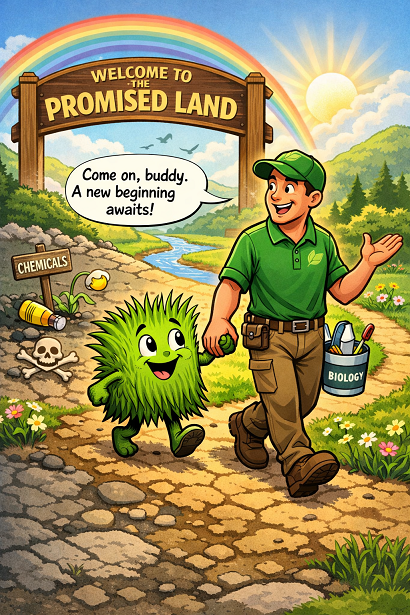
The Two Paths: “Force It” vs. “Guide It”
The synthetic path
Synthetics are like putting your lawn on a constant IV drip. The grass gets hit with fast-available inputs, spikes growth and color, and you feel like you’re winning.
But that “winning” often comes with a hidden bill:
-
microbial life gets suppressed
-
soil structure collapses over time
-
water stops soaking in like it should
-
roots stay shallow because the plant doesn’t need to explore
-
the lawn becomes dependent (and needy)
You don’t build an asset with dependency. You build a subscription you can’t cancel.
The biological path
Biology is like rebuilding the kitchen, stocking the pantry, and teaching someone to cook—so meals keep showing up without emergency takeout.
It’s slower at first because we’re not just chasing symptoms.
We’re rebuilding what’s missing.
And once the system turns on, the lawn starts doing something that feels almost unfair:
It holds color better, drinks less, resists weeds and disease more naturally, and becomes easier to maintain.
That’s not hype. That’s what happens when the soil is no longer fighting you.
“Restocking the Shelves”: Why Your Lawn Might Be Stuck
If you’ve read the “restocking the shelves” idea, you already understand the biggest problem in modern turf:
Most lawns aren’t failing because the homeowner is lazy.
They’re failing because the soil is empty.
The shelves are bare.
And when the shelves are bare, you can’t shop in all the aisles.
That means:
-
nutrients are missing or locked out
-
biology doesn’t have a home
-
water doesn’t infiltrate and store properly
-
the plant can’t access what it needs, even when it’s “in the soil”
So what do we do?
We restock.
Not with “miracle” products. With the fundamentals that nature always asks for.
What We’re Really Doing in a Biological Program
A real biological lawn program is basically three big moves—done in the right order, with consistency:
1) Rebuild what’s missing (carbon + structure)
Your soil needs carbon the way your body needs oxygen. It’s not optional.
We’re rebuilding:
-
organic matter / humus potential
-
aggregation (crumb structure)
-
pore space for air and water
-
a soil environment that can hold moisture without suffocating roots
This is where lawns start to “feel” different under your feet. Less crusty. Less concrete. More sponge.
2) Balance pH and mineral relationships (so the plant can “shop” again)
pH isn’t just a number—it’s access.
Think of pH like a grocery store. When pH is out of range, entire aisles get roped off.
You can have nutrients present… and still have a hungry lawn.
A biological program doesn’t ignore chemistry. It works with it.
We correct what’s blocking uptake so the lawn stops living in survival mode.
3) Reintroduce friendly microbial life (and actually support it)
Microbes aren’t decorations. They’re the workforce.
But here’s the part most people miss:
You can’t just “add microbes” and call it biology.
You have to give them:
-
a place to live (habitat)
-
food to eat (carbon sources)
-
oxygen and moisture conditions that don’t kill them off
In other words, you don’t just “apply biology.”
You manage an ecosystem.
And once that ecosystem stabilizes, the lawn stops needing to be propped up constantly.
Why Biology Doesn’t Always Look Dramatic on Day 7
This is the part that trips people up:
Visible change in turf is often the last thing to show up.
Not because nothing is happening—because the real work starts underground.
Early wins in a biological system are often things like:
-
water soaking in better
-
less runoff
-
soil staying moist longer between cycles
-
roots starting to thicken and explore
-
disease pressure easing
-
weeds becoming less aggressive over time
If you only judge success by “how green is it this week,” you’ll miss the entire transformation.
That would be like judging physical fitness by your mood after one workout.
The system needs reps.
Soil Is Forgiving (If You Listen)
Here’s the encouraging truth:
Soil is always forgiving.
It doesn’t hold grudges. It holds signals.
If you listen to what it’s asking for—and respond consistently—soil will come back.
Even if it has been:
-
compacted for years
-
salted with synthetics
-
overwatered, underwatered, or watered wrong
-
starved of carbon
-
stripped of biology
Soil wants to work. It’s designed to work.
But it can’t do it if we keep forcing the plant while ignoring the foundation.
That’s why my approach is never about “making your lawn behave.”
It’s about removing the obstacles that prevent it from thriving.
The Real Goal: A Lawn That Costs Less Over Time
This is the business model shift that matters:
Synthetics often create a lawn that becomes more expensive over time.
Biology is designed to create a lawn that becomes less expensive over time.
Less:
-
water
-
band-aid treatments
-
emergency rescue applications
-
frustration
-
endless “what now?” moments
A biologically supported lawn becomes an asset.
Not a monthly rental payment to your inputs.
What I Tell Every New Customer (And What You Should Tell Yourself)
If you’re looking for an answer, you’re not crazy—and you’re not alone.
The path forward is simple, but it isn’t always instant:
-
Test and observe (we don’t guess)
-
Restock what’s missing (carbon + structure + biology)
-
Correct the blockers (pH/mineral relationships)
-
Feed the workforce (microbes need food)
-
Stay consistent long enough to let the system turn on
And through all of it, remember this:
We do not force a lawn into success.
We guide it there.
If you want the fast “pop,” there are ways to fake that.
But if you want a lawn that stays green longer, handles stress better, needs less water, and stops falling apart every season—then biology is the honest path.
And honest systems are the ones that last.
Get in touch with us: