
Last Updated on January 15, 2026 by Brian Beck
If you own a lawn on the Front Range, you already know the truth: water isn’t just “something you do” anymore—it’s an ever-growing operating expense. And the frustrating part is this: most people are trying to solve a soil problem with a sprinkler solution.
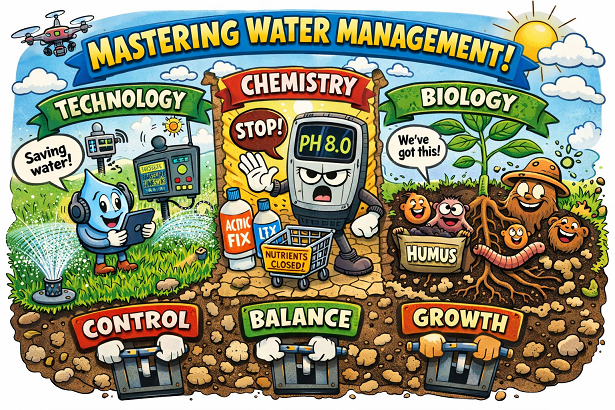
You can absolutely get smarter about water. In fact, there are three mechanisms you can use to control this cost:
-
Technology (measure and manage water application)
-
Chemical (remove soil conditions that repel or waste water)
-
Biological (build a living “plumbing system” that delivers and stores water)
Here’s the punchline: If your soil is chemically and biologically dysfunctional, technology becomes a very expensive band-aid.
1) Technology: You Can’t Manage What You Don’t Measure
Modern irrigation tech is incredible. It lets you scrutinize and control water use in ways that were impossible 10–15 years ago:
-
Smart controllers that adjust to weather/ET
-
Soil moisture sensors
-
Flow sensors that detect leaks or broken heads
-
Pressure regulation to stop misting and overspray
-
Matched precipitation nozzles so zones apply evenly
Technology helps you stop wasting water. It fixes the distribution and timing side of the equation.
But here’s its limit:
Technology can’t make bad soil absorb water.
You can have the most efficient system in the world and still lose the war if the soil is:
-
sealed, crusted, or compacted
-
chemically dispersed (won’t aggregate)
-
biologically dead (no structure-building life)
-
running at a pH that locks up key functions
That’s when you get the classic Front Range scenario: your sprinkler is “working,” but the lawn still looks thirsty. It’s like pouring water onto a parking lot and wondering why the tree isn’t happy.
2) Chemical: When Soil Is “Opposed” to Water
This is the part nobody wants to hear because it’s not sexy. It’s not a new controller. It’s not a fancy nozzle.
It’s chemistry.
pH is the gatekeeper.
I like to explain pH like this:
pH is your lawn’s ability to shop in all the aisles of the grocery store.
When pH is in a functional range, the plant can “buy” what it needs—nutrients, enzymes, proper root function, resilience.
As pH climbs (and we live in alkaline territory), those aisles start closing. In Colorado, high pH is infamous for tying up nutrients like iron, even when the soil technically contains plenty of it—resulting in weak performance and chlorosis symptoms in many plants. CSU notes major issues in Colorado once soils are above about 7.3, especially related to iron availability.
And once the plant’s nutrient machinery is compromised, water efficiency collapses because:
-
roots don’t develop properly
-
stress signals increase
-
stomata regulation becomes dysfunctional
-
the plant can be surrounded by moisture and still behave like it’s in drought
There’s also a bigger “alkaline stress” reality: research reviews on alkaline stress describe how high pH conditions can inhibit water–nutrient absorption and contribute to osmotic-type stress dynamics.
So no—pH doesn’t magically “block” water like a force field.
But high pH breaks the plant’s ability to use water efficiently, which is how you end up paying more and getting less.
Chemistry also controls infiltration.
Soils don’t just need water applied—they need water accepted.
When structure collapses (often from imbalance and low carbon), water runs off, puddles, or goes down cracks and bypasses roots. This is where correcting the chemical side of structure matters—especially calcium-driven aggregation and reducing conditions that lead to sealing and poor pore space.
Technology can’t fix that. Chemistry can.
3) Biological: The Soil’s “Plumbing System” (Fungi, Humus, and the Water Battery)
Now for the part that actually changes the game long-term.
Microbes—especially fungi—don’t just “help” plants. They build the infrastructure that makes water management cheaper and easier.
Fungal hyphae act like microscopic pipelines.
Fungal hyphae extend far beyond the root zone, increasing functional surface area and helping plants access water and nutrients, while also improving aggregation and water movement through soil structure.
You can think of fungi as the underground contractors:
-
they build channels
-
they stabilize soil crumbs (aggregates)
-
they connect the plant to a larger resource network
Humus is the water battery.
Here’s what most people miss:
Humus isn’t “dirt improvement.” Humus is stored potential.
It’s reserve energy, buffering capacity, and—critically—water-holding capacity.
And the relationship is not small.
A University of Minnesota Extension analysis notes that for every 1% increase in soil organic matter (by weight), the maximum potential increase in available water-holding capacity is roughly 1.5 to 1.7 times the amount of SOM (by weight) (with the real-world outcome depending on soil type and context).
That’s why biology is the long lever:
-
better structure
-
more storage
-
less runoff and evaporation loss
-
deeper rooting
-
fewer irrigation events to maintain color and density
In plain English: humus helps your soil behave like a sponge instead of a brick.
The Reality: You Need All Three (But in the Right Order)
If you’re trying to control water costs with technology alone, you’re trying to run a business with only a calculator and no bank account.
Here’s the correct model:
-
Technology stops obvious waste and improves precision
-
Chemistry removes the invisible locks (pH, structure, availability, infiltration)
-
Biology builds the system that stores and delivers water with less effort
Or said another way:
Technology is the thermostat. Chemistry is the wiring. Biology is the insulation.
A smart thermostat won’t save you money if your windows are missing.
What This Looks Like in the Real World (Simple Action Plan)
If you want water costs to go down instead of up, do this:
-
Audit irrigation (coverage, pressure, flow, zone timing, sensors)
-
Soil test first (don’t guess—know your pH, calcium/magnesium dynamics, salts, and organic matter)
-
Correct the chemical barriers that prevent water acceptance and root function
-
Feed biology so fungi, aggregates, and humus start building your water battery
And yes—this is exactly why blanket advice fails. Your neighbor’s “8 minutes a zone” is not a strategy. It’s a superstition.
Closing Thought: Don’t Pay Retail for Water Because Your Soil Is Broken
Water is too expensive to keep pouring into a system that can’t hold it, can’t use it, or can’t transfer it efficiently.
If you want to actually control the cost, stop thinking like a sprinkler operator and start thinking like a systems designer:
Technology. Chemistry. Biology.
That’s how you stop renting your lawn and start owning it.
(And if your lawn is currently drinking like a college freshman on spring break… it’s probably not a water problem. It’s a soil problem.)
Engage with us and we will reach out, click the link here: