
Last Updated on October 15, 2025 by Brian Beck
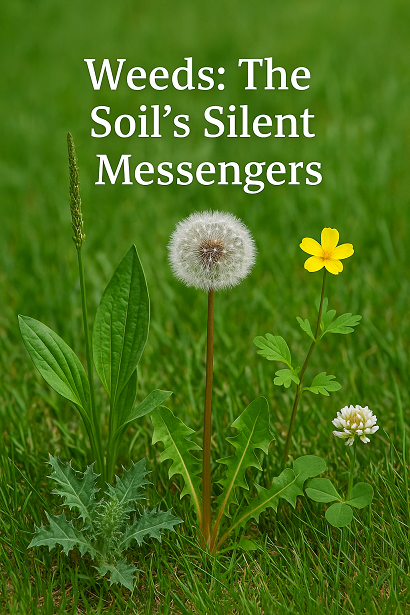
When most people see weeds, they see a nuisance. But in reality, weeds are nature’s way of sending a message — a biological signal about what’s going wrong beneath the surface. Every weed species has its preferred conditions: compacted soils, high or low pH, poor structure, or nutrient imbalances. They don’t grow by accident — they grow because the environment allows them to thrive.
In other words, weeds are indicators, not enemies. They’re the symptoms of a system out of balance.
The Root Cause: Synthetic Dependence
Most lawns that struggle with weeds are victims of years of synthetic fertilizer and chemical use. These products force-feed nutrients into the grass without addressing the soil’s biological health or structure. Over time, this disrupts the natural balance of microbes, depletes humus, and hardens the soil.
When biology is suppressed, weeds take over the job of healing — or, more accurately, surviving — in damaged soil. They’re opportunists filling the void left by missing life.
Healthy, balanced soil doesn’t need chemical weed control because the environment naturally favors grass, not invaders.
Five Common Weeds and What They Tell You
1. Dandelion (Taraxacum officinale)
Indicates: Compacted, low-calcium soils with poor structure.
Why it grows: Dandelions have deep taproots that mine calcium and nutrients from deeper layers. They’re trying to rebuild what compaction and synthetic fertilizers destroyed — structure and mineral balance.
2. Clover (Trifolium repens)
Indicates: Low nitrogen availability and a disrupted microbial nitrogen cycle.
Why it grows: Clover is a nitrogen fixer. When synthetics destroy the microbes that convert atmospheric nitrogen naturally, clover steps in to restore the process.
3. Plantain (Plantago major)
Indicates: Compacted, wet, or poorly drained soils with low oxygen.
Why it grows: Plantain thrives where air exchange is poor — a sign that the biological structure is gone and the soil can’t breathe.
4. Crabgrass (Digitaria spp.)
Indicates: Low calcium, low humus, and high magnesium or potassium soils — often from over-fertilization.
Why it grows: Crabgrass prefers hot, hard, bare soil. It’s not a water-loving plant — it’s a survivor of dysfunctional soil systems.
5. Chickweed (Stellaria media)
Indicates: High nitrogen, low calcium, and high surface moisture.
Why it grows: This soft, fast-growing plant thrives where balance is lost and surface fertility is artificially inflated by synthetics.
The Biological Solution
Instead of attacking weeds, we must listen to what they’re telling us. A proper soil test, followed by a biological correction program, rebuilds balance from the ground up.
By restoring microbial diversity, humus content, and mineral balance, the lawn ecosystem shifts in favor of turfgrass. Once the soil becomes balanced and alive again, weeds simply lose their niche — and nature moves back into harmony.
At Blade to Blade, we don’t fight weeds — we translate their message.
They’re nature’s early warning system, and once you understand their language, you can build a lawn that’s not only beautiful but biologically self-sustaining.