
Last Updated on October 3, 2025 by Brian Beck
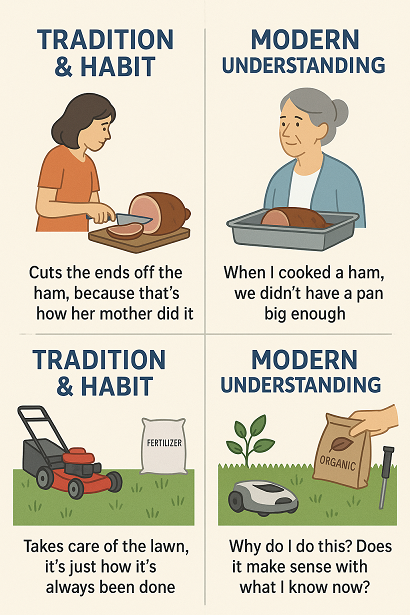
There’s an old story about a woman who always cut the ends off her ham before putting it in the oven. When asked why, she replied, “Because that’s how my mother did it.” Curious, she asked her mother. The mother shrugged and said, “That’s how my mother did it.” Finally, they asked the grandmother, who laughed and said, “Well, when I cooked hams, we didn’t have a pan big enough—so I had to cut the ends off.”
For two generations, the reason behind the ritual was lost. What began as a practical necessity turned into an unquestioned tradition. The ham was trimmed, not for flavor, not for presentation, but simply because that’s how it had always been done.
The Trap of Tradition in Lawn Care
This story hits home when we think about how people treat their lawns. Many follow routines passed down by their parents or neighbors without ever asking why. “Fertilize four times a year.” “Always water three times a week.” “Bag the clippings.” “Spray for weeds every spring.”
But do these traditions actually make sense? Or are they just habits—cutting the ends off the ham, so to speak—rooted in outdated tools, old information, or simple convenience?
Much of conventional lawn care was developed in a different era, when water was cheap, synthetic fertilizers were king, and nobody questioned the long-term effects on soil health. Just because something has “always been done that way” doesn’t mean it’s the best way—or even a good way.
“If It Ain’t Broke, Don’t Fix It”
One of the most dangerous phrases in history is: “If it ain’t broke, don’t fix it.”
That mindset assumes things are fine just because the surface looks acceptable. Your lawn might be green, but is it healthy? Is it efficient? Or are you pouring water, chemicals, and money into keeping up appearances while the soil underneath becomes weaker year after year?
Lawn care habits often mask deeper issues instead of addressing them. Synthetic fertilizer, for example, might make your grass grow fast and look lush for a season, but it doesn’t solve compaction, low humus, or poor microbial life in the soil. Watering three times a week might keep grass alive, but it can also waste hundreds of dollars on water that the soil can’t hold.
Asking Better Questions
Tradition and habit should never be the default. Instead, ask yourself:
-
Why am I doing this?
-
Does this practice make sense for my soil and climate?
-
Is there a better way with modern knowledge and tools?
When we start questioning tradition, we open the door to smarter, more sustainable solutions. Biological lawn care, automated mowing, and soil-based fertility programs are examples of approaches that break the cycle of “how it’s always been done.”
Final Thought
The grandmother didn’t cut the ham to improve it—she did it because she had no choice. Times changed, but the habit stayed. Don’t let your lawn suffer the same fate. Question tradition. Challenge conventional wisdom. And remember: the best lawn isn’t the one that looks good today out of habit—it’s the one that thrives tomorrow because you chose to do things differently.