
Last Updated on September 28, 2025 by Brian Beck
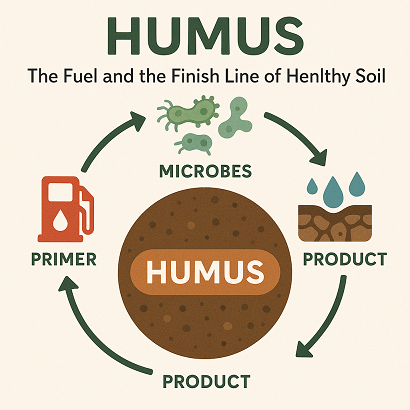
When we talk about soil health, we are really talking about one thing: humus. This dark, stable form of carbon is both the primer and the product of the microbial activity in soil. Without it, the “engine of biology” sputters and stalls. With it, the soil transforms into a living, breathing ecosystem capable of sustaining healthy, resilient turf.
Why Humus Matters
Humus is more than just decomposed organic matter—it represents the energy currency of the soil. It is stable carbon, meaning it resists rapid breakdown and persists for decades. This stability is what gives humus its unmatched ability to:
-
Hold water: Humus can carry its own weight in water several times over, acting like a sponge. In dry regions, this is the difference between survival and collapse.
-
Buffer nutrients: Excess minerals like sodium, magnesium, or potassium often cause nutrient antagonism—blocking other essential nutrients from entering the plant. Humus neutralizes these excesses and restores balance.
-
Fuel microbes: Microbes need energy just like plants and animals. Humus provides the long-term carbon source that allows microbial life to thrive and multiply.
A balanced soil needs around 40 pounds of humus per acre to properly function. Unfortunately, most soils in our area fall drastically short of that benchmark.
The Deficiency in Our Soils
After reviewing hundreds of soil tests across the region, one truth is impossible to ignore: our soils are humus-starved. This deficiency explains why water runs off instead of soaking in, why nutrients get locked up, and why synthetic fertilizers fail to deliver long-term results. Without humus, the microbial workforce has no fuel. Without microbes, the soil has no ability to manufacture more humus. It is a vicious cycle.
Kickstarting the Biological Engine
This is why humus must be applied—even though it isn’t cheap. Think of it as priming a pump: until you give the microbes the carbon they need, they cannot do the work of restoring soil balance. Once that biological engine is started, however, the process becomes self-sustaining:
-
Apply humus to give microbes the fuel they need.
-
Microbes multiply and begin processing organic material in the soil.
-
New humus is created as byproduct of microbial activity.
-
Soil structure improves: water retention, aeration, and nutrient cycling all increase.
Over time, the need for supplemental humus decreases because the biology of the soil has learned to generate its own.
The Long Game of Soil Health
Humus is not a quick-fix input; it is the foundation of a living system. By investing in humus, we are not just correcting a deficiency—we are building a resilient soil engine that powers itself year after year. Healthy soils are not built overnight, but when you recognize humus as both the starting point and the finish line, the path forward becomes clear.
Humus is the spark. Microbes are the engine. Together, they create the living soil every lawn deserves.