
Last Updated on September 15, 2025 by Brian Beck
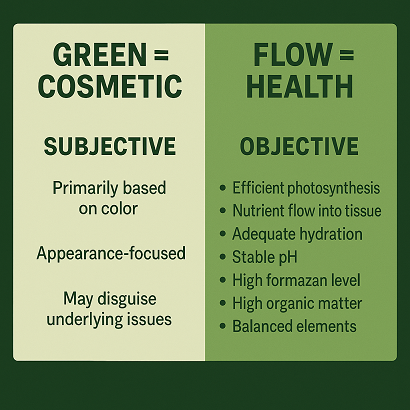
For decades, the picture of a “perfect” lawn has been painted with one brushstroke: green. To many homeowners, if their lawn is emerald from fence line to sidewalk, it must be healthy. But here’s the truth: color alone is one of the most deceptive and misleading indicators of turf health.
A lawn can be a deep green and still be on life support. Just like a person can look tan and fit but suffer from underlying heart disease, a lawn can be “cosmetically” healthy while running on chemicals, poor soil, and dysfunctional biology.
Lawn Health Is Not Subjective
Color is subjective—it satisfies the eye and the emotions. But true lawn health is objective. It can be defined, measured, and improved. The ultimate goal of any plant, grass included, is simple: how efficiently it can photosynthesize and create glucose.
Glucose is the plant’s energy currency. When a lawn photosynthesizes efficiently, it builds a strong internal engine—one that powers growth, disease resistance, recovery, and beauty. And whether or not this engine is firing on all cylinders comes down to one thing: nutrient flow efficiency—how well the plant can pull resources from the soil into its tissues.
The Measurable Markers of True Lawn Health
A genuinely healthy lawn has nothing to do with cosmetic tricks and everything to do with measurable soil and plant conditions:
-
Adequate hydration – consistent, deep watering that builds resilience rather than dependency.
-
Stable pH – a buffered soil environment where nutrients are available and not locked out.
-
High formazan levels – a direct measure of microbial strength and biological activity in the soil.
-
High organic matter and humus – the “black gold” that fuels microbial life, retains water, and drives soil fertility.
-
Balanced calcium and sulfur – two key regulators that govern nutrient exchange and soil structure.
-
Balanced macro and micro elements – ensuring no excesses that cause antagonism and no deficiencies that create weakness.
When these conditions are in place, a lawn doesn’t just grow—it flows. The nutrient pipeline runs smooth and strong, producing a turf system that performs like a blown Hemi engine, roaring with efficiency and power.
What This Biological Engine Delivers
When nutrient flow is optimized and the soil engine is humming, the lawn gains bulletproof resilience:
-
Maximum organic material digestion – less thatch, more usable nutrients.
-
Biological nitrogen fixation – pulling nitrogen naturally from the atmosphere instead of expensive synthetic bags.
-
Natural soil aeration – microbes and humus keep the soil porous and alive.
-
Maximized water-holding capacity – less waste, deeper roots, and resistance to drought.
This is the biological engine of lawn health. It’s not a quick chemical reaction, but a stable, self-sustaining system that produces beauty, durability, and efficiency all at once.
What We Seek
At the end of the day, the pursuit isn’t about chasing “green.” It’s about building a system that works as nature intended: balanced, strong, and resilient. A lawn running on its full biological engine is not just beautiful—it’s bulletproof. That’s what we seek, and that’s what defines true lawn health.