
Last Updated on August 14, 2025 by Brian Beck
Let’s get this out of the way first—your neighbor’s lawn has absolutely nothing to do with your lawn. Comparing the two is like comparing a microwave dinner to a gourmet meal. Sure, they might both be green, but how they got there (and what they cost to maintain) are entirely different stories. And spoiler alert: one of them is running on a synthetic system that’s quietly draining their wallet while yours could be running on something far more efficient.
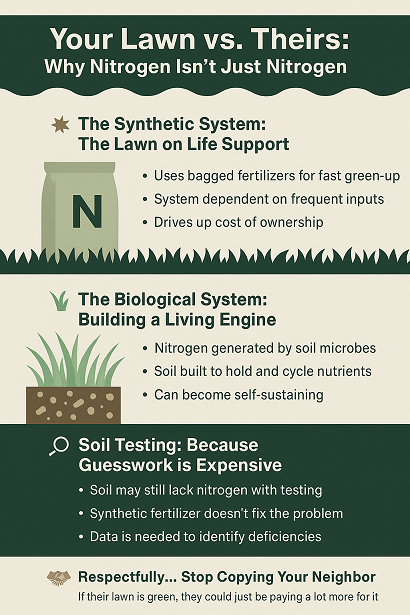
💥 The Synthetic System: The Lawn on Life Support
Most conventional lawns—like your neighbor’s—are managed using synthetic nitrogen products. These are bagged fertilizers that provide an instant jolt of nitrogen, giving the grass a quick green-up. It’s flashy. It’s fast. And it’s exactly what people have been told to do for decades.
But here’s the catch: this is a rental system. You’re borrowing green from a chemical reaction. The nitrogen doesn’t stick around, and the soil does nothing to help—it just becomes dependent. Worse, with little microbial life in the soil to support nutrient cycling, the cost of ownership skyrockets. More fertilizer, more often. More water, more problems. And good luck growing anything without a Ph.D. in juggling inputs.
🌱 The Biological System: Building a Living Engine
In a biological system, we’re not just spoon-feeding nitrogen—we’re building an engine capable of generating it. This engine? It’s made up of billions of microbes, living in healthy, carbon-rich soil. These microbes do something incredible: they take nitrogen from the air (which is about 78% nitrogen, by the way) and make it available to your grass, for free.
Yes, free nitrogen—once you know how to unlock it.
But like any engine, it only runs well if it’s properly built and maintained. If your soil is compacted, dead, or missing key biological players, that engine can stall out. That’s why we sometimes do apply nitrogen—but not as a crutch. It’s more like adding oil to a new engine during its break-in period. We’re helping the soil build capacity, not bypassing it.
🔍 Soil Testing: Because Guesswork is Expensive
Here’s the kicker: your lawn could be severely nitrogen deficient and still be green if you just dumped enough synthetic fertilizer on it. But you’ll never know what’s really happening without a soil test. Maybe your nitrogen is low. Maybe it’s there, but the biology isn’t active enough to cycle it. Maybe the pH is off, or calcium and sulfur are locking nutrients up like Fort Knox. A bag of 32-0-4 isn’t going to solve that. Only data will.
Without testing, you’re not growing a lawn—you’re gambling.
🤝 Respectfully… Stop Copying Your Neighbor
We say this kindly, but with just enough sarcasm to wake up the neighborhood: stop judging your lawn based on what’s happening across the street. If your neighbor’s lawn is green, great—but they might be burning $1,000 a year to keep it that way while your biologically managed lawn is setting up a self-sustaining nitrogen economy under the surface.
One is a sugar rush. The other is a balanced diet. Which one do you want to feed your lawn?
🧠 Final Thought: Nature Already Knows What to Do
Grass has been growing on this planet for millions of years without synthetic nitrogen. What changed? Our impatience. Our addiction to convenience. And yes, our belief that a bag of chemicals is somehow better than the most powerful system ever created—life itself.
So next time someone says “just throw down some fertilizer,” smile politely and keep building your engine. In a few seasons, they’ll be asking what you’re doing… and you can tell them, “I taught my soil to breathe.”