
Last Updated on August 2, 2025 by Brian Beck
Ever wonder why most people cut their lawn once a week? If you think it’s because that’s what grass needs, think again. The weekly mow is not a horticultural breakthrough—it’s a cultural habit born out of the post-World War II American suburb. And unfortunately, it’s hurting your lawn more than helping it.
The Legacy of the Weekly Mow
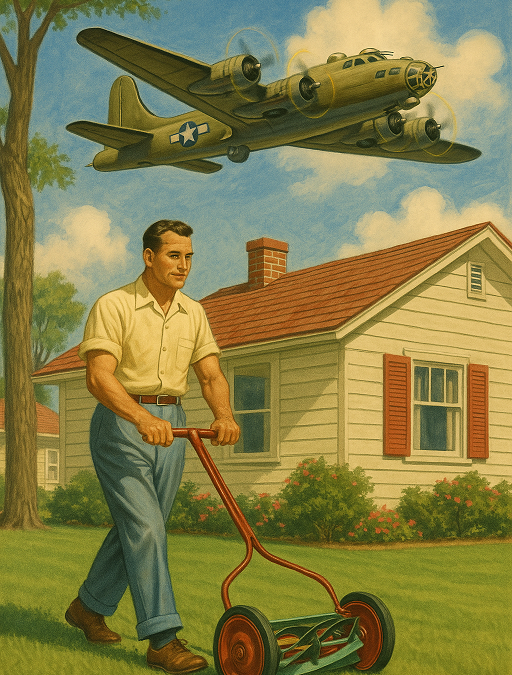
After World War II, mass production shifted from tanks to toasters—and lawn mowers. Affordable homes spread across suburbia, and with them, came tidy green lawns. The freshly returned war veteran (now Dad) was crowned King of the Yard, and his throne was the new gasoline-powered mower. No one else was allowed to touch it. Mowing became a weekly ritual. One part pride, one part tradition, and zero parts biology.
That routine stuck. But here’s the problem: it never had anything to do with what grass actually needs.
The Science: Why Frequency Matters
Grass, like any plant, performs photosynthesis. That’s how it turns sunlight into sugars—its life force. And chlorophyll, the green pigment in grass, is the engine for that conversion. When grass is cut infrequently, more than one-third of the blade is often removed at once. This shocks the plant, reducing its ability to photosynthesize efficiently. In other words, you just robbed your lawn of its ability to eat.
This stress is even worse during hot weather. The plant is already struggling to retain moisture and energy, and then—whack!—a third of its surface area disappears. It’s like sending a runner into a race with half a lung.
What Your Lawn Actually Wants
A healthy lawn craves frequent, light cuts—ideally every day, or at least every other day. This maintains a steady state of photosynthesis, reduces stress, suppresses weeds, and helps thicken the turf. But let’s face it: who has time to mow twice a week?
Enter: Robotic Mowing
Robotic mowers have quietly existed for 30 years, but only recently are they beginning to change the game for homeowners and professionals. These machines mow daily, lightly trimming the grass without human intervention. They don’t take weekends off, don’t complain, and don’t burn fossil fuels.
This isn’t about laziness—it’s about liberation. It’s about giving your lawn what you physically don’t have time to provide. Automation frees you from the outdated post-war habits and replaces them with a smarter, healthier system.
The Bonus Benefits
By cutting a little every day, robotic mowers:
-
Increase plant health through consistent chlorophyll production
-
Suppress weeds by never letting them reach seed
-
Eliminate noise pollution (they’re whisper-quiet)
-
Reduce exposure to burning gas and oil
-
Create a tighter, more uniform appearance that looks pro-level every single day
And let’s be honest—it rocks to have a lawn that looks freshly cut every day.
A New Standard for Lawn Care
It’s time to retire the notion of mowing as a once-a-week event. Instead, embrace the concept of mowing as a process—a gradual, constant stewardship of your turf. Your lawn doesn’t need tradition. It needs light, food, water, and consistency.
So the next time you think about firing up that mower on Saturday morning, remember: World War II might’ve shaped your habit—but technology is here to reshape your lawn.