
Last Updated on July 21, 2025 by Brian Beck
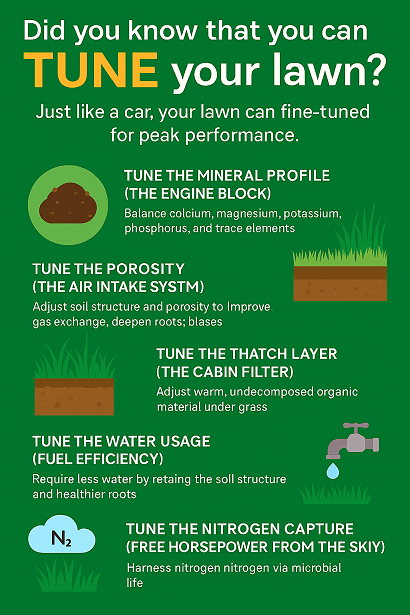
Just like a car, your lawn can be fine-tuned for peak performance.
When people think about tuning, they usually think of cars—adjusting the engine, improving airflow, tweaking the suspension, and dialing in the fuel system for performance. But what if I told you that your lawn is no different?
That’s right—you can tune your lawn. Not just mow it and fertilize it, but actually optimize it like a finely calibrated machine. Most homeowners treat their lawn like an appliance—turn it on, throw some water and fertilizer at it, and hope it works. But real performance? Real health and efficiency? That requires a tune-up.
Here’s how.
🧪 1. Tune the Mineral Profile (The Engine Block)
Just like an engine needs the right fuel and oil mixture, your soil needs the right balance of calcium, magnesium, potassium, phosphorus, and trace elements. Too much of one and not enough of another throws the whole system off.
A soil test is your diagnostic tool. It tells you what’s firing on all cylinders and what’s misfiring.
-
High magnesium? Your soil might be too tight.
-
Low calcium? Roots may be starved of oxygen.
-
Unbalanced pH? Nutrients become unavailable—even if they’re there.
🌬️ 2. Tune the Porosity (The Air Intake System)
Airflow isn’t just for engines—it’s for roots too. Compacted soil suffocates roots and microbial life. You need to adjust your lawn’s soil structure and porosity to allow air and water to move freely.
-
Biological aeration from microbes and earthworms helps.
-
Adding organic matter acts like turbocharging your soil’s breathability.
-
Healthy porosity = more gas exchange, deeper roots, and better drought resilience.
🍂 3. Tune the Thatch Layer (The Cabin Filter)
Thatch is a layer of undecomposed organic material that builds up between your soil and grass blades. A little thatch is okay—like a filter. Too much? It chokes airflow and traps moisture.
Biological systems with active microbes can digest thatch naturally, reducing the need for mechanical removal and allowing your turf to “breathe” again.
💧 4. Tune the Water Usage (Fuel Efficiency)
A tuned lawn needs less water. Why?
Because it has:
-
Better porosity and structure to hold moisture.
-
More organic matter that acts like a sponge.
-
Healthier roots that grow deeper and wider.
By tuning your lawn’s biology and soil, you may cut your water use by 30-50% without sacrificing color or density. That’s like doubling your fuel mileage.
🌤️ 5. Tune the Nitrogen Capture (Free Horsepower from the Sky)
Did you know the air above your lawn is 78% nitrogen? A properly tuned soil teeming with microbial life and active carbon cycling can convert atmospheric nitrogen into usable forms for your grass.
This means:
-
Less synthetic fertilizer
-
More free nutrition
-
Cleaner, more sustainable growth
This is the equivalent of pulling horsepower straight from the atmosphere—without extra cost.
🔧 Conclusion: It’s Time for a Lawn Tune-Up
A healthy, optimized lawn isn’t built on bags of synthetic fertilizer and guesswork. It’s built on data, biology, and strategic fine-tuning.
So next time someone tells you their lawn needs more fertilizer or water, ask them:
“Have you tuned it yet?”