
Last Updated on July 20, 2025 by Brian Beck
🌱 1. How Microbes React to Synthetic Fertilizers
Synthetic nitrogen is usually delivered in forms like:
-
Urea (CO(NH₂)₂)
-
Ammonium nitrate (NH₄NO₃)
-
Ammonium sulfate ((NH₄)₂SO₄)
These forms are:
-
Highly water-soluble
-
Immediately plant-available
-
Saline in nature (high salt index)
Microbial Reaction:
-
Microbes do break down and utilize synthetic N compounds as a food source, especially ammonium.
-
However, they don’t function normally around it:
-
High salt concentrations dehydrate microbes and inhibit enzyme function.
-
Sudden influxes of soluble nitrogen disrupt microbial balance, leading to:
-
Reduced diversity
-
Decreased fungal populations
-
Decline in mycorrhizal colonization
-
-
-
Over time, microbial communities become less resilient and less functionally diverse.
🚨 2. Why Synthetic Fertilizers Damage the Soil
The damage is not because microbes don’t use synthetic nitrogen, but because of the collateral effects on the soil ecosystem:
Key Damaging Effects:
| Effect | Explanation |
|---|---|
| Microbial burnout | Synthetic N stimulates bacteria to quickly decompose organic matter, leading to long-term loss of humus and carbon. |
| Salt stress | High salt index can desiccate root hairs and microbial cells, especially fungi. |
| pH imbalance | Ammonium-based fertilizers acidify the soil over time, reducing nutrient availability and microbial activity. |
| Soil compaction | Reduced fungal activity and organic matter loss impair soil aggregation. |
| Nutrient leaching | Water-soluble forms easily leach, especially nitrate, leading to pollution and nutrient cycling disruption. |
Bottom line: Synthetics are like fast food for plants—quickly absorbed but harmful to the “gut microbiome” of the soil.
🍃 3. How Organic Nitrogen is Different
Organic forms of nitrogen come from:
-
Compost
-
Manures
-
Plant residues
-
Fish hydrolysate
-
Feather meal, alfalfa meal, etc.
These materials are not water-soluble and must be:
-
Mineralized by microbes into ammonium
-
Then nitrified into nitrate
Microbial Interaction:
-
Microbes feed first; plants get what’s left.
-
Organic matter supports fungi, diversifies microbes, and builds carbon.
-
Nutrients are slow-release, buffered, and less prone to leaching.
-
This maintains soil structure, aeration, and long-term fertility.
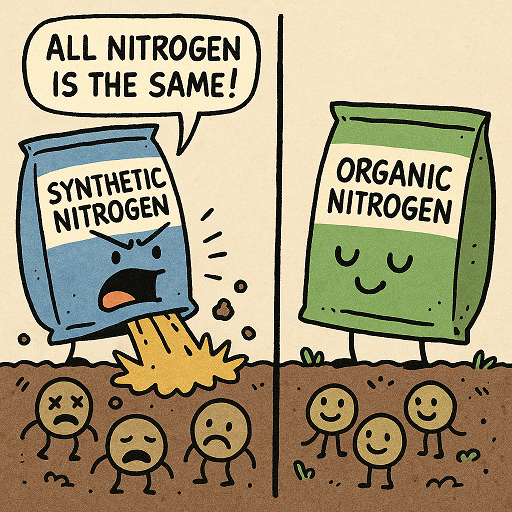
⚖️ 4. Why “All Nitrogen is the Same” is Scientifically Inaccurate
This claim ignores the delivery system, soil biology, and ecosystem impact.
Here’s a simple analogy:
Saying all nitrogen is the same is like saying all calories are the same.
1000 calories of broccoli vs. 1000 calories of candy—both are “calories,” but only one supports health.
Fundamental Differences:
| Characteristic | Synthetic Nitrogen | Organic Nitrogen |
|---|---|---|
| Form | Inorganic salts | Organic compounds |
| Availability | Immediate | Slow-release |
| Microbial health | Harmful long-term | Beneficial long-term |
| Soil organic matter | Depletes | Builds |
| Leaching risk | High | Low |
| Carbon to nitrogen ratio | N only | C:N balance supports microbes |
🧠 5. Summary for Debating a Golf Course Superintendent
Response to the “no difference” claim:
“While nitrogen itself may be an element, the form in which it’s delivered determines whether it supports or degrades the soil ecosystem. Synthetic nitrogen disrupts soil biology through salt stress, microbial burnout, and organic matter loss. Organic nitrogen feeds the soil life first, enhances biodiversity, and builds long-term soil fertility—something especially important for sustainability in high-value turf like golf courses.”