Last Updated on December 23, 2024 by Brian Beck
There is confusion in the market amongst commercial contractors that is costing them dearly. We are sacrificing efficiency for effectiveness. This might seem like a crazy statement but please let me explain. For the past few decades the landscaping industry as it pertains to mowing turf has become more costly to operate and it has not fundamentally changed in a long time. Let me shed some light on this for you.
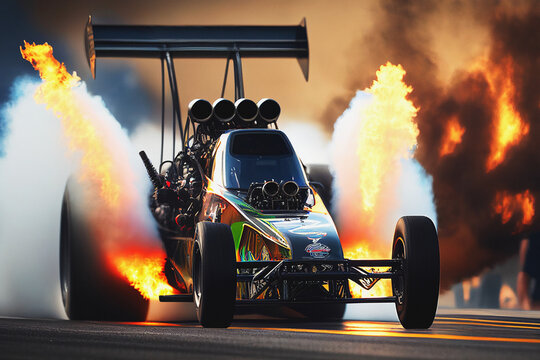
A top fuel dragster is a very effective automobile. Boasting a 500 in.³ engine which produces more than 10,000 hp it can travel 1/4 of a mile in just over three seconds at around 330 miles an hour. It can consume 12 to 20 gallons of nitromethane at $300 per gallon. The Mitsubishi Mirage, which is the most efficient vehicle in North America has a 1.2 L engine producing under 80 hp. It can achieve over 40 miles to the gallon on the highway and is a very efficient vehicle. As you can see between these two vehicles there is a massive disparity between the energy that they consume. One is very well adapted to going as fast as possible in a short period of time in the other vehicle can probably take you to work for better part of the month before you need to refill the gas tank.
Now, let me provide you another example that’s closer to home. I recently wrote a paper for Smart City Alliance to illustrate the inefficiency of the turf mowing industry. The comparison was between the Grounds Master and the Husqvarna CEORA. The Toro, is a 7000 pound behemoth with up to 15 cutting blades on a batwing mowing deck. It is a beautiful machine that can mow up to 20 acres in a day. It sports a 72 hp diesel engine that produces over 53 kW of energy while burning through over 2 1/2 gallons of diesel per hour. The Husqvarna which is a robotic mower uses just slightly over 310 W of energy to drive three cutting discs that have small razor blades. It can cut about 5000 ft.² per hour and can operate day or night. As you can see we are utilizing a massive amount of energy to mow grass in a quick manner. This comes at a cost. While the Toro costs over $130,000 just to purchase it also requires several thousands of dollars per year in maintenance as well as a few thousand dollars in diesel and is limited during certain hours of operation which requires a human operator which of course you have to pay, no one works for free right? The robotic mower which requires only about 1% of the energy to operate per hour that the diesel powered mower requires is far more efficient. While the diesel powered equipment is far more productive it is expending an exorbitant amount of energy in order to cut a few inches of grass. The 2 1/2 gallons of diesel that is expended in one hour could operate the robotic mower to mow almost 950 acres of turf with the same amount of energy or it could operate 334 mowers in one hour to mow approximately 83 acres of turf. This story quickly becomes a cautionary tale of the tortoise and the hare as you can see. Given that the commercial operator must move from site to site regardless if he is operating on large commercial properties or residential properties there must be movement in between jobs in order to be productive. This is the compound issue in addition to the one that I’ve just illustrated that is producing a massive amount of inefficiency. The typical commercial operation has approximately four people in a truck that costs around $75,000, pulling a trailer, which is a liability in and of itself, loaded with anywhere from $30-$80,000 worth of equipment. In between jobs when the equipment is not running mowing grass this becomes a massive amount of waste or it becomes inefficient. If we can illuminate this inefficiency out of the equation and utilize automation as a force multiplier, leveraging time a company can quickly become extremely more profitable and a lot more productive. The same four people that were previously suffering under the inefficient system can now begin to have their workload significantly reduced while multiplying the amount of work that is possible several times over thus making the business more productive and more profitable.
This is going to become the new norm as people embrace automation. For those that are early adopters and take advantage of the power of automation good things will come. For those that hesitate or refuse to adopt newer technologies will succumb to market pressures that will drive them out of business. This will not only be better for the business but it will be better for the employee, the customer, the turf and the environment. This is a win-win scenario for all elements involved. The future is going to be very different and we are going to need to reverse our mentality so that we can become efficient while being effective.