
Last Updated on June 20, 2025 by Brian Beck
The Automation Blind Spot: When Mowers Lag Behind Washing Machines
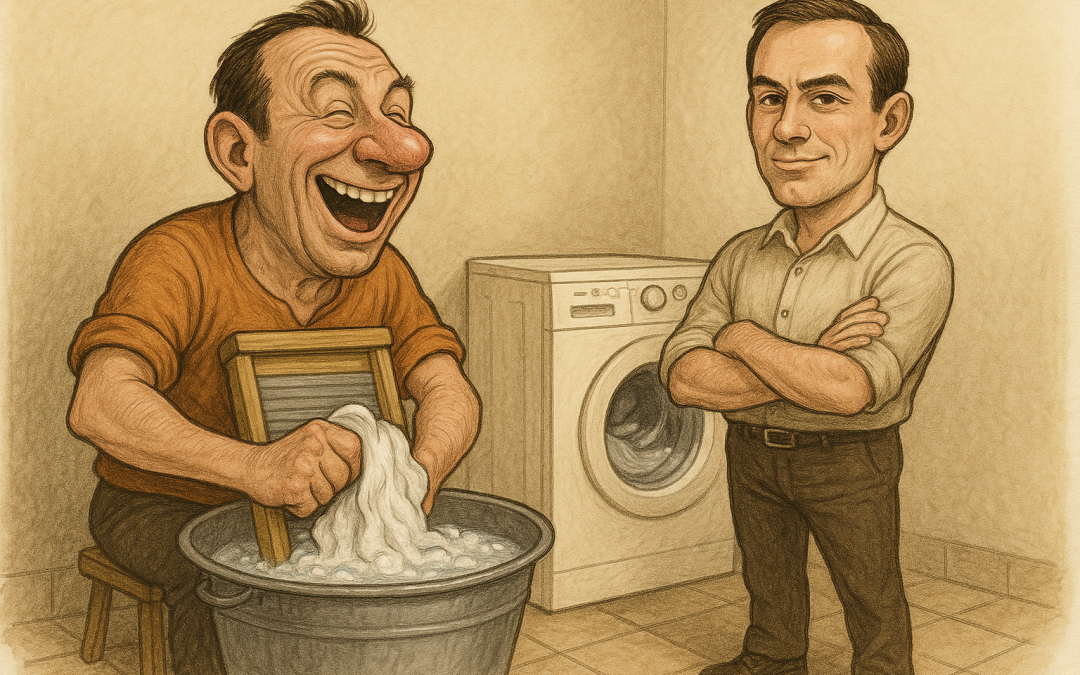
In our fast-paced, convenience-driven world, automation has quietly become the backbone of everyday life. Most of us wouldn’t dream of hauling out a washboard and tin bucket to do laundry — we rely on washing machines to handle that chore efficiently. But oddly enough, when it comes to mowing lawns, a surprising number of people still fire up their gas-powered push mowers every week, ignoring robotic mowing technology that is just as capable of revolutionizing yard care. Why do we accept automation in one realm and reject it in another?
Let’s explore this disconnect by comparing two technologies: the washing machine and the robotic lawn mower.
Washing machines have been mainstream since the mid-20th century, transforming a back-breaking, time-consuming task into something as simple as pushing a button. Few people question their value. Nobody is arguing for the “craft” of manually scrubbing shirts on a washboard — the time savings, efficiency, and reliability of automated laundry are too obvious to deny.
Robotic mowing, however, is often met with skepticism or outright dismissal. Many still consider robotic mowers a novelty or believe they can’t match the precision of doing it themselves — even as they spend hours each month mowing grass with a noisy, gas-burning machine. This is the contradiction: people who wouldn’t tolerate doing laundry the 19th-century way still insist on mowing like it’s 1985.
Why the inconsistency?
Part of the answer lies in the pace and visibility of technological change. Washing machines had a long head start. Their benefits were clear, and their adoption was practically universal by the time robotics emerged as a consumer technology. Robotic mowers, by contrast, are newer and less well understood. Many homeowners simply haven’t taken the time to explore how these machines work, or they’ve held on to outdated assumptions about their cost, effectiveness, or reliability.
Another issue is cultural inertia. There’s a persistent idea that mowing your lawn is part of being a responsible homeowner — an act of physical participation. Automation in the home (laundry, vacuuming, dishwashing) is accepted because it takes place behind closed doors. Lawn care is visible. Letting a robot do it might feel, to some, like a shortcut rather than a smart decision.
But make no mistake: robotic mowing is to lawn care what washing machines were to laundry. These machines save time, reduce emissions, and deliver consistent results without human intervention. If you’re still pushing a gas mower around the yard each weekend, consider this: would you also be willing to wash your clothes by hand?
In the end, the inconsistency reveals more about our habits than it does about the technology. Automation is already here. It’s just waiting for us to recognize it — not only in the laundry room, but in the backyard as well.